
Calculating the Risks of Online Schooling
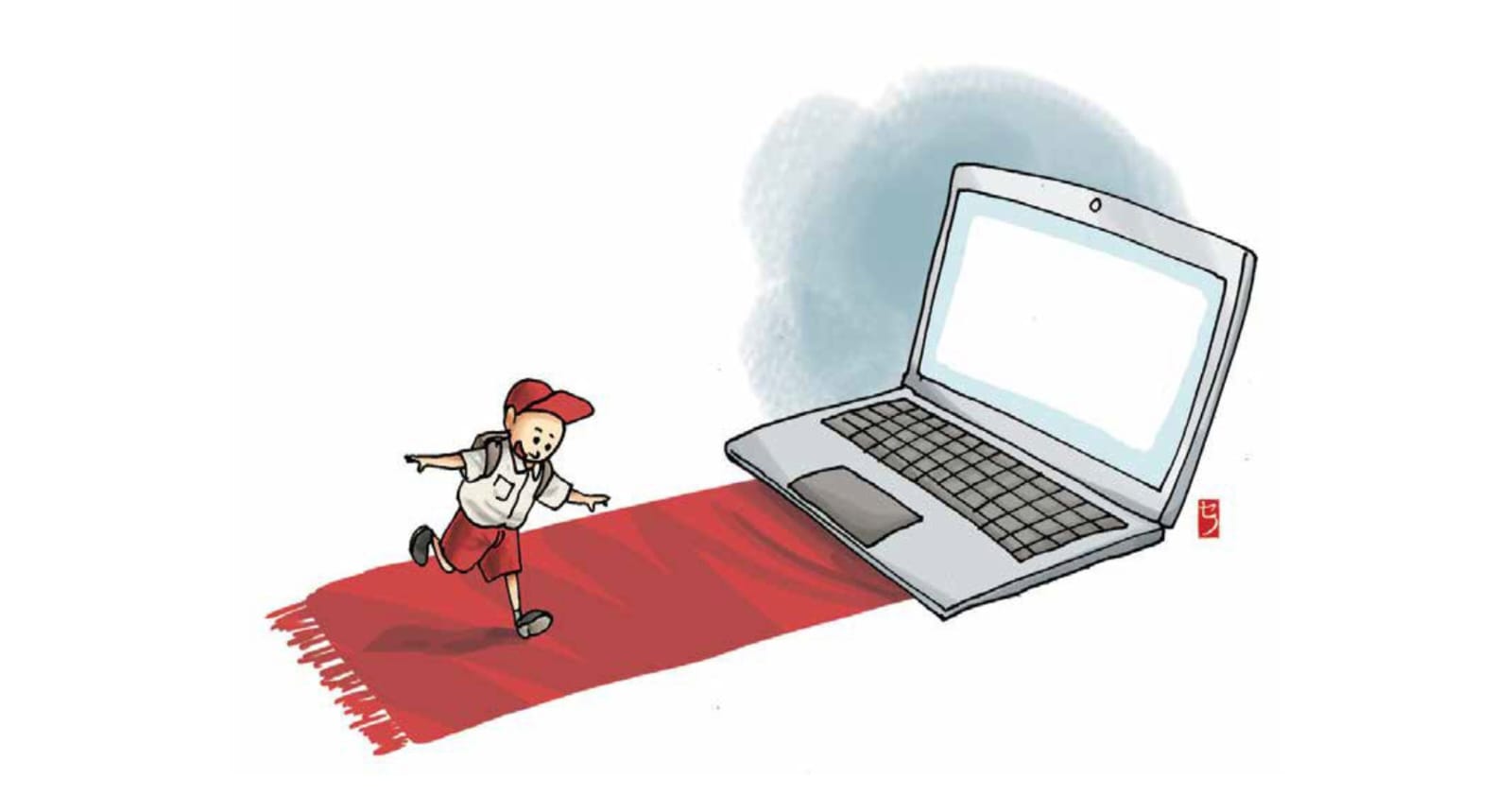
The government’s plan to implement online learning activities similar to those during the COVID-19 pandemic has been confirmed cancelled. Concerns about causing learning loss have led to the initial plan for online learning not being implemented. Even proposals for hybrid learning, combining offline and online methods, are feared to potentially lower the quality of education. Therefore, it is assured that future learning activities will continue to be conducted face-to-face (offline).
LEARNING FROM EXPERIENCE
Objectively, it must be acknowledged that online schooling is a learning process that gave birth to the COVID-19 generation. They are young people in school and university age ranges who experienced a degradation in education quality due to online learning activities.
During the COVID-19 pandemic, online schooling was indeed an emergency solution that had to be chosen due to conditions that did not allow for offline learning. On one hand, online learning was able to prevent the risk of COVID-19 transmission, and currently, it may be true that online learning can save fuel consumption in society. However, on the other hand, we certainly cannot turn a blind eye to the risks that may arise when the learning process is conducted at each student’s home via Zoom or other online contacts.
Various studies by Atsani (2020) and Julaeha & Nurdeni (2024) that identify the negative impacts of online learning, from declining learning quality, internet access gaps, to student mental health issues, show that online schooling causes more harm than benefit. Face-to-face learning cannot be replaced by digital screens. More specifically, there are several risks that we may have to bear if learning is conducted online or hybrid.
First, the risk of declining learning quality or standards. Understanding of the taught material is often incomplete due to the lack of social interaction between teachers and students. Without direct interaction with teachers, students generally struggle to grasp complex concepts. With online learning, the high learning burden is not matched by the understanding gained by students.
With learning only via Zoom, teachers often face difficulties in supervision, and students frequently attend physically without truly learning. Students learning at home through Zoom cannot have their concentration controlled because their attention is often divided by uncomfortable, noisy home conditions, and so on. This causes learning loss or the loss of academic abilities, where many students, especially at the primary level, fall far behind in basic skills like reading and counting.
Second, the risk of worsening class disparities due to the digital divide among students. It is no secret that differences in gadget ownership mean that one student and another generally experience disparities in absorbing and following online learning activities.
Online learning during the COVID-19 pandemic often revealed real social inequality issues in Indonesia. In various regions, not all students have stable internet access or adequate digital devices. While some children can follow classes smoothly, many others—especially in remote areas or low-income families—are forced to lag behind because they cannot afford decent Wi-Fi subscriptions.
The class disparity in online learning activities not only creates but also strengthens structural educational injustice. Conditions in various regions show technical obstacles and the cost of internet quotas borne by parents as an additional heavy burden.
Do not imagine that the economic power of students’ parents is the same, because in reality, society is often divided into polarised socio-economic classes, causing their ability to engage in online learning to be unequal.
Third, the risk of character education being neglected. Objectively, it must be acknowledged that school is not only a place to gain academic knowledge but also a habitat where students socialise and form their social character. The social isolation experienced by students when online learning is implemented not only disrupts character education but also risks increasing anxiety disorders, depression, and declining learning motivation. Children lose opportunities to interact, play, and build social skills with peers. The impact is a generation more vulnerable to stress and gadget addiction.
Unlike offline learning, where teachers can more interactively teach discipline, manners, and social values. When students follow online school, character education becomes nearly impossible. In online learning, students’ focus is often only on completing teacher assignments, not on the process of character formation. Teachers often lose authority when their relationship with students is distant. In online relationships, the risk of students becoming less respectful to teachers becomes more open.
Experience has shown that cyberbullying behaviour tends to increase with high gadget use by children. Children are also at risk of being contaminated by cyberporn when they become more intensely exposed to the internet. Approximately 50% of child internet users have been exposed to sexual content on social media.