
Cabinet Secretary Teddy Urges Parents to Restrict Social Media Access for Children
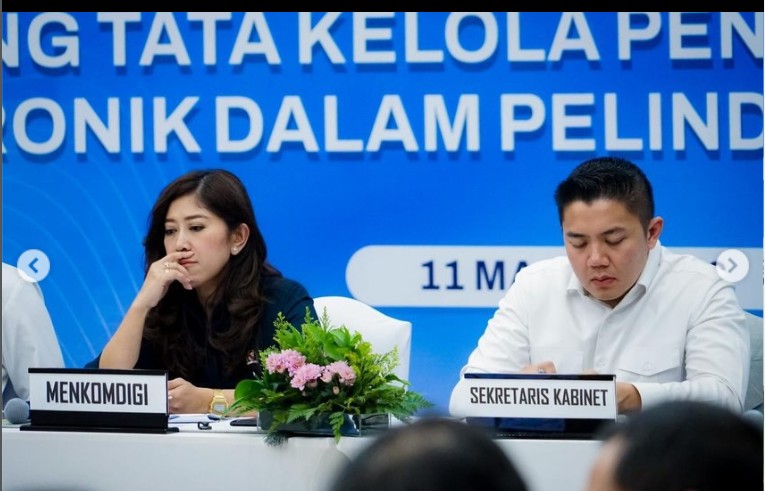
Cabinet Secretary Teddy Indra Wijaya has invited parents throughout Indonesia to participate actively in monitoring social media usage among children, particularly those under 16 years of age.
The call was made following the government’s issuance of a policy restricting social media account ownership for minors. The regulation is contained in the Minister of Communication and Digital Affairs Regulation No. 9 of 2026, which came into effect on 28 March 2026.
The policy derives from Government Regulation No. 17 of 2025 concerning Digital Child Protection (PP TUNAS), which was previously signed by Prabowo Subianto on 28 March 2025. This regulation serves as the legal foundation for the government’s efforts to enhance child protection in the digital sphere.
“Going forward, we seek cooperation from all members of society, from all parents, from young people and children, and certainly from our colleagues in the media to maximise and ensure that this government regulation concerning PP TUNAS (Waiting for Child Readiness) can function optimally,” said Cabinet Secretary Teddy following a coordination meeting to implement Regulation 17/2025 with relevant ministries and institutions at the Communication and Digital Affairs Building in Central Jakarta on Wednesday (11 March).
Reducing Risks
According to Teddy, the policy is expected to have a positive impact on Indonesia’s younger generation. He assessed that restricting social media access for children can help mitigate various internet-related risks, such as exposure to age-inappropriate content and potential cybercrime. “The benefits and objectives can have a positive impact on Indonesia’s entire younger generation,” said Teddy.
He also explained that through this regulation, children are only permitted to use social media once they have reached an age considered sufficiently mature and psychologically ready. To ensure effective policy implementation, the government has assigned spokespersons from relevant ministries and institutions to provide technical explanations to the public. This responsibility falls primarily under the coordination of the Ministry of Communication and Digital Affairs, headed by Meutya Hafid.
Additionally, the government plans to conduct widespread socialisation of the policy to both regional governments and educational institutions. This effort aims to ensure schools and educational environments can support the implementation of regulations intended to protect children in the digital world.
“Certainly, we will socialise this to the public going forward. Alhamdulillah, just last week this was presented by the Minister of Communication and Digital Affairs regarding this regulation, and alhamdulillah it received attention and support from parents in particular,” explained Teddy.
Cross-Sector Collaboration
Minister of Communication and Digital Affairs Meutya Hafid emphasised that the formulation of regulations derived from PP TUNAS was conducted through collaboration across various stakeholders. The government, together with other stakeholders, has worked to accelerate policy implementation ahead of the 28 March 2026 implementation date. This step was taken to ensure child protection in the digital sphere operates more effectively.
She also acknowledged that implementing a national-scale policy inevitably involves various challenges. Nevertheless, the government considers the measure important for safeguarding the younger generation from various social media usage risks.
“There certainly are (challenges), and as we discussed earlier, Indonesia is the first country implementing this at such a large scale, yes. So Australia has 5.7 million children, we have 70 million children when calculated from age 16 and below,” emphasised Meutya.
Child Protection System
This policy restricting social media access forms part of the government’s strategy to strengthen child protection systems in the digital sphere. Regulations derived from PP TUNAS also contain technical guidance for digital platform providers to be more responsible in protecting child users when accessing internet services.
Meutya stressed that the government wishes to ensure Indonesian children are not exposed to increasingly serious risks in cyberspace, such as pornographic content, cyberbullying, and online fraud.
“Our children face increasingly real threats, including exposure to pornography, cyberbullying, and online fraud. The government is present so parents no longer have to fight alone against the power of algorithms,” said Meutya in an official statement.
In the initial phase of policy implementation, restrictions will be applied to several social media platforms and networking services widely used by children, including YouTube, TikTok, Facebook, Threads, Instagram, X, Bigo Live, and Roblox. The policy is expected to strengthen child protection whilst creating a safer digital ecosystem for Indonesia’s younger generation.