
Business Owners Complain of Surging Logistics Costs, Here's the Government's Plan
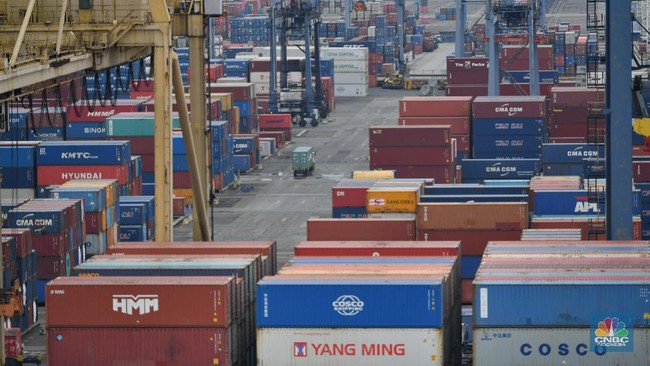
Jakarta, CNBC Indonesia - The rise in global oil prices due to escalating conflicts in the Middle East is beginning to affect the real sector. Trade Minister Budi Santoso revealed that business actors have voiced complaints about the surging logistics costs.
“Friends (business owners) indeed say that logistics costs are increasing; some continue operating despite the high costs, while others are taking a wait-and-see approach,” Budi told reporters at his office in Jakarta on Friday (27/3/2026).
Although pressure on costs is already being felt, the government cannot yet measure the precise impact on national exports. Budi stated that official figures from the Central Statistics Agency (BPS) will serve as the primary reference for assessing the extent of the war’s impact on trade performance.
“Not yet (data on losses from the war), since the war started in February, right? So we’ll see the exact figures then (starting from) February, April yeah (date) 1 April we’ll know. Yes, on 1 April, we’ll discuss the real impact based on the available figures,” he said.
Nevertheless, signals of pressure are already evident on the ground. Surges in energy prices and changes in distribution routes are driving up logistics costs, although export demand, particularly from the Middle East region, has not shown a significant decline.
“Demand from the Middle East, according to friends (business owners), is actually still there continuously, unchanged. Yeah, but they might be thinking whether they can afford the high costs, perhaps profits will decrease,” Budi explained.
Amid this situation, there are no reports of total export halts. However, some exporters are adopting a cautious stance while monitoring global developments.
“Not yet (export halts), from my communications with friends (business owners), no. So they’re just conveying that logistics costs are getting higher,” he said.
Budi emphasised that the rise in logistics costs is not limited to specific sectors but affects nearly all export commodities. This aligns with the dominance of non-oil and gas products, particularly manufactures, in Indonesia’s exports to the Middle East.
The government is beginning to examine schemes for sharing the surging logistics costs. Options under discussion include cost division between exporters and importers, up to the possibility of passing them on to consumers in destination countries.
On the other hand, the government views this pressure as an opportunity to improve the domestic logistics ecosystem to make it more efficient and competitive. Dialogues with business actors and logistics associations are being intensified to address distribution barriers.
Not only domestically, the government is also pursuing solutions at the global level. Budi revealed that he has instructed the Indonesian delegation at the World Trade Organization (WTO) forum to discuss logistics issues with the European Union.
“That’s one of them; I’ve asked our delegation to meet with the EU team. The aim is to discuss implementation under current conditions, one of which relates to logistics. So we’ve agreed to seek the most efficient logistics solutions for exports-imports to EU countries,” Budi said.
This step is being taken to ensure that trade cooperation with the European Union continues optimally, despite logistics cost pressures arising from global dynamics.