
Business Leaders: Rupiah Breaches Rp 18,000, Industry Hit by Double Squeeze
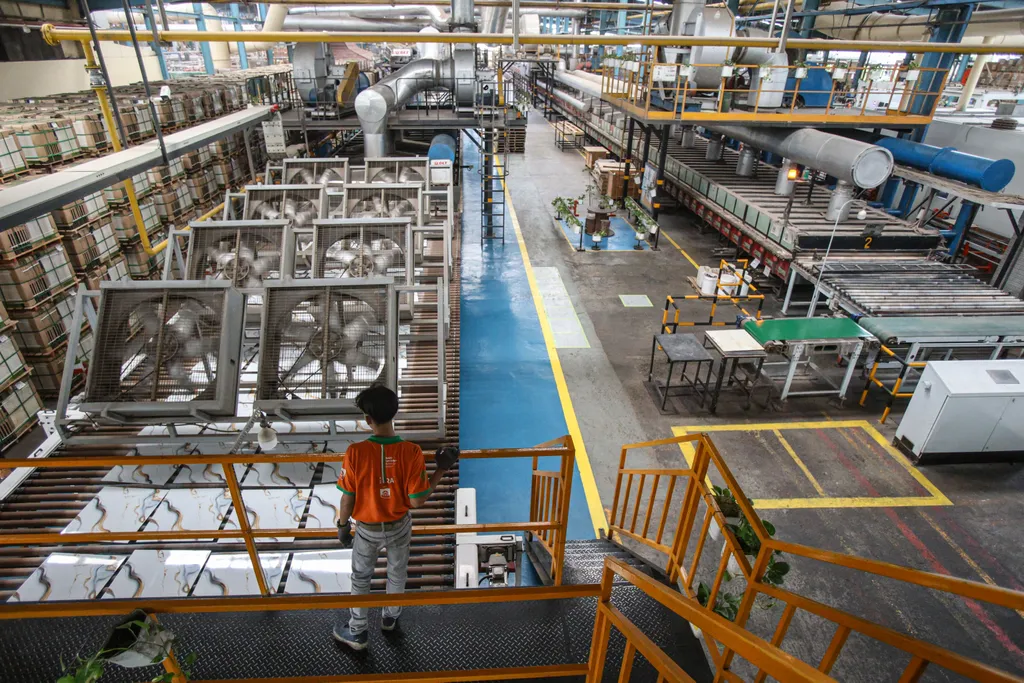
The national manufacturing industry is highly sensitive to the weakening of the rupiah exchange rate. Approximately 70 per cent of raw materials and intermediate goods for the national manufacturing industry still depend on imports. This means that when the rupiah weakens, imported input costs rise and immediately enter the cost of goods sold.
On Thursday (4/6/2026), the rupiah exchange rate against the US dollar breached the Rp 18,000 level, a previously unprecedented occurrence. What is the impact on manufacturing? How are industry players strategising to survive?
Kompas interviewed the Chairwoman of the Indonesian Employers’ Association (Apindo), Shinta W Kamdani, and the Chairman of the Indonesian Ceramic Industry Association (Asaki), Edy Suyanto, separately on Thursday (4/6/2026).
What is the impact of the continued weakening of the rupiah on the manufacturing industry?
Shinta W Kamdani:
The impact of the rupiah’s depreciation is not only seen from the exchange rate level itself, but from the transmission of the rupiah’s weakening to the structure of production costs, financing costs, business margins, and certainty in making business decisions. Pressure on the rupiah has been occurring gradually since the beginning of the year, so the impact on the real sector is now increasingly felt.
For the manufacturing industry, the rupiah’s weakening is very sensitive because the national production structure still has a fairly high dependence on imported raw materials and intermediate goods, around 70 per cent. This means that when the rupiah weakens, imported input costs increase and directly enter the cost of goods sold.
This condition is also occurring amidst logistics, energy, and financing costs that are still relatively high. So, what business actors are facing now is not only exchange rate pressure but also layered cost pressures or externally driven cost pressure.
Edy Suyanto:
The rupiah depreciation is increasing the burden on industry, including the ceramic industry. Moreover, this is happening when the HGBT (certain natural gas price) tariff rises to 7 US dollars per MMBTU (million British thermal units) from the previous 6 US dollars. This adjustment can actually still be tolerated by business actors provided that the gas supply in the field is available as needed.
Another issue is that, so far, gas purchase transactions under the HGBT scheme must use US dollar denomination. This triggers a double squeeze on the national ceramic industry’s production cost structure.
So, first, the gas price rises. We are hit by this. Second, we pay for gas using US dollars. You can imagine, this is two impacts. Therefore, it is like adding insult to injury.
Paying in US dollars is very burdensome for business actors. Why not pay in rupiah? This gas is from Indonesian earth, and the transactions are also domestic. We have complained about this many times.
What is the current state of the manufacturing industry?
Shinta W Kamdani:
If we look at industry activity indicators, we see that the manufacturing sector is still in a fairly challenging phase. Indonesia’s Manufacturing PMI in May 2026 did rise from 49.1 to 50.0. However, that figure is still right on the threshold between contraction and expansion.
The components within it also still show pressure, such as output falling for three consecutive months, a decline in raw material purchases, reduced input inventories, a decline in employment, and a fairly deep export contraction. So, the PMI improvement is more accurately read as a stabilisation signal, not yet as a strong and evenly distributed manufacturing recovery.
Edy Suyanto:
Actually, the HGBT policy that has been running since 2020 was a lifesaver that revived the national ceramic industry.
Currently, the industry’s condition is instead faced with gas supply problems. The HGBT tariff has now risen to 7 US dollars per MMBTU.
The problems are increasingly complex because the HGBT gas supply received by the industry is only 40-45 per cent of its needs. The supply shortage must be met through gas from LNG regasification at an expensive price of around 21 US dollars per MMBTU.
As a result, the average gas price paid by the ceramic industry is currently around 15 US dollars per MMBTU, or more than double the HGBT price. On average, the ceramic industry pays around 15 US dollars per MMBTU for gas.
The Indonesian ceramic industry faces higher gas costs compared to competitor countries in ASEAN, such as Thailand and Malaysia, even though Indonesia is a gas producer.
The current situation has caused energy costs to rise sharply. If at the beginning of the HGBT implementation the portion of energy costs was only 27-28 per cent of total production costs, now the figure has the potential to soar to exceed 45 per cent. In fact, gas costs account for about 40 per cent of the overall ceramic production costs.
The surge in energy costs has the potential to erode industry profit margins by 3-4 per cent. This is quite significant considering the average business margin in the ceramic sector and several other manufacturing industry sectors is only 9-10 per cent.
What is the worst-case scenario for the manufacturing industry if the rupiah weakening continues?
Shinta W Kamdani:
In practice, the impact of the rupiah’s weakening is not uniform across industries. Companies that have higher local content or have a natural hedge from exports are certainly relatively more resilient. However, for industries where the majority of inputs are still imported and their markets are domestic, the pressure will be greater.
Business margins can become increasingly depressed, cash flow becomes tighter, and business decisions will become more conservative. In conditions like this, companies will usually review production costs, raw material purchase contracts, pricing strategies, inventory management, and expansion plans.
The worst-case scenario is if the rupiah weakening lasts for a prolonged period and is not balanced with the stabilisation of energy costs, logistics, and raw material supply, the pressure on manufacturing could deepen.
Investment and expansion decisions are highly dependent on stability in the exchange rate and business certainty.