
Business Leader Warns Job Vacancies in Indonesia Are at Yellow Alert: Why?
Jakarta, CNBC Indonesia - Business leaders have revealed that Indonesia’s current workforce situation requires serious attention, as many workers remain unabsorbed in available job opportunities. This condition can be described as entering the “yellow alert” stage.
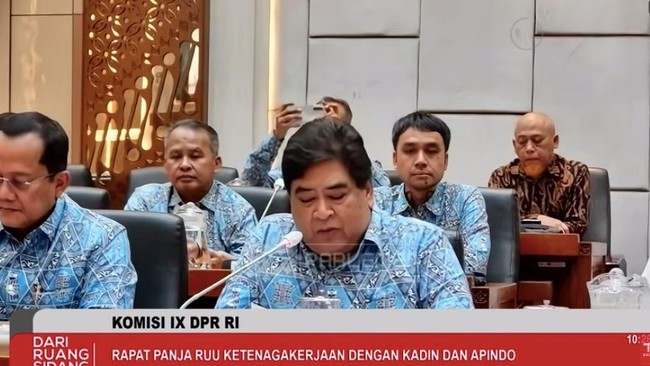
Apindo’s Chairman for Labour Affairs, Bob Azam, stated that Indonesia’s employment situation is currently in a “yellow alert” phase, where many potential workers are not being absorbed into existing jobs.
“Currently, our employment situation, if I may say, is in a yellow alert condition. Why yellow alert? Because every year there are 3.5 million new job seekers entering the workforce, but not all are absorbed,” said Bob Azam during his presentation at the Working Committee (Panja) meeting on the Employment Bill (RUU Ketenagakerjaan) with Commission IX of the House of Representatives (DPR RI), Tuesday (14/4/2026).
He explained that for every one percent increase in Indonesia’s economic growth, the available jobs can only absorb between 200,000 and 400,000 workers. With Indonesia’s economic growth still around 5%, the number of workers absorbed or employed reaches only 2 million people, leaving 1.5 million without jobs or unabsorbed.
“If we look at our economic growth, every 1% growth can absorb between 200,000 to 400,000 people, if the investments are all labour-intensive. But if not labour-intensive, more capital-intensive, perhaps 200,000 people, or even just 100,000. So if our economic growth is 5% and all labour-intensive, only 2 million are absorbed, the remaining 1.5 million are not,” he clarified.
With many potential workers still unabsorbed, they tend to shift to the informal sector, where welfare is generally minimal.
“Especially if not labour-intensive, with many investments or capital-intensive, perhaps less than 100,000 people. Thus, the burden of workers entering the labour market is very heavy, and if not absorbed, they will shift to the informal sector,” he explained.
Bob added that informal sector workers in Indonesia reach 60%, while the formal sector or those working in companies is only 40%. Moreover, the informal sector often does not pay taxes, eroding state revenue.
“If we look at the informal sector, currently the number of informal workers is 59%, possibly now more than 60%. So only less than 40% in the formal sector, formal workers. And informal workers are non-tax payers, so even if our employment is said to be decreasing, but as long as they work in the informal sector, it won’t affect state revenue. Because they don’t pay income tax. This is also one of the issues we face in employment,” he said.
In addition, the large number of workers with lower secondary education makes Indonesian workers’ competitiveness still lacking. However, he emphasised that competitiveness is not due to education, but rather the lack of training for those workers.
“Then also creativity that currently lacks competitiveness because most of our workforce still has lower secondary education. Actually, lower secondary education is fine, as long as there is a funding system for them to get training. But in training, we are still very far from needs, especially because our workforce has lower secondary education and in their journey, they actually need training so they can move to more competitive jobs and have better income,” he said.
Bob also touched on the issue of widespread layoffs (PHK), where workers still find it difficult to get new jobs if laid off.
“Now we also face the issue of rampant PHK, because there is economic slowdown. But actually, what we worry about is not the PHK itself, but the new jobs. If after PHK they can get new jobs in a short time, in my opinion, that’s better. But we all realise that getting a job now is very difficult,” he stated.