
Business Leader Reveals Sluggish State of Indonesia's Cement Factories, Capacity Utilisation Declines
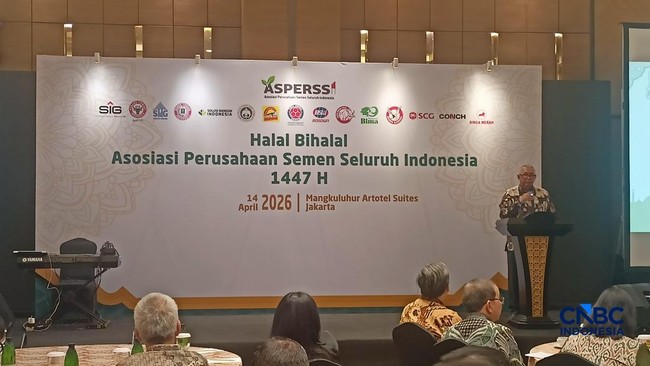
Indonesia’s national cement industry is still facing heavy pressure amid a market that has not fully recovered. The All-Indonesia Cement Producers Association (ASPERSSI) records limited industry growth, accompanied by a significant decline in capacity utilisation.
“Utilisation has dropped to 53.9%. This is our challenge,” said ASPERSSI General Chairman Lilik Unggul Raharjo during the ASPERSSI Halalbihalal event on Tuesday (14/4/2026). For information, ASPERSSI was previously known as ASI or the Indonesian Cement Association, with the name change effective since December 2025.
Amid these pressures, industry players are also beginning to update the national production capacity. Adjusting the capacity figures is deemed important to reflect the real conditions on the ground.
“For the future, we will use a capacity figure of 124.6 million tonnes. And this has been confirmed by all members,” said Lilik.
On the demand side, early 2026 provides a slight breath of fresh air, although it has not fully restored conditions to two years prior. There is an increase, but it is not yet strong enough to close the historical gap.
“If we look at January-March 2026 compared to the same period in 2025, there is indeed growth. But compared to 2024, it is still below. There is 5.3% growth compared to last year,” explained Lilik.
However, this data is still in the process of internal validation to ensure accuracy before becoming a reference for policies and official reporting.
Pressure from logistics costs and global uncertainties has led several export destination countries to hold back demand, directly impacting domestic production absorption.
Amid these conditions, the national cement industry is also faced with structural challenges in the form of excess capacity. With low utilisation, efficiency becomes a crucial issue that must be addressed immediately.
However, behind the short-term pressures, the industry is beginning to direct long-term strategies towards sustainability. ASPERSSI has prepared a decarbonisation roadmap targeting net-zero emissions by 2050.
“In ASPERSSI’s roadmap, we target net zero emissions by 2050 with several pathway steps,” said Lilik.