
Business Forum Discusses Seizing Opportunities Amid Trump Tariff Policies
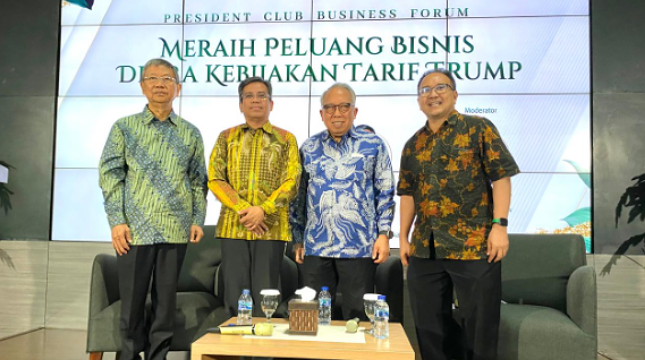
The President Club Business Forum, together with the Ministry of Investment/BKPM, the Indonesian Exporters Association (GPEI), and Jababeka, held a discussion entitled “Seizing Business Opportunities in the Era of Trump’s Tariff Policies” at the President Lounge in Jakarta on Wednesday (28/5/2025).
The discussion, initiated by Jababeka Group CEO S.D. Darmono, featured Deputy Chairman of BKPM for Investment Promotion Nurul Ichwan and GPEI Chairman Benny Sutrisno. Senior Kompas journalist Budiman Tanuredjo served as moderator.
In his opening remarks, S.D. Darmono stressed the importance of shared understanding regarding the unilateral actions taken by a superpower against other nations and their impact on Indonesia. “The unilateral actions taken by US President Donald Trump on tariffs have shaken the world. The question is whether this makes us think more sectorally or individually in responding to the problem,” Darmono said.
He urged the government, business community and academics to think collectively to achieve public welfare, and expressed hope that the discussion would inspire entrepreneurs and public policymakers.
“Regarding the trade war between the US and China, we no longer view it as worryingly as before. This is because the US and China have lowered import tariffs, although the percentage reductions differ between the two sides. But this indicates a compromise has been reached,” said Nurul Ichwan.
According to Ichwan, Indonesia has initiated separate meetings with both the US and China. In its negotiations with the US, Indonesia has also offered to purchase American food commodities, which was received positively. “So we are simply shifting commodities we need from other countries to the US,” he said.
“Indonesia is more advanced than other Southeast Asian nations because we are offering what aligns with their wishes, including reciprocal tariffs,” Ichwan continued.
He noted that Indonesia needs to identify the comparative advantage arising from tariff increases. Indonesia’s opportunity to capture market share is significant, given that Vietnam faces a higher tariff of 46 per cent compared to Indonesia’s 32 per cent and Thailand’s 36 per cent.
Ichwan acknowledged that Indonesian commodities affected include textiles, footwear and electronics. However, he said Indonesia has the opportunity to increase exports of other important commodities, namely gold bars, coffee and energy.
The Indonesian government has affirmed that the trade balance remains stable and the risk of US tariff increases continues to be anticipated through several strategic measures, including opening opportunities for new markets, negotiating tariff reductions primarily through deregulation, and optimising trade diversion potential.
“Indonesia has a great opportunity in the electric vehicle (EV) battery sector. With downstream processing support and resource potential, this sector could serve as a gateway to strengthen Indonesia’s position in the global supply chain affected by the tariff war,” Ichwan said.
GPEI Chairman Benny Sutrisno noted that whilst the US-China tariff war has seen reductions in tariff levels, there is no clarity on when it will end. In this situation, cross-institutional coordination involving the Ministry of Investment and ambassadors becomes crucial for diplomatic efforts to accelerate tariff reductions and bridge cooperation between local entrepreneurs and international partners.
“The Indonesian government is expected to take active steps to balance trade with the United States. One proposed strategy is increasing imports from the US for strategic products such as gas, petroleum and wheat,” Benny said.
He added that this adjustment is not only to maintain bilateral relations but also to send a positive signal in maintaining trade balance stability and tactically expanding the commodity portfolio.
“Amid external pressure from the tariff war, domestic industry requires more targeted and structured support. The government needs to consider providing fiscal incentives such as tax reductions and subsidies to affected exporters, particularly in labour-intensive sectors,” he said.
Benny further stressed that accelerating industrial automation, strengthening innovation capacity and improving product quality must be priorities. “Micro, Small and Medium Enterprises (MSMEs) must also not be overlooked. They must be equipped with access to broader export markets and supported with inclusive and sustainable financing,” he said.
During the discussion, diverse views emerged on steps the government could take. Former ASEAN Deputy Secretary-General Bagas Hapsoro stated that Indonesia must leverage its position at regional and multilateral levels.
He outlined comparisons of Indonesia’s competitiveness with other ASEAN nations regarding reciprocal tariffs: Indonesia faces a 32 per cent tariff, higher than Malaysia (24 per cent) and the Philippines (17 per cent), but lower than Thailand (36 per cent), whilst Cambodia (49 per cent), Laos (48 per cent), Vietnam (46 per cent) and Myanmar (44 per cent) face higher tariffs.
Three strategies were identified for addressing tariff policies: first, ASEAN regional solidarity, with Indonesia supporting Malaysia as ASEAN Chair to initiate regional dialogue with the US; second, export market diversification, with the government accelerating completion of 16 free trade agreements (FTAs) to expand market access; and third, enhancing competitiveness by attracting investment in manufacturing sectors, particularly electronics and automotive, through accelerated bureaucratic and regulatory reform.
Hapsoro added that Indonesia plans to revive bilateral cooperation with the US through the Trade and Investment Framework Agreement (TIFA) and diversify export markets by opening new markets in Africa, South Asia and the Middle East through strengthened economic diplomacy.
The forum concluded that amid shifting global policies, Indonesian entrepreneurs must be proactive, build strong networks and astutely identify opportunities arising from uncertainty. The government and business community must continue to work in synergy to ensure Indonesia remains competitive in international trade, particularly during the era of Trump’s tariff policies.