
Business Community Optimistic about China-ASEAN Market Potential
Beijing (ANTARA) - The ZGC AI International Service Hub (ASEAN), or the Zhongguancun Artificial Intelligence Enterprise Global Expansion Service Station (ASEAN), was recently officially launched in Beijing.
CGS International, a foreign subsidiary of China Galaxy Securities, will leverage ASEAN’s resource advantages to provide professional investment banking services to Chinese artificial intelligence companies expanding into the ASEAN market.
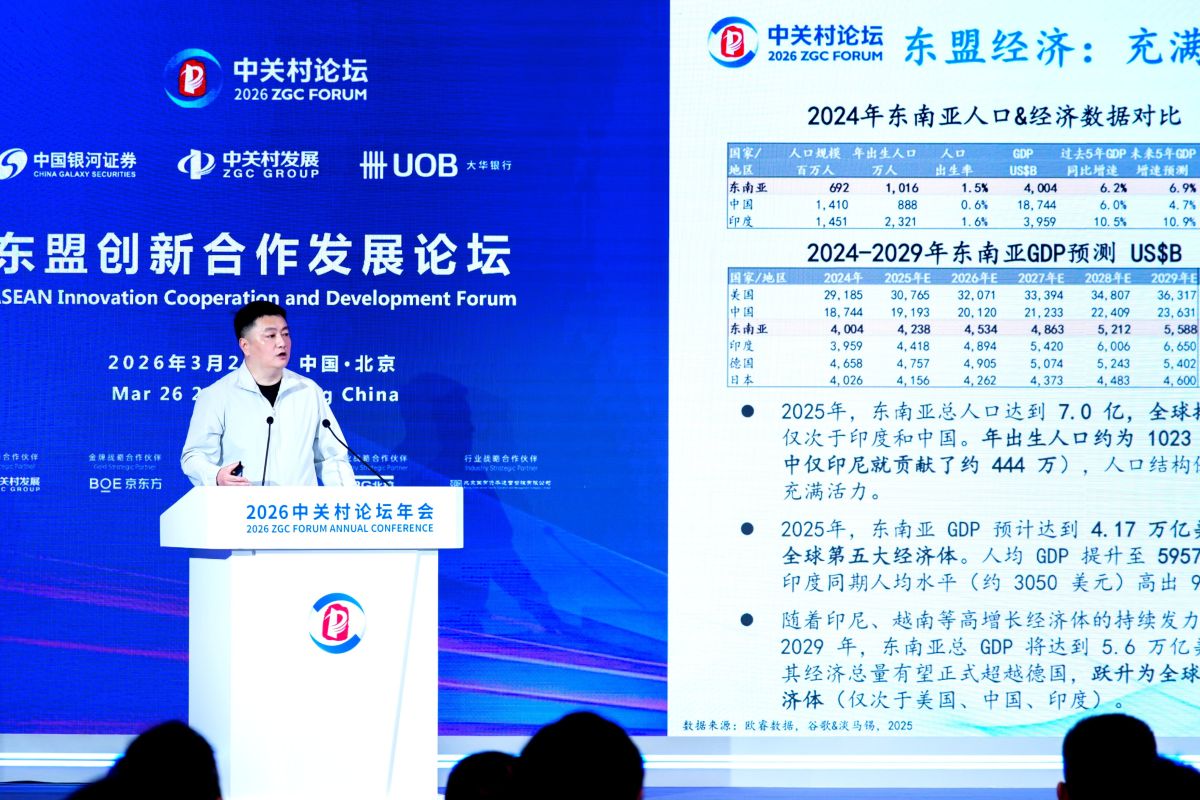
This information was obtained by the reporter at the Zhongguancun Forum Annual Conference 2026, which was recently held in Beijing.
The forum attracted participation from government representatives, experts, academics, company executives, and leaders of international organisations from China and ASEAN countries to jointly discuss new pathways for technological innovation cooperation and regional development.
Several guests present stated that China and ASEAN share geographical proximity and complementary industrial structures, with broad prospects for cooperation in the digital economy, artificial intelligence (AI), green technology, and biomedicine.
ASEAN is one of the world’s most dynamic economic regions and an important partner in the joint development of the Belt and Road Initiative.
This year marks the fifth anniversary of the comprehensive strategic partnership between China and ASEAN.
In recent years, the development of China-ASEAN Free Trade Area 3.0 has progressed steadily, while the benefits of RCEP continue to be felt, providing strong institutional guarantees for deepening bilateral cooperation.
“The scale of trade and investment between the two sides continues to set new records, industrial and supply chain linkages are becoming increasingly tight, and cooperation in the digital economy and green economy is also developing rapidly,” said Bo Shanglang, Chairman of the ASEAN Economic and Trade Promotion Association.
“Southeast Asia is a large consumer market for technological innovation, and Indonesia has become the core of digital transformation in ASEAN,” said Qu Tian, Founder of ATM Capital. He explained that Indonesia’s e-commerce sector is developing rapidly with significant consumption potential. The Chinese e-commerce logistics company J&T Express, founded and developed in Indonesia for over 10 years, has now become Southeast Asia’s largest logistics company with daily shipment volumes exceeding 120 million packages.
According to him, ASEAN countries have a strong need for digital transformation, while China has accumulated rich experience in AI, big data, and cloud computing. In the future, both sides need to promote closer ties between research institutions, universities, and companies, including through the establishment of joint laboratories, technology transfer centres, and innovation incubators.
In addition, mechanisms for policy coordination should be explored to support cross-border mobility of innovation factors, enabling talent, technology, capital, and data to flow more smoothly across the region.
“We can focus on digital infrastructure connectivity, promoting the development of cross-border optical cables, 5G network deployment, and smart city construction. In the areas of new energy vehicles, renewable energy, and green finance, both sides can strengthen technology exchanges and jointly create new growth points,” added Bo Shanglang.
In recent years, technological innovation cooperation between Beijing and ASEAN has yielded significant results. Last October, the China (Beijing Sub-centre) - ASEAN Trade and Investment Promotion event was successfully held, with the establishment of an industrial and supply chain cooperation fund.
Several Beijing companies signed cooperation agreements with companies from Indonesia and Malaysia in green trade and smart energy monitoring. In the same month, the Beijing Economic-Technology Development Zone also organised companies to participate in the Southeast Asia Sustainable Development Expo, achieving more than 80 potential cooperation projects.
“In the past, delivering one package in Indonesia could take five to seven days; now it basically only takes two to three days. Efficiency has improved significantly, encouraging more people to use e-commerce platforms,” he said.
Wu Junjie, General Manager of the Commercial Department at Sembcorp Development Ltd., noted that Indonesia has a population of over 270 million with a vast consumer market, rapidly developing digital economy, and significantly growing AI applications. “Indonesia has the largest digital consumer base in ASEAN, requiring foundational algorithms like those from Zhongguancun and large-scale applications in industry. This market has a strong demand for technological solutions, and the potential for future cooperation is enormous,” he said.
Wang Ziyuan, Chairman of the Singapore Chinese Chamber of Commerce in China, assessed that China-ASEAN cooperation is now moving from traditional trade towards deeper innovation synergy, industrial synergy, and ecosystem synergy.
China has strong innovation capacity, a complete industrial foundation, and extensive application scenarios, giving it complementary advantages with ASEAN. The chamber of commerce currently connects major Chinese cities with Singapore’s resource network.