
Bulog's 2kg SPHP Rice Ready for Launch, Just Awaiting This
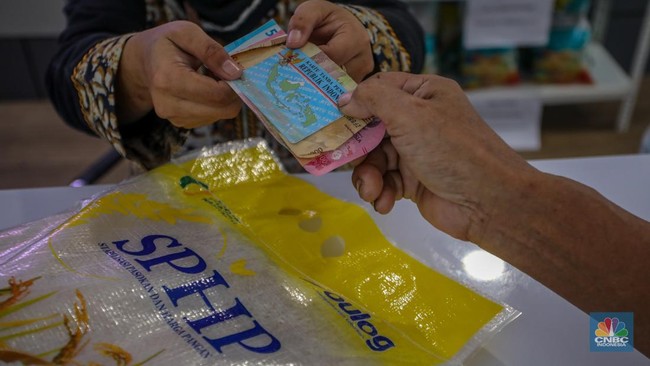
The government plans to introduce rice under the Stabilisation of Food Supply and Price (SPHP) programme in 2 kilogram (kg) packaging. This step is intended to expand access for low-income communities who have previously struggled to purchase rice in larger packaging.
To date, SPHP rice distributed through Perum Bulog has only been available in 5kg packaging. With the addition of a 2kg option, the government hopes that food aid distribution will be more targeted.
Deputy for Food Availability and Stabilisation at the National Food Agency (Bapanas), I Gusti Ketut Astawa, stated that this packaging variation is being prepared to reach groups with limited purchasing power.
“It would be excellent if 2kg SPHP rice could be available. In markets, we often see our fellow citizens preferring to buy just 1 to 2kg of rice,” said Ketut in his statement, quoted on Friday (10/4/2026).
According to him, this policy aligns with the directives of President Prabowo Subianto, who emphasises support for the small people.
“Therefore, it would be great to open up space for new packaging. This is certainly for the people, for the little people, as conveyed by the President yesterday; he is strongly advocating for the little people. So, this must be implemented,” he said.
In terms of regulations, the 2kg packaging option has been accommodated in the Decision of the Head of Bapanas Number 34 of 2026. This regulation allows Bulog to distribute SPHP rice in two packaging options: 5kg and 2kg.
The 50kg packaging remains available on a limited basis, particularly for specific regions such as Maluku, Papua, and 3TP areas (disadvantaged, frontier, outermost, and border regions).
Bapanas also regulates the maximum purchase limits at the consumer level. For 5kg packaging, the public can purchase a maximum of five packs. For 2kg packaging, purchases are limited to a maximum of two packs. SPHP rice purchased cannot be resold because it contains government subsidies.
The SPHP programme itself has been running since early March 2026 and is targeted to distribute up to 828,000 tonnes of rice throughout the year, with a subsidy budget of Rp4.97 trillion.
In its implementation, Bulog is asked to prioritise distribution to non-production centre areas and regions not currently in the peak harvest season. This policy aims to maintain farmers’ paddy prices so they do not fall below the Government Purchase Price (HPP).
Looking ahead, the government will further study the implementation of the 2kg packaging, including from the aspects of costs and subsidy needs.
“Of course, we will discuss it. We will follow up once there is an order from the Minister. We will immediately conduct calculations on possible subsidies and so on. Hopefully, it won’t change much; for example, the SPHP price in Zone 1 is Rp12,500 per kg, there’s no difficulty, just multiply by 2 for the 2kg packaging,” explained Ketut.
Separately, the Head of Bapanas, who is also the Minister of Agriculture (Mentan) Amran Sulaiman, emphasised that this policy is purely to meet the needs of the people.
“What is clear is that our food aid is already being distributed. What is clear is that there is plenty of rice. The size can just be adjusted. Whatever for the people, as per the President’s orders, serve. That is the demand of the people, because it’s not possible from Bulog’s request. Not possible from Bapanas’s request. If the people need it, we act for the people,” said Amran.
Based on Bapanas records, the realisation of SPHP rice distribution from early March to 7 April 2026 has reached 82.8 million kg. This programme also supports inflation control, particularly for rice commodities.
On a monthly basis, rice inflation in March 2026 was recorded at 0.65%, slightly up from February 2026 at 0.43%. Annually, rice inflation is at 3.71%, much lower compared to March 2024, which once reached 20.07%.