
Building Two New Petrol Refineries, Pertamina Targets Completion by 2030
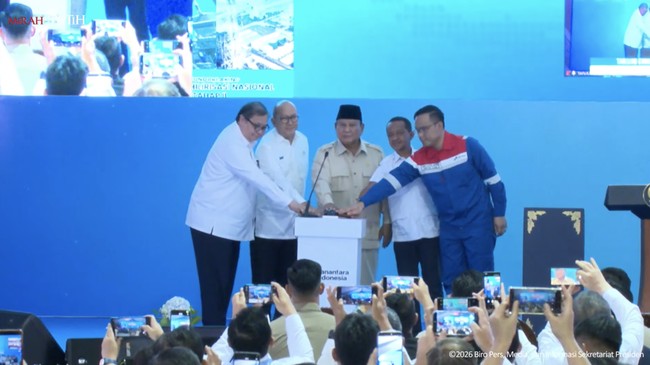
PT Pertamina Patra Niaga is currently building two oil refineries (BBM) focused on petrol production at its existing facilities in Dumai and Cilacap.
The two refineries, whose construction was recently inaugurated by President Prabowo Subianto yesterday, Wednesday (29/4/2026), are targeted to be completed and begin production by the end of 2030.
Direktor of Infrastructure Projects and Asset Integrity at Pertamina Patra Niaga, Setyo Pitoyo, explained that the project to increase national petrol production capacity is currently in the stage of calculating investment indicators. The aim is to provide positive impacts for the country.
He stated that the 2030 operational target is still a provisional schedule pending further technical studies.
“Provisionally scheduled to finish in 2030, provisionally. We haven’t conducted the engineering study or anything like that yet,” he said when met in Cilacap, quoted Thursday (30/4/2026).
To achieve this target, Pertamina is considering acceleration efforts using modular technology. This method allows refinery components to be worked on in parallel off-site, making the final installation process more efficient and faster.
“Hopefully with these studies or acceleration efforts, for example, building using modular methods so we build in parallel off-site, then it’s like playing a puzzle. Hopefully it can be faster,” he explained.
Both new refinery facilities are designed to produce petrol with high-octane standards. Setyo emphasised that the product specifications will at minimum match the quality of Pertamax fuel (RON 92).
“Gasoline is petrol, yes petrol. Correct. The standard for the upcoming one will directly be at minimum Pertamax quality,” he added.
The investment for building each refinery is estimated to reach US600millionorequivalenttoRp10.4trillion(assuminganexchangerateofRp17, 337perUS). Thus, the company requires total funding of up to US$1.2 billion or equivalent to Rp20.82 trillion for the construction of the two new petrol refineries.
“Each US$600 million, so total around US$1.2 billion. That doesn’t include, for example, upgrading utilities or facilities and so on,” he clarified.
Inaugurated by President Prabowo
It should be noted that on Wednesday (29/4/2026), President Prabowo Subianto inaugurated 13 phase-2 downstream projects with an estimated investment of Rp116 trillion. Of the 13 downstream projects, 5 are from the energy sector, 5 from the mineral sector, and 3 from the agricultural sector.
The President emphasised that downstream processing is a fundamental step in transforming Indonesia’s economic structure towards a high value-added industry-based economy that is more resilient to global dynamics.
“Downstream phase one has 13 projects in 13 locations and some at this time, this year we will also add 6 more downstream projects, and continuously we will add more. There might be phases 4, 5, 6, God willing this year too,” Prabowo explained at the inauguration event in Cilacap, Central Java, Wednesday (29/4/2026).
Prabowo stressed that downstream processing of natural resources in Indonesia is the only way for the country to become more prosperous. Therefore, the government will continue to pursue downstream development in the country.
“Downstream is the only way for us to become more prosperous,” Prabowo asserted.
2 BBM Refinery Projects
The capacity expansion for the petrol refineries will be carried out at the existing RU II Dumai and RU IV Cilacap facilities. The total capacity will reach 62,000 barrels per day (bpd), targeted to operate in Quarter IV-2030.
“This project will substitute petrol imports by up to 2 million KL per year or 9.47% of the national supply-demand gap, support the fulfilment of Pertamax Series from domestic production, and reduce imports of by-products including propylene and LPG,” stated Danantara in a written statement, quoted Thursday (30/4/2026).
The project is seen as contributing to strengthening national energy resilience while maintaining energy price stability, which ultimately supports people’s purchasing power and economic activities.
In addition to refineries, the programme covers the energy, metals and minerals, construction materials, and agroindustry sectors, aiming to reduce import dependency, strengthen the national industrial supply chain, increase value added from domestic resources, and create broader job opportunities and economic activities for the community.
“Downstream processing is a strategic instrument in driving value creation domestically through the processing and industrialisation of natural resources,” added Danantara.
In addition to increasing value added, downstream processing is seen as playing a role in strengthening economic independence by reducing dependence on global supply chains that can face dynamics and uncertainties in certain conditions, including geopolitical factors.
Through strengthening the domestic supply chain, downstream processing also ensures more reliable availability of national needs, while driving the transformation of the economic structure towards a high value-added industrial base.