
Building the Qurban Economic Supply Chain
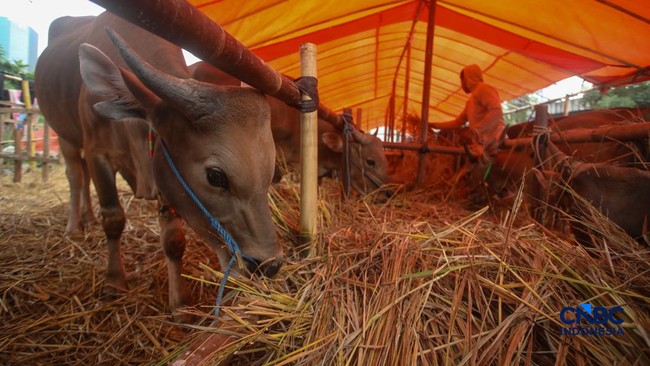
Eid al-Adha, also known as Qurban, in 2026 or 1447 AH presents a timely opportunity to strengthen national unity and synergy among citizens. The festival interrupts recent exhausting political and economic issues, calling for renewed collaboration and unity to advance development.
Qurban holds profound significance, not only as an act of obedience to the Divine (hablum minallah) but also as an economic and social dimension filled with synergy, cooperation, mutual assistance, and sharing (hablum minnas).
The term ‘qurban’ originates from Arabic, derived from ‘qaruba-yaqrubu-urbaanan’, meaning closeness in spiritual and social dimensions. Spiritually, it is referred to as al-udhhiyyah or adh-dhahiyyah — sacrificial animals such as camels, cattle (buffalo), and goats slaughtered during Qurban and the days of Tashriq to draw closer to Allah SWT, as demonstrated by Prophets Ibrahim and Ismail.
Social and Economic Dimensions
Beyond its strong spiritual aspect, Qurban carries social and economic dimensions through care for others. The sacrificed meat is distributed to communities near the slaughter site, sharing joy and blessings.
Qurban embodies social compassion, sharing spirit, and love for neighbours and the community. As demonstrated by Prophet Muhammad SAW, he personally slaughtered his animals and distributed them to the poor and needy.
Economically, Qurban holds profound meaning for society, especially amid economic slowdown and weakened purchasing power.
Qurban can serve as a strong social solidarity to bolster the economy. Its value is substantial. The National Zakat Agency (Baznas) through its Strategic Research Centre (Puskas) projects Indonesia’s Qurban economic potential to reach Rp34.85 trillion in 2025, based on an estimated 3.56 million participating households.
This value equates to real economic stimulus. When managed effectively, Qurban can act as an instrument for economic equality and national food security.
Qurban’s economic character is unique due to direct distribution. Money spent on sacrificial animals largely flows to rural livestock hubs. Thus, Eid al-Adha creates a significant multiplier effect for rural economies.
The Ministry of Agriculture notes national sacrificial animal availability for 2025 at approximately 3.2 million heads, including cattle, goats, sheep, and buffalo. This supply underscores rural livestock sectors as the backbone of national Qurban needs.
Economic activity extends beyond animal sales to feed, veterinary medicines, transport services, and seasonal labour. Hence, the Qurban economy creates an extensive value chain for communities.
Preparing the Qurban Economic Supply Chain
Success of the Qurban economy hinges on a robust supply chain — from livestock breeding, feed provision, fattening, inter-regional distribution, animal health services, slaughterhouses, cold logistics, to meat distribution. Disruptions in any link directly impact prices, quality, and equitable distribution.
Indonesia’s Qurban supply chain currently faces classic issues. First, heavy reliance on small-scale rural farmers with limited capital, technology, and market access.
Second, uneven animal distribution. Third, poor data integration between production hubs and consumer regions. Consequently, Eid al-Adha often brings price volatility and distribution imbalances — urban areas face surpluses and meat pile-ups, while remote regions struggle with access shortages.
The substantial Qurban economic potential warrants attention from both government and entrepreneurs keen on building a strong supply chain. Qurban should be viewed as part of national economic empowerment and food security strategy. Supply chain preparation must be year-round, not just seasonal before the festival.
The first step is strengthening the upstream rural livestock sector. Small-scale farmers form the backbone of national Qurban supplies but face high feed costs, limited financing access, and poor livestock quality. The state must intervene with low-cost financing, productive feed subsidies, livestock cooperative strengthening, and rural farming modernisation.
Second, accelerate digitalisation of the Qurban supply chain. Current livestock market information is fragmented and asymmetric — farmers lack real-time pricing data, while consumers struggle to find quality animals at fair prices.
Digital technology can shorten distribution chains and enhance market efficiency. Qurban digital platforms enable farmers to connect directly with consumers, lembag