
Building Optimism Amid Global Uncertainty
Building Optimism Amid Global Uncertainty
Jakarta, CNBC Indonesia – The government continues efforts to maintain economic resilience through various policies and stimuli to sustain consumer purchasing power amid global uncertainties.
Global economic uncertainties have worsened due to geopolitical conflicts, including the US-China trade war, Ukraine, and Iran, indirectly affecting the national economy.
Fortunately, Indonesia’s resilience, bolstered by a strong domestic market, has kept the economy growing at 5.61% in Q1 2026.
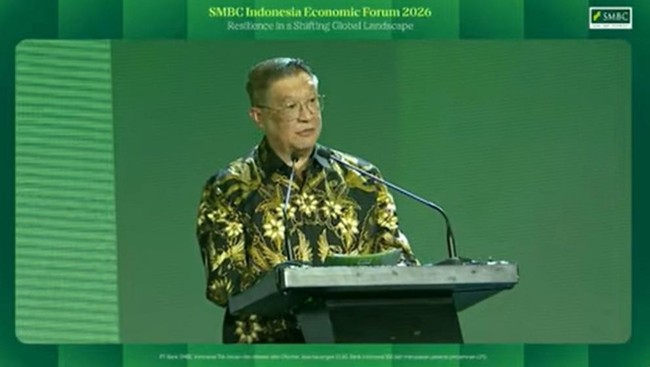
Henoch Munandar, President Director of PT Bank SMBC Indonesia Tbk (SMBC Indonesia), expressed optimism that with maintained economic stability, Indonesia could become a regional growth hub.
“We see a dynamic world where global supply chains, technology, energy transition, and international investment flows are shaping a new normal marked by volatility, turbulence, uncertainty, complexity, and ambiguity. Amid this uncertainty, we hope Indonesia remains resilient, maintains strong optimism and economic stability thanks to its large domestic market,” Munandar said while opening the SMBC Indonesia Economic Forum 2026, reported on Thursday, 21 May 2026.
Discussions at the forum highlighted that amid global fragmentation and rising volatility, domestic stability, policy consistency, and investor confidence will be key differentiators for a nation’s competitiveness.
SMBC Indonesia views national economic resilience not just as the ability to withstand global pressures but as a foundation to strengthen Indonesia’s position as a new regional growth centre. With increasingly selective global capital flows, regulatory certainty, institutional quality, and a stable investment climate will be crucial for attracting long-term capital.
This optimism is well-founded, as Indonesia can leverage global dynamics through strong competitiveness to expand business opportunities and create a sustainable economy.
“We see the importance of maintaining stability as a foundation while keeping momentum. This requires close collaboration between government, public, and private sectors. Our SMBC Indonesia Economic Forum serves as a constructive dialogue space for stakeholders, responding to global dynamics, broadening perspectives, reinforcing optimism, and providing insights for future investments,” he added.
The government has also implemented strategies to sustain economic growth amid global turbulence, including maintaining a healthy State Budget (APBN) with a controlled deficit.
Acting Director General of Financial Sector Stability and Development at the Ministry of Finance, Herman Saheruddin, stated that the ministry ensures the State Budget acts as a shock absorber, allowing Indonesian consumers to maintain their activities.
“The key factors are domestic household consumption, domestic investment, and government consumption. These domestic factors, with a population exceeding 200 million, demonstrate our vast potential when properly directed,” he said.
He further explained that through fiscal functions in the State Budget, the government is now more disciplined in timely budget implementation, carefully managing expenditures and timing. This step is critical as it creates multiplier effects on both consumption and investment.
Fundamentals of Indonesia Are Strong
Masyita Crystallin, Head of Economics, Portfolio Alignment, and Sustainability at Danantara Investment Management, noted Indonesia’s economy is nearing $1.4 trillion, making it the largest in Southeast Asia and the fourth-largest emerging market outside China.
With this, Indonesia has significant potential to sustain and strengthen its economy moving forward.
“This is not hope—it is a fact that we have a large economic size. However, the next question is whether this size can translate into productivity and ultimately economic progress,” Masyita said.
She added that Indonesia’s economic strength is not only supported by natural resources but also by stable domestic growth. Beyond natural resources, she emphasised the importance of human capital development.
According to her, Indonesia has the demographic dividend privilege due to a larger working-age population compared to non-productive age groups. However, she cautioned this advantage is temporary. Therefore, job creation and capital accumulation are key to maximising the demographic dividend and driving long-term economic growth.
The Importance of Private Sector Support in Strengthening Indonesia’s Economy
Senior Economist Raden Pardede stated Indonesia cannot rely solely on the State Budget and SOEs but must depend on the private sector, which has a larger engine.
Therefore, he urged the government to act as a catalyst to support private sector efforts in boosting the economy. Current conditions allow this, as government budgets are limited, but the private sector, banking, and financial sectors are healthy.
Pardede stressed that this situation differs from the 1998 financial crisis when the private sector was severely damaged.
“Now the situation is quite strong, the government is okay, but they are limited. So my suggestion is the government…