
Building food self-sufficiency from a cramped attic
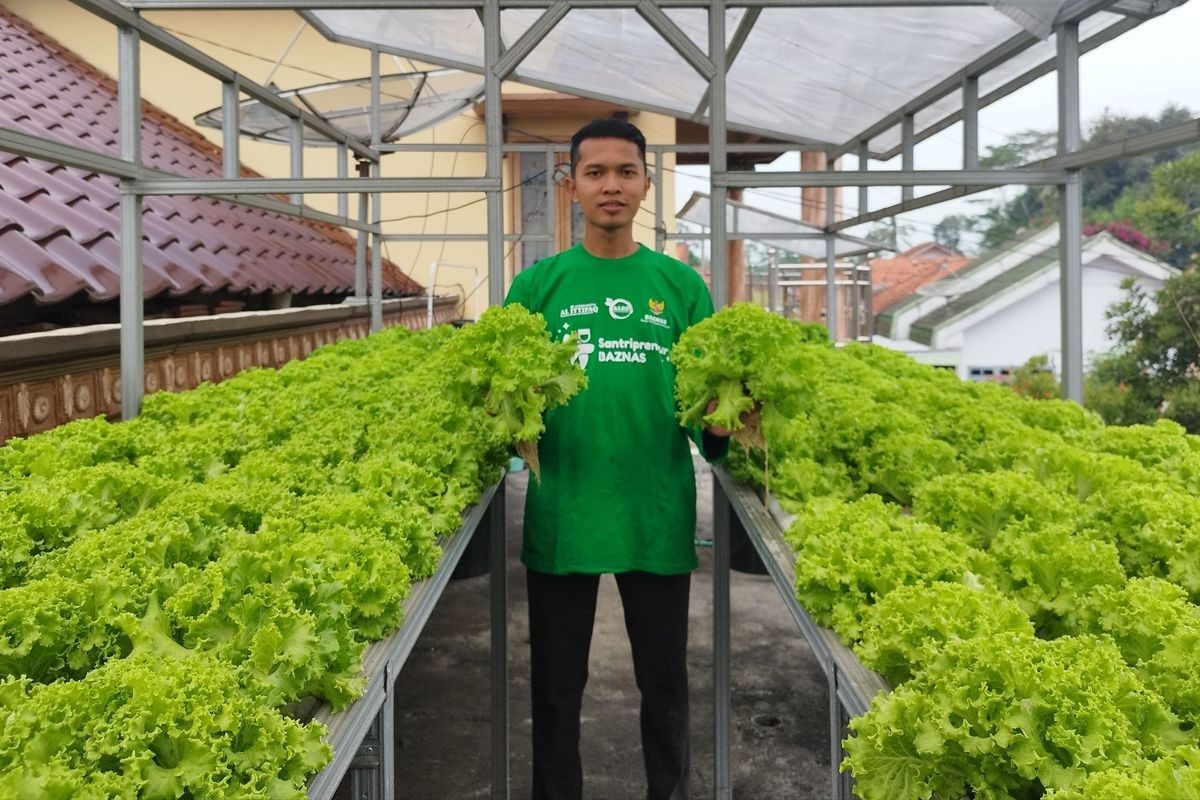
Lumajang, East Java - In the attic of a 40-square-metre house, the midday heat makes it stuffy due to the hot tin roof, cramped space, and simple shelves serving as witnesses to an unpromising experiment: 70 recycled plastic bottles arranged as a hydroponic system.
This modest home, with its narrow attic, belongs to Arif Hermawan (28), a resident of Curahpetung Village, Kedungjajang Subdistrict, Lumajang Regency, East Java, who transformed it into a hydroponic lettuce farm.
When he first started hydroponic farming in 2019, the early days offered no hope: lettuce seedlings failed to grow properly, with weak roots, yellowing leaves, and some dying before harvest.
The sound of water flowing through PVC pipes is ordinary, but for Arif, it is not just a daily rhythm—it is a record of a long journey of failures that nearly made him quit hydroponics.
He repeatedly climbed the attic only to see the same failures, silent and unexplained. At one point, he sat quietly for a long time—not from surrender, but from not understanding what was happening to his hydroponic plants.
The young man from Kedungjajang Subdistrict is not an agriculture graduate but a Sharia economics graduate who previously worked as a sales marketer.
Hydroponics was not part of his plan; he discovered it through online videos and began without full confidence, trying with 70 recycled bottles. When attempting to apply the knowledge from video social media, he kept questioning why it wasn’t working.
Slowly but surely, Arif began recording, observing, and repeating. Gradually, he realised something simple: he wasn’t failing at planting, but hadn’t yet understood the hydroponic system.
With his wife, Arif shifted to a new approach. The same attic became a small hydroponic system with 340 planting holes. Pipes were rearranged, water flow improved, and nutrients re-formulated.
But failure didn’t vanish immediately. New issues arose: pumps failing in the morning, nutrient flow clogging at noon, and evening worries as he checked if all plants were still alive.
During this phase, his body changed—sleep decreased, rest times became irregular, and his hands were often wet from nutrient solution. Yet, he kept climbing the attic daily, not out of confidence, but because he had come too far to quit.
His wife played a quiet but constant role, offering comfort. Sometimes silent, sometimes questioning if the business was worth continuing. Uncertain, but never fully abandoning the process.
One morning, as usual, he climbed the attic. This time, he didn’t find damage. Instead, he saw a few plants standing tall, offering new hope. Not many, but enough to pause his exhaustion. Finding this, there was a different silence.
His patience rewarded him with changes in the hydroponic plants. The change wasn’t a big victory, but a small, almost unnoticed sign. At least, the plants no longer died all at once.
The lettuce began to stay greener, roots started to hold. Imperfect, but enough for Arif to stop thinking his hydroponic efforts were total failures.
His perseverance paid off with the first hydroponic lettuce harvest, making him smile. The harvest wasn’t sold; he brought it down and shared with neighbours.
Some residents who received free vegetables asked if they were for sale, and they would buy them. This became the turning point for Arif to take his hydroponic business more seriously.
Demand started to emerge—small but enough to change how he viewed his work. At that point, he decided to leave his sales marketing job.
He then took a Rp65 million bank loan. Behind the number lay unseen pressure: loan repayments, providing for his family, and the possibility of failing again.
Arif sat quietly, not calculating profits and losses, but assessing the chances of survival and expansion for his hydroponic farming business.