
Budget Deficit Threatens to Exceed 3%, Government Prepares Government Regulation in Lieu of Law on State Budget
Jakarta - The government is currently preparing a Government Regulation in Lieu of Law (Perppu) concerning the 2026 State Budget and Expenditure Law (APBN).
This step is being taken due to global geopolitical uncertainty, particularly conflicts in the Middle East which have driven up world oil prices and disrupted oil supplies in the market.
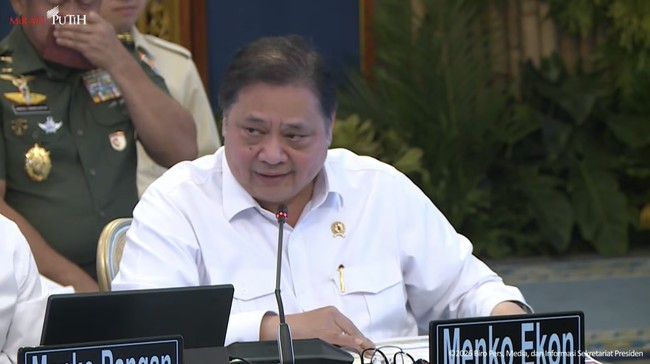
Economic Coordination Minister Airlangga Hartarto stated that the Perppu is intended to facilitate changes to budget assumptions in the 2026 APBN as a result of global geopolitical turbulence. The 2026 APBN deficit is estimated to widen due to changes in assumptions regarding Indonesian crude oil prices (ICP), exchange rates, and economic growth.
According to Hartarto, such Perppu measures were previously employed during the Covid-19 pandemic in 2020. “We issued a Perppu during Covid, there are several factors that need to be included in the Perppu being prepared. The timing is of course a political decision by the President, but this is the content of the Perppu we prepared during Covid, which we have adapted. The differences concern state revenue, where there are emergency income tax and value-added tax incentives in affected sectors without changing tax law,” Hartarto said during a Full Cabinet Session at the State Palace on Friday, 13 March 2026.
“For import duties, there is exemption of certain raw materials to keep our exports running, then tax deferral for SMEs and energy-intensive industries. We also have potential to obtain windfall gains from oil and gas non-tax revenue and commodities. We can calculate this for compensation purposes. Typically when oil prices rise, commodity prices like CPO, nickel, gold, and copper also rise, and we can in a manner of speaking impose additional taxes. Regarding budgeting and deficit costs, the deficit can exceed 3%, and cross-programme budgets can be changed without Parliament. With this Perppu, the government has flexibility to make changes,” he explained.
“Energy cash transfers will be continued and emergency social assistance will be added via Presidential Regulation, and issuance of government securities will proceed using the State Asset Liquidity mechanism,” he added.
Hartarto outlined several scenarios based on changes to crude oil prices and exchange rates. Three scenarios include:
First scenario: Indonesian crude oil prices of US$86 per barrel, exchange rate of Rp17,000 per US dollar, whilst the APBN assumes Rp16,500 per US dollar, with growth maintained at 5.3%, and government securities figure higher at 6.8%, the APBN deficit is estimated to reach 3.18%.
Second moderate scenario: ICP of US$97 per barrel, exchange rate of Rp17,300, growth of 5.2%, government securities higher still at 7.2%, resulting in a deficit of 3.53%.
Third worst-case pessimistic scenario: ICP of US$115 per barrel, exchange rate of Rp17,500, growth of 5.2%, government securities at 7.2%, resulting in a deficit of 4.06%.
“This means that with these various scenarios, it is difficult for us to maintain a 3% deficit unless we cut spending and reduce growth. These are the scenarios we need to discuss in a limited session,” he concluded.