
Budget Committee: Education Budget for Free Nutritious Meals Programme Is Government and Parliament Decision
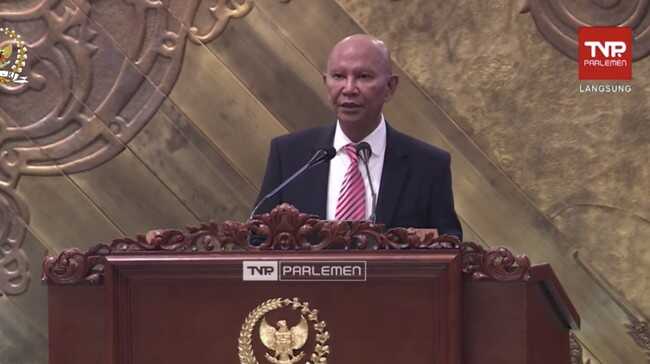
Jakarta – The head of Indonesia’s Parliament Budget Committee, Said Abdullah, has responded to public concerns regarding education budget allocations now being used to fund the government’s free nutritious meals programme (Makan Bergizi Gratis, MBG), with the 2026 State Budget Law (APBN) being challenged by teacher groups at the Constitutional Court.
“This programme naturally attracts public attention given its reach extends to tens of millions of beneficiaries,” said Said in a written statement on Friday, 27 February 2026.
Said initially noted that the programme is legitimate given that the average prevalence of chronic malnutrition amongst Indonesian children remains high at approximately 19 percent. This means that out of every 100 births, 19 percent experience chronic malnutrition. He considers this percentage moderately high, as the World Health Organisation standard for low prevalence is below 10 percent.
He also cited that nutrition interventions through school feeding programmes such as MBG have long been implemented by many developed countries, including China and Japan, as well as Scandinavian nations such as Finland and Norway, and have been adopted by developing countries including India and Brazil.
Regarding the budgeting process, Said emphasised that the APBN is the only law whose draft is proposed by the government to parliament. Consequently, parliament’s position regarding the proposed budget, including education budget allocations for specific programmes, is limited to adjusting, increasing, or decreasing budget allocations for programmes and ministries/institutions jointly agreed upon with the government.
“According to the constitution, parliament has the authority to reject the entire proposed APBN budget, and vice versa,” Said stated.
In the budgeting process, Said noted that the education budget allocation remains protected in accordance with constitutional mandate, namely 20 percent of state expenditure.
The education budget allocation in the 2025 APBN was Rp724.2 trillion and in 2026 is Rp769 trillion. Across these two budget years, the education budget allocation, which includes MBG expenditure, was Rp71 trillion in 2025 and Rp268 trillion in 2026.
In 2026, the Budget Normalisation Programme (BGN) received budget allocation according to the APBN Law of Rp268 trillion, with Rp255.5 trillion dedicated to supporting the MBG programme and Rp12.4 trillion for programme management support.
“Of the BGN programme budget of Rp255.5 trillion, Rp223.5 trillion is allocated for education functions,” Said explained, who is also a PDI Perjuangan politician.
As the education budget increases, Said noted, other managing ministries also experience increases, in addition to BGN. This includes the Ministry of Primary and Secondary Education (Kemendikdasmen).
The increases result from rising state expenditure from 2025 to 2026, as state expenditure serves as the basis for calculating the 20 percent education allocation.
“Budget increases are not only received by Kemendikdasmen, but also by the Ministry of Education, Culture, Research and Technology (Kemendiktisaintek), the Ministry of Religious Affairs (Kemenag), the Ministry of Social Affairs (Kemensos), and the Ministry of Public Works (Kemen PU) in carrying out education functions from the APBN,” Said noted.
Kemendikdasmen received an increase of Rp21.5 trillion, Kemendiktisaintek an increase of Rp3.3 trillion, Kemenag an increase of Rp10.5 trillion, Kemensos an increase of Rp4 trillion, and Kemen PU an increase of Rp1.7 trillion.
“Therefore, in 2025 and 2026, the MBG budget allocation becomes an element included in the education budget position. This has become a political decision between parliament and the government,” Said stated.
Nonetheless, Said acknowledged respect for civil society groups challenging the MBG budget allocation under education spending at the Constitutional Court.
“However, based on constitutional studies and review, parliament and the government have made this decision. We hope this explanation clarifies the composition of the MBG budget and education budget allocation,” Said concluded.