
BSKDN Promotes Data-Driven and Collaborative Approach to Air Pollution Control
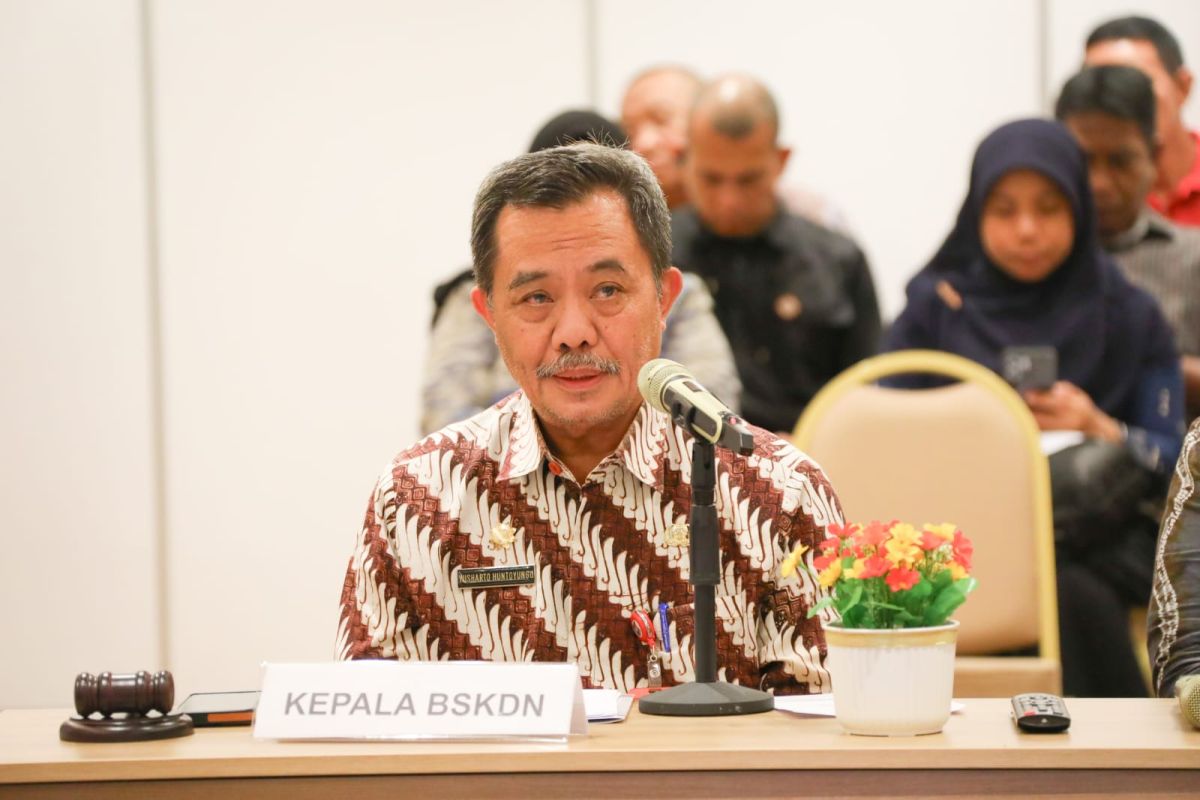
Jakarta (ANTARA) - The Head of the Agency for Domestic Policy Strategy (BSKDN) of the Ministry of Home Affairs, Yusharto Huntoyungo, has emphasised the importance of measured, data-driven air pollution control supported by inter-regional collaboration.
“In line with the Indonesian President’s directive, handling the air pollution crisis must be carried out in a more measured, systematic, and data-based manner, including through strengthening cross-sector and cross-regional coordination,” Yusharto said in a statement in Jakarta on Friday.
This was conveyed during the opening of a policy discussion forum themed “Strategic Policy Planning and Inter-Regional Coordination in Air Pollution Control: Case Study of the Jabodetabek Air Pollution Crisis 2023” in Jakarta.
In his remarks, Yusharto said the forum represented a responsive step to anticipate the potential recurrence of the air pollution crisis, particularly as the dry season approaches after the end of the rainy season.
He recalled the experience of the 2023 air pollution crisis, when concentrations of fine particulate matter measuring 2.5 microns (PM2.5) increased significantly and had serious impacts on public health.
“This activity is responsive in nature to address a situation that may well occur again as we enter the dry season. If not properly controlled, we risk facing another air pollution crisis like the one in 2023, when concentrations of very small-sized particles increased, leading to higher prevalence of respiratory diseases and the potential for acid rain,” he said.
Yusharto explained that various studies show that concentrations of pollutants such as PM10 in several areas remain above the established quality standards.
This condition not only impacts public health but also creates significant economic consequences, particularly in the form of increased healthcare costs and the government’s budget burden in providing basic services.
Several studies also show that air pollution in the Jakarta metropolitan region contributes to high prevalence rates of respiratory diseases, cardiovascular diseases, and other health impacts.
Exposure to air pollution is even associated with thousands of premature deaths each year.
“These facts demonstrate that the air quality problem is not merely an environmental issue but is closely linked to public health, economic productivity, and quality of life for urban residents,” he explained.
According to him, one of the main challenges in controlling air pollution is its cross-boundary nature. Emission sources can originate from various sectors such as transportation, power generation, industry, and domestic activities.
Additionally, meteorological factors also influence the dispersal of pollutants across various administrative regions. For this reason, Yusharto said that efforts to control air pollution require a comprehensive and coordinated approach across regions.
In this context, the BSKDN views it as important to establish a discussion forum that can serve as a space for evidence-based policy dialogue, as well as an initial platform for coordination in formulating strategies to manage the air pollution crisis in metropolitan areas.
Through this forum, Yusharto hopes that stakeholders can gain a more comprehensive understanding of air quality conditions in various regions, including the identification of emission sources that contribute to the decline in air quality.
Furthermore, the forum is also expected to identify opportunities for strengthening policy coordination and inter-regional cooperation in controlling cross-boundary emissions.
“We hope this discussion can produce comprehensive information and concrete policy recommendations that are responsive to the conditions we currently face, particularly in strengthening synergies between the central government, regional governments, and other stakeholders,” he added.
Yusharto also expressed optimism that with strong commitment and cooperation from all parties, efforts to control air pollution in Indonesia’s largest metropolitan area, the Jabodetabek region, can be carried out more effectively.
In this way, better air quality and a more sustainable environment can be realised for the public.
“With strong commitment and collaboration from all parties, we are optimistic that air pollution control in the Jabodetabek metropolitan region can be conducted effectively so that healthier air quality and a more sustainable environment can be achieved together,” said Yusharto.
Meanwhile, Bogor City Mayor Dedie A. Rachim emphasised that one of the strategic steps to reduce air pollution in the Jabodetabek metropolitan area is to strengthen the public transportation system.
According to him, accelerating the development and optimisation of the Jabodebek LRT is important to reduce public dependence on private vehicles.
“So what is the suggestion? There are already many suggestions, one of which is for the Jabodetabek metropolitan area: complete what is called the Jabodebek LRT. This way, our dependence on the use of two-wheeled and four-wheeled vehicles will be reduced,” said Dedie.