
BSKDN of the Ministry of Home Affairs to oversee the implementation of national priority programmes
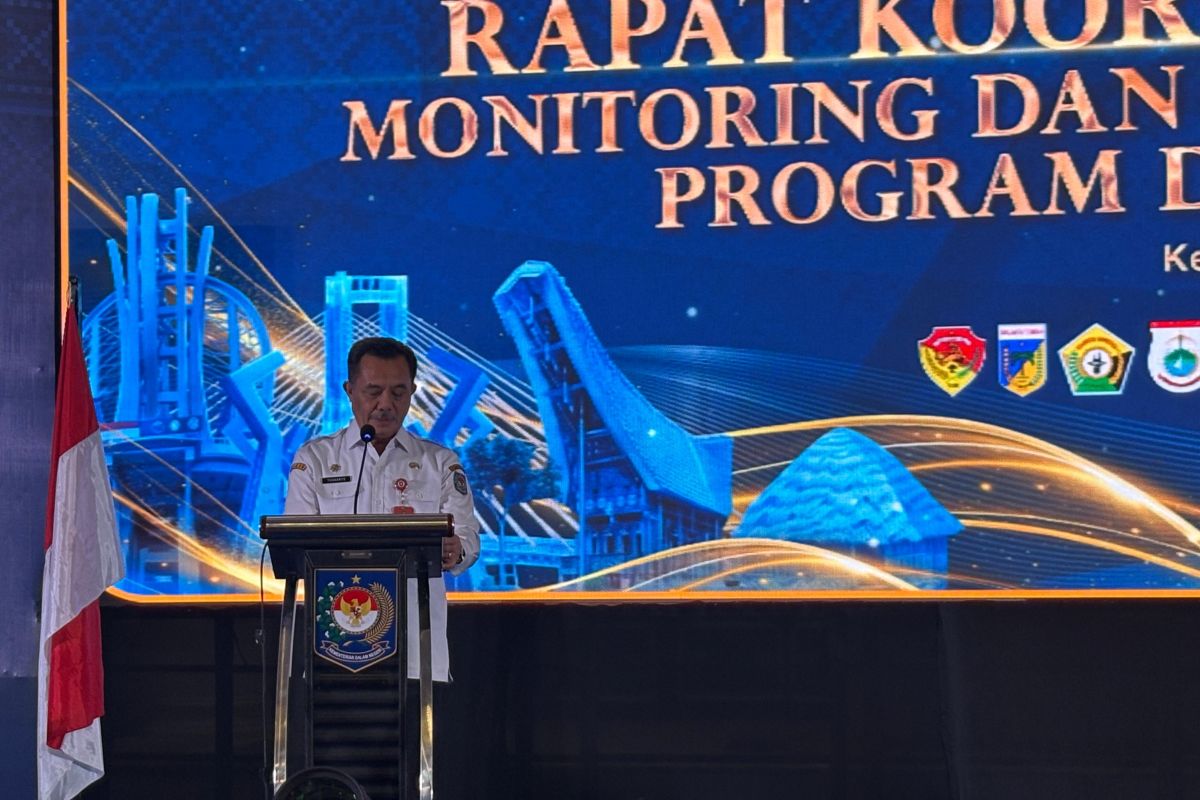
Jakarta (ANTARA) - The Domestic Policy Strategy Agency of the Ministry of Home Affairs will continue to oversee the implementation of various national priority programmes to ensure they run effectively, on target, and have a real impact on society.
Head of the Domestic Policy Strategy Agency (BSKDN) Yusharto Huntoyungo, in his statement in Jakarta on Wednesday, said that every region has characteristics and great potential that can be developed to support development success.
Therefore, the implementation of national priority programmes needs to be carried out adaptively, taking into account the needs and capacities of each region.
“Showcasing its uniqueness and having very great potential. For us, there is no poor region; all have potential ready to be actualised into advanced and prosperous regions for their communities,” said Yusharto.
This was stated by Yusharto at the Regional Coordination Meeting for Monitoring and Evaluation of the Implementation of the President’s Directive Programmes Batch I in Kendari, Southeast Sulawesi.
According to him, the President’s Directive Programmes are national priority agendas that must be seriously overseen by all levels of government because they directly relate to public needs, from inflation control, food self-sufficiency, eradication of extreme poverty, to improving the quality of basic services.
Therefore, the implementation of programmes in the regions requires strengthened coordination, policy synchronisation, as well as integrated monitoring and evaluation.
“The President’s Directive Programmes are national priority agendas that must be seriously overseen by all levels of government. These programmes directly touch on public needs, so their implementation in the regions requires policy synchronisation, strengthened governance, and integrated monitoring and evaluation,” he said.
According to him, the forum is important for strengthening the quality of policy recommendations to make them more operational and suited to regional conditions.
He added that monitoring and evaluation of programme implementation should not be interpreted merely as administrative supervision, but must be able to serve as an instrument for policy improvement oriented towards solving field problems.
“Monitoring and evaluation (monev) should not be interpreted as activities to find faults. Monev must become an instrument for policy improvement, not just administrative supervision,” said Yusharto.
He said that BSKDN is currently strengthening its policy hub function as a strategic policy nexus within the Ministry of Home Affairs.
Through this strengthening, BSKDN seeks to connect data, analysis, field issues, and policy recommendations to support more targeted and evidence-based decision-making.
According to him, the success of the President’s Directive Programmes ultimately should not only be measured by administrative achievements, but by how much the public truly feels the tangible, fair, and sustainable presence of the government.
“The success of the President’s Directive Programmes must consider how much the people in the regions feel the real, fair, and sustainable presence of the state,” he concluded.