
BSKDN Encourages Central Java to Strengthen Innovation Through Policy Briefs
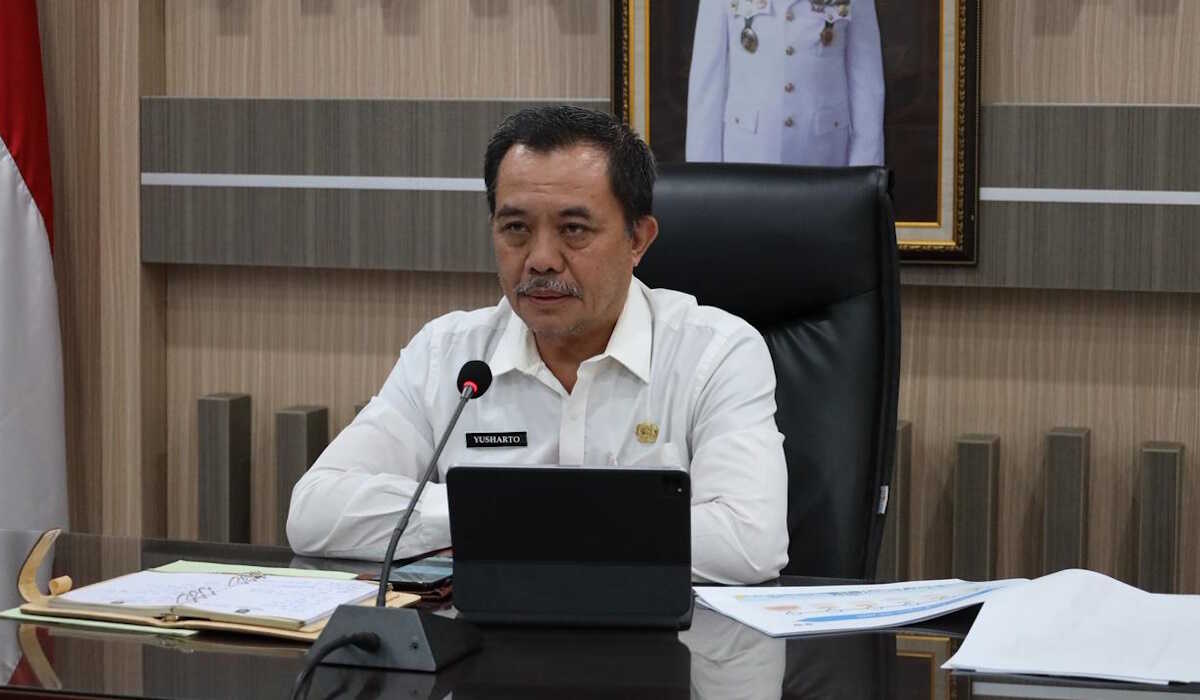
The Badan Strategi Kebijakan Dalam Negeri (BSKDN) of the Ministry of Home Affairs (Kemendagri) has invited the Central Java (Jateng) Provincial Government to strengthen regional innovation through the preparation of policy briefs as a strategic instrument in building evidence-based policy. This invitation was conveyed by the Head of BSKDN, Yusharto Huntoyungo, during a virtual meeting with the Badan Riset dan Inovasi Daerah (BRIDA) of Central Java Province from the BSKDN Office (February 25).
Yusharto emphasized that regional innovation needs to be transformed into sustainable public policies and integrated into governance. Therefore, an analytical instrument is needed to legitimize inventions so that they can be implemented as innovative and impactful solutions.
According to him, innovation is an invention used to answer actual problems, both current conditions and future challenges. However, to ensure that this innovation does not merely remain a good practice, a policy brief is needed as a basis for policy analysis that ensures the solution is feasible, measurable, and sustainable.
“Innovation is an invention used to solve problems or become a solution to problems that are currently being felt, not in the past, and also possibly to be responsive to the future,” said Yusharto.
In addition, he explained that a policy brief serves as a bridge between invention and innovation, while also ensuring that the policies taken are not merely based on intuition or short-term interests, but on scientific evidence, empirical data, and proven best practices. With this approach, the risk of policy failure can be reduced and the use of resources can be optimized.
On the other hand, Yusharto emphasized the important role of BRIDA as an institution that has the mandate to strengthen research and development functions in the region. According to him, BRIDA needs to be the driving force in integrating research and development functions, improving the management of research and innovation, and ensuring that every innovation has strong policy analysis support.
“With the support of policy briefs, innovation will no longer be limited to sectoral programs but can develop into a strategic policy instrument that leads to more adaptive and progressive governance to support the formation of public policies in the region,” he said.
On this occasion, he also linked the strengthening of regional innovation with the national agenda towards Golden Indonesia 2045. He said that Indonesia’s achievements in competitiveness and innovation at the global level require faster and more structured work from all levels of government.
“To remain in the same position, we must run faster. In the context of government innovation, this means that we must continue to innovate, strengthen governance, and ensure that every innovation has a strong policy basis,” he concluded. (M-3)
This achievement also marks Central Java as the region with the second-highest labor absorption rate on the island of Java.
The gap in access to medical services between urban and rural areas must be addressed immediately through proactive outreach services.
A strategy is being implemented through a scheme of improvement to routine rehabilitation to maintain connectivity between regions.
As of October 2025, damage to conservation areas due to illegal mining has reached 409 hectares.
On the Kanci-Pejagan toll road, 3,465 vehicles exited the toll road between 00:00 and 08:00 this morning.
The Head of BSKDN of the Ministry of Home Affairs, Yusharto Huntoyungo, emphasized the importance of analysis and evaluation of policies that are no longer relevant to current conditions.
Media Talk 2026 is very relevant to the role of BSKDN as a think tank of the Ministry of Home Affairs that is tasked with preparing and formulating strategic policy recommendations.
The Indonesian ASRI (Safe, Healthy, Clean, and Beautiful) movement must start from the work environment.
BSKDN of the Ministry of Home Affairs together with the SKALA Program continue to strengthen strategic collaboration in order to encourage the measurement of the impact of policies after implementation in the region.
The Head of BSKDN of the Ministry of Home Affairs, Yusharto Huntoyungo, emphasized that the achievements and awards for regional innovation should not be the end point in innovating.