
BRIN Issues Warning: What Percentage Chance of Godzilla El Niño Hitting Indonesia?
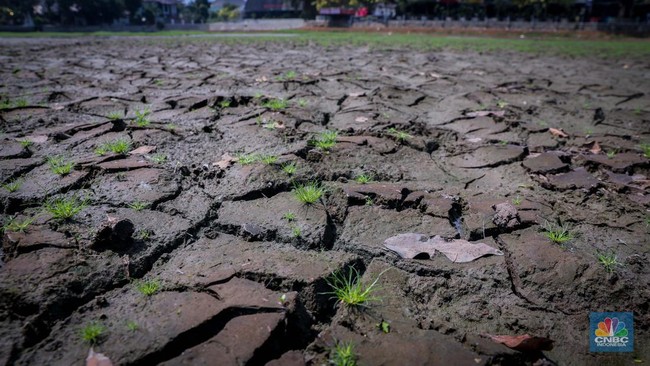
Jakarta, CNBC Indonesia - Warnings about the potential emergence of a strong El Niño, dubbed “Godzilla”, in Indonesia are gaining attention. However, amid these concerns, agriculture observer Khudori urges the public not to rush to conclude that the worst-case scenario will occur.
He assesses that information regarding the “Godzilla” El Niño remains unclear and should be handled cautiously to avoid counterproductive panic.
“Regarding this ‘Godzilla’ El Niño, it’s still murky. I don’t intend to downplay the intent of the BRIN researchers. Perhaps it’s to make the public aware of the danger and prompt the government to act swiftly,” Khudori told CNBC Indonesia on Wednesday (25/3/2026).
“But if not careful, it could be counterproductive. That’s why I asked colleagues at BMKG about the situation. Their explanation isn’t as dire as the BRIN researchers’ prediction,” he added.
Khudori emphasised that the chance of an extreme El Niño occurring is currently relatively small, based on information he received from the Meteorology, Climatology, and Geophysics Agency (BMKG).
“According to my colleagues at BMKG, the current conditions mean the chance of reaching super-strong levels, or so-called Godzilla, is only 15-20%. Based on current calculations, the highest likelihood is only up to moderate levels,” he explained.
He also reminded that El Niño predictions have limitations over certain timeframes, so interpretations must be done carefully.
“ENSO predictions issued in February-March-April have good accuracy only up to 3 months. That means predictions of El Niño strength for the 4th month and beyond must be interpreted cautiously,” he clarified.
Thus, according to him, the chance of a “Godzilla” El Niño remains small and cannot yet be confirmed to occur.
“The explanation from my BMKG colleagues is clear: the chance of it (Godzilla El Niño) is still small right now. I’m not the expert. So I asked the competent ones,” said Khudori.
Previously, the National Research and Innovation Agency (BRIN) predicted that Indonesia would face a strong-intensity El Niño phenomenon, often dubbed “Godzilla”, this year. This condition has the potential to make the dry season longer and drier, especially in western and southern Indonesia.
El Niño itself is a phenomenon of warming sea surface temperatures in the equatorial Pacific Ocean that impacts reduced rainfall in Indonesia. In its strong phase, this phenomenon is called “Godzilla” because it can trigger significant climate anomalies.
“El Niño is a phenomenon of warming sea surface temperatures in the equatorial Pacific Ocean. The El Niño phenomenon, including the potential strong ‘Godzilla’ variation, causes the dry season in Indonesia to become longer and drier,” wrote BRIN Climate and Atmosphere Research Centre researcher Erma Yulihastin, quoted from the official Instagram post @brin_indonesia on Saturday (21/3/2026).
Several global models indicate that El Niño began developing since April 2026. At the same time, a positive Indian Ocean Dipole (IOD) phenomenon is also expected to occur, strengthening the drought impact in Indonesia.
The impact of these two phenomena can be seen from the shift in cloud formation patterns. Rainfall activity is expected to be more concentrated in the Pacific Ocean, while Indonesia experiences a lack of clouds and rain.
“Cloud and rain formation is concentrated over the Pacific Ocean. Conversely, the Indonesian region experiences minimal clouds and rain,” she wrote.
In addition, the positive IOD, marked by cooling sea surface temperatures around Sumatra and Java, further worsens the decline in rainfall, particularly in western Indonesia.
Alert Level 1 for Drought and Flood Threats
BRIN estimates that the combination of El Niño and positive IOD will last throughout the dry season, from April to October 2026.
However, BRIN emphasises that this condition is predicted not to be uniform across all of Indonesia.
“The impact of super El Niño and positive IOD is not uniform in Indonesian regions. This happened during the 2023 El Niño and positive IOD,” BRIN wrote.
In terms of regions, BRIN’s prediction models show that most of Java Island to East Nusa Tenggara (NTT) will experience dry conditions earlier. This has the potential to disrupt the agriculture sector, especially in national rice granary areas.
Conversely, eastern Indonesian regions such as Sulawesi, Maluku, and Halmahera are expected to still experience high rainfall even during the dry season period.