
BRIN Drives Higher Education Consolidation, UMS Ready to Accelerate Innovation Commercialisation
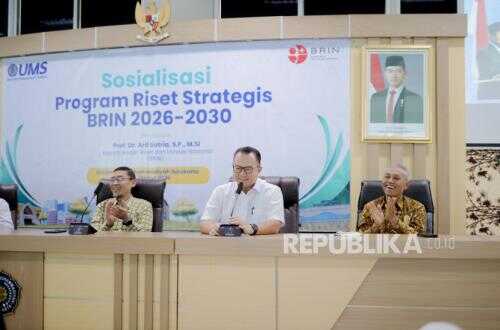
Muhammadiyah University of Surakarta (UMS) reaffirmed its commitment as a progressive private research-based campus through the launch of the BRIN Strategic Research Programme 2026–2030 Socialisation. The event featured Prof Arif Satria, Head of the National Research and Innovation Agency (BRIN) of the Republic of Indonesia, at UMS’s main building on 1 March 2026.
In his presentation, Arif emphasised the importance of a national research roadmap as a reference for lecturers and students in preparing theses and dissertations. He stressed that research must not stop at publication but must deliver tangible impact.
“Research must have impact. It must provide answers to societal and industrial challenges. Because a nation’s advancement is determined by innovation and the number of researchers involved,” he stated.
He also expressed appreciation for UMS’s efforts in establishing itself as a private research university that consistently strengthens the research ecosystem.
“I am proud of UMS’s commitment to building a research ecosystem. I hope it continues to advance, succeed, and produce more commercialised innovations,” he said.
Arif cited the Endogenous Growth theory from Nobel Prize-winning economist Paul Romer, which holds that economic growth is largely determined by research and development, innovation, and human capital quality. He explained that the Global Innovation Index correlates with a country’s GDP per capita, with higher innovation indices reflecting greater competitiveness and national prosperity.
However, Indonesia’s position within ASEAN remains lagging, making improved research quality a collective challenge for higher education institutions. “If we want to advance, we cannot simply submit proposals and hope for immediate approval. What matters is the seriousness in consistently building a research ecosystem,” he said.
In reflective remarks, Arif urged the establishment of complementary research ecosystems based on competencies and characteristics. He also highlighted challenges in the public’s scientific mindset, citing the viral phenomenon of an unusually shaped catfish that was treated as a spiritual rather than scientific matter. “When interviewed figures are spiritual leaders and it is called a ‘sacred catfish’, we see that science has not become the primary reference. This is a challenge for education,” he observed.
According to Arif, Indonesia should learn from research institution models in Germany, such as the Max Planck Society for basic research, the Leibniz Association for applied research, and the Fraunhofer Society, which focuses on commercialisation. He also referenced the Metal-Organic Framework (MOF) discovery by Japanese scientist Susumu Kitagawa, which significantly increased gas storage capacity.
Moreover, Silicon Valley has flourished through consolidation between universities such as Stanford University and global technology companies including Apple, Google, and Tesla. In China, enterprises like Huawei demonstrate the strength of corporate research through researcher-heavy human resource structures.
Through the 2026–2030 Strategic Research Programme, BRIN is promoting a leapfrogging strategy to ensure Indonesia becomes not merely a market but a producer of innovations. Consolidation among higher education institutions is key, including collaboration between UMS and other campuses in an innovation holding model. BRIN focuses on high-cost, high-risk research whilst opening funding opportunities for master’s and doctoral students, research assistants, and post-doctoral fellows.
UMS Rector Prof Harun Joko Prayitno, in his remarks, invited all participants to appreciate the academic gathering as part of ‘Research Reflection’ (Tadarus Riset), a term describing the collective spirit of building a sustainable research culture. He also encouraged the formation of flagship research programmes focusing on reducing imports and strengthening national essential needs such as food, energy, and pharmaceuticals.