
BRIN Develops EroSlide for Erosion and Landslide Detection Based on IoT
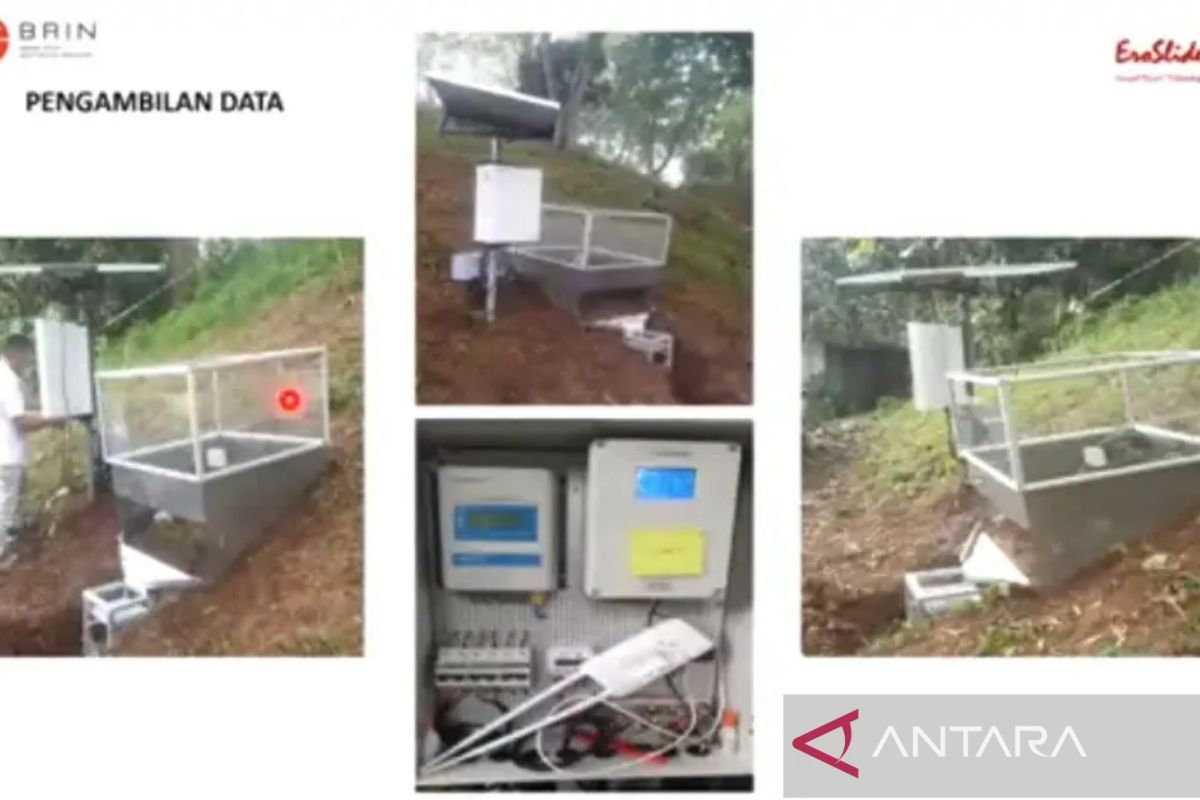
Jakarta (ANTARA) - The National Research and Innovation Agency (BRIN) has developed a device called EroSlide to monitor various parameters, such as rainfall, surface runoff, infiltration, and sediment volume, in an integrated and real-time manner using the Internet of Things (IoT).
Senior Expert Engineer from BRIN’s Centre for Mineral Technology Research, Nendaryono Madiutomo, explained in a statement in Jakarta on Sunday that EroSlide is equipped with various sensors, including a tipping bucket rain gauge, a load cell sensor to measure sediment, and a flow sensor to calculate water runoff.
“The data generated is then sent and processed centrally, allowing it to be used for further analysis, including mapping potential erosion and landslides,” he said.
Nendaryono stated that the device has been tested on sloping land with fairly steep inclines and has demonstrated its ability to record data continuously. In the future, the system will be developed further by adding other sensors, such as soil moisture, pH, and temperature, to improve the accuracy of the analysis.
He added that this technology has the potential to be developed into a landslide early warning system. This is based on the close relationship between erosion intensity and the potential for landslides in an area.
With a deep understanding of science supported by innovative technology like EroSlide, Nendaryono hopes that natural resource and environmental management can be carried out more effectively and wisely.
“Accurate data is an important foundation in predicting disaster potential and identifying the economic value of an area, so that development can proceed in harmony with environmental preservation,” he said.
Nendaryono revealed that the process of mineral enrichment and soil weathering on sloping land is greatly influenced by various factors, such as rainfall, slope gradient, soil type, and environmental conditions.
Erosion, particularly water erosion, acts as the main agent that accelerates land degradation while transporting material from upstream to downstream.
He assessed that soil nutrients, both macro elements like nitrogen, phosphorus, potassium, calcium, and magnesium, as well as micro elements like iron, manganese, zinc, boron, copper, molybdenum, and chlorine, are highly vulnerable to loss due to erosion. This condition directly impacts soil fertility and land productivity.
“Erosion not only causes a decline in soil quality in the upstream areas but also triggers mineral enrichment in downstream regions due to the transportation and deposition of material,” stated Nendaryono Madiutomo.