
BRIN and Ministry of Culture Collaborate to Trace Nusantaran Civilisation Spanning 1.8 Million Years
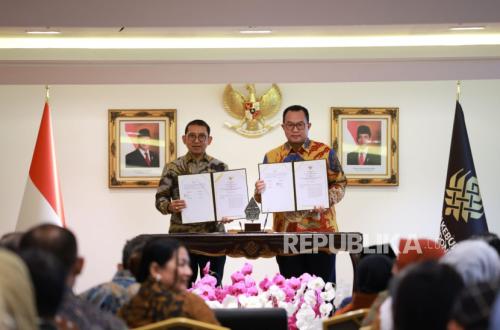
The Indonesian National Research and Innovation Agency (BRIN) and Ministry of Culture have entered into a collaborative research partnership on cultural research. The cooperation spans from uncovering traces of Nusantaran civilisation to advancing the digitisation of regional languages.
BRIN Head Arif Satria stated that through the ongoing research collaboration, BRIN is investigating the potential evidence of Nusantaran civilisation, estimated to have existed for approximately 1.8 million years. Should this be scientifically proven, Indonesia would be considered to hold significant strategic importance within geographical and civilisational contexts.
Arif explained that Indonesia’s position between the Pacific Ocean and Indian Ocean makes it a meeting point for various major world civilisations. With approximately 708 languages globally, around 10 per cent of which are found in Indonesia, and 1,340 ethnic groups, Indonesia possesses exceptionally diverse culture.
The potential age of Nusantaran civilisation reaching 1.8 million years is regarded as an extraordinary wealth that strengthens Indonesia’s position as a crucial node in global civilisational dynamics.
“This is BRIN’s responsibility, as we have the Arbastra Research Organisation (Archaeology, Language and Literature). Our task is to prove these hypotheses. So our archaeology researchers at BRIN are now working hard to discover the finest works from our society of old,” Arif said following the signing of the memorandum of understanding on Tuesday, 10 March 2026.
Arif stated that in the era of artificial intelligence (AI), future challenges also relate to language digitisation. He explained that AI accuracy levels remain significantly influenced by the language being used.
When using English, accuracy can reach approximately 80 per cent. However, when using Indonesian, this drops to around 60 per cent, and when using regional languages, it falls to only about 42 per cent.
According to him, this situation demonstrates the need to strengthen digitisation of Indonesian and regional languages so that they are more widely recognised in AI systems. This simultaneously represents a challenge for BRIN to promote integration of various regional languages into the global digital ecosystem.
“I hope cooperation with the Ministry of Culture will increasingly build our confidence that our rich social diversity will become our model to colour the world and inspire it,” he said.
Minister of Culture Fadli Zon emphasised that Article 32, paragraph (1) of the 1945 Constitution mandates the state to advance Indonesian national culture amid world civilisation, whilst simultaneously guaranteeing society in maintaining and developing its cultural values.
“And I believe the state referred to is certainly not only the Ministry of Culture, but all of us, from central government, provinces, cities, to the lowest level, as well as the private sector, have the obligation to advance Indonesian national culture amid world civilisation,” Fadli Zon stated.
Through cooperation between the Ministry of Culture and BRIN, along with the Ministry of Communication and Digital, the Ministry of Creative Economy/Creative Economy Agency, the Ministry of Forestry, and the DKI Jakarta Provincial Government, it is important to combine various resources and data possessed so that management of cultural wealth can be conducted more optimally in the digital era.
“These cultural assets will then be translated into Intellectual Property (IP), which has not yet been significantly developed and we have not fully maximised at all. Working with BRIN, I believe there is a great deal of recent new research that has only just been announced,” Fadli Zon said.