
Bridge Collapse in East Kupang Disrupts Land Access to Timor Island, Emergency Route to Open Soon
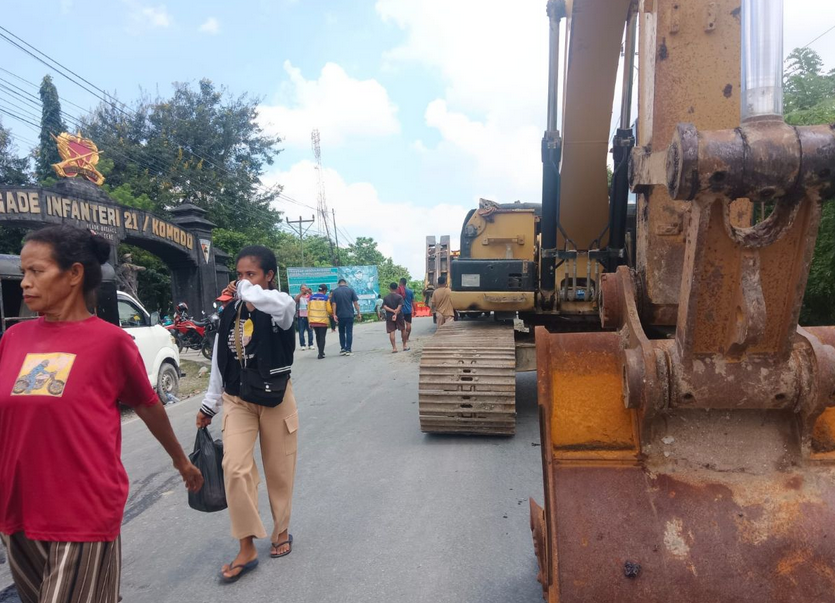
The main land transport access on Timor Island, East Nusa Tenggara (NTT), has been completely paralysed following the collapse of a bridge at the border between Naibonat Ward, East Kupang Subdistrict, and Kuimasi Village, Fatuleu Subdistrict, Kupang Regency, sinking approximately 1.3 metres deep on Thursday (26/3/2026) at 05.00 WITA.
The NTT Provincial Government, together with the National Road Implementation Agency (BPJN) NTT, has deployed heavy equipment and begun opening an alternative route on the left side of the damaged bridge. The construction of this emergency access is currently underway on site.
NTT Deputy Governor Johni Asadoma stated that the alternative route will be built using a crossway system to allow passage for vehicles, including logistics vehicles, during the bridge repair process. “Our target is at least three days for it to be usable, maximum five days, provided the weather cooperates. We pray for good weather so the work can be completed quickly,” he said.
He emphasised that this road section is a vital route connecting Kupang City with several areas on Timor Island such as South Central Timor, North Central Timor, Belu, up to Malaka, and even serving as access to Timor Leste. “The impact is very significant. Economic circulation is hampered, and the distribution of people’s needs is not running smoothly. Therefore, we must act quickly,” he said.
Currently, large vehicles such as trucks cannot pass due to the severely damaged bridge condition. The temporary emergency route can only be used by small vehicles like motorcycles and pick-up cars with strict restrictions. “We don’t want to take risks. If the bridge breaks completely, vehicles could plunge freely and potentially cause casualties,” Johni Asadoma stressed.
The central government is also assured to intervene to accelerate handling, given the road’s status as a national route. The bridge collapse is suspected to have been triggered by natural factors such as soil movement and weakening of the building structure.
At the incident site, traffic flow is observed to be congested with queues of vehicles stretching out. Several vehicles, including trucks loaded with stones from the south such as Kolbano, are held up at the location. In addition, public transport, pick-up cars, to private vehicles are also trapped in the jam, with queues reaching hundreds of metres. The average load of the held-up trucks is estimated to range between 7 and 8 tonnes.
Nyongki, one of the truck drivers, said the drivers chose to wait because they were worried about crossing the damaged bridge. “I’ve been waiting since 5 a.m.,” he said.
Residents say the queue even reaches Takari direction, while some vehicles are held at road junctions. The government hopes the emergency route will soon be operational so that connectivity between regions on Timor Island can be restored and community logistics distribution activities can run normally.