
BRI Ventures-TaniHub Case: When Startup Business Risk Intersects with Criminal Law
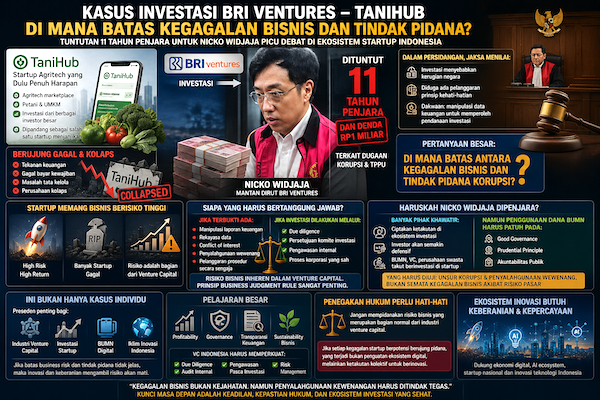
The case seeking an 11-year prison sentence for former BRI Ventures CEO Nicko Widjaja over investments in agritech startup TaniHub has become one of the most controversial cases in Indonesia’s startup ecosystem. Prosecutors allege the investment caused state losses and violated prudence principles. The case emerged after BRI Ventures’ investment in TaniHub — once regarded as one of Indonesia’s most promising agritech startups — ended in failure following financial crisis and collapse. Prosecutors have sought an 11-year prison term and a Rp1 billion fine for Widjaja over alleged corruption and money laundering in the investment management. But the key question now goes beyond Widjaja as an individual. More crucially, where is the line between business failure and criminal corruption? Startups are inherently high-risk ventures. In the global venture capital industry, startup failures are commonplace. Even in Silicon Valley, most startups fail to scale or shut down. Venture capital models are built on high-risk, high-return assumptions. TaniHub was once a notable startup, securing investments from major investors and seen as having significant potential in Indonesia’s agritech sector. Problems arose when the company faced financial pressure, failed to meet obligations, and eventually collapsed. Such failures are not unusual in the startup business context. Hence, many in the tech industry question whether every failed investment decision should automatically be criminalised. Who should be held accountable? The answer is not black and white. If there is proven manipulation of financial reports, data fabrication, conflicts of interest, abuse of authority, or intentional procedural breaches, those involved must face legal consequences. The charges do include allegations of financial data manipulation by TaniHub to secure investment funding. However, if the investment decision was made through due diligence, investment committee approval, internal oversight, and legitimate corporate processes, the case becomes far more complex. Business risk is inherent in venture capital, and the business judgment rule becomes crucial here. Should Nicko Widjaja be jailed? This is a major debate in Indonesia’s startup and investment sector. Many argue that criminalising failed business decisions without clear evidence of malicious intent or abuse of power could create widespread fear in the national startup investment ecosystem. Investors would become overly cautious. State-owned enterprises, venture capital firms, and private companies might hesitate to invest in startups due to perceived high legal risks if the business fails. Yet startup investments are not government bonds or deposits; failure risk is always high. On the other hand, funds tied to state-owned enterprises must adhere to principles of good governance, prudential principles, and public accountability. Thus, the objective test should determine whether corruption and abuse of authority truly existed, or if it was merely business failure due to market risks and poor startup conditions. This is not just an individual case. The Widjaja matter could set a critical precedent for Indonesia’s venture capital industry, startup investments, digital state-owned enterprises, and innovation climate. If the line between business risk and criminal acts remains unclear, the impact on the national technology investment climate could be severe. Especially as Indonesia seeks to build a digital economy, AI ecosystem, national startups, and technological innovation — all requiring risk-taking. The key lesson is that Indonesia’s startup ecosystem can no longer grow with weak governance. During the ‘startup boom’, many investments were made aggressively with high valuations and a ‘growth at all costs’ mindset. But following the global startup correction wave, investors are now more focused on profitability, governance, financial transparency, and business sustainability. Therefore, Indonesian venture capital must strengthen due diligence, post-investment monitoring, internal audits, and risk management. However, law enforcement must also proceed cautiously to avoid criminalising normal business risks inherent in venture capital. Otherwise, the result would not be a strengthened digital ecosystem but collective fear hindering innovation and investment in Indonesia’s technology sector.