
BRI Holds IDR 80 Trillion in SAL Funds, Majority Allocated to Micro Loans
Headline
The overdue payment of dues needs to be realized first while considering the economic conditions.
The overdue payment of dues needs to be realized first while considering the economic conditions.
PT Bank Rakyat Indonesia (Persero) Tbk (BRI) welcomes the extension of the placement of IDR 200 trillion in surplus budget funds (SAL) in banks that are members of the Association of State-Owned Banks (Himbara). This move is considered a positive sentiment for banking liquidity stability and strengthens the transmission of fiscal policy to the real sector.
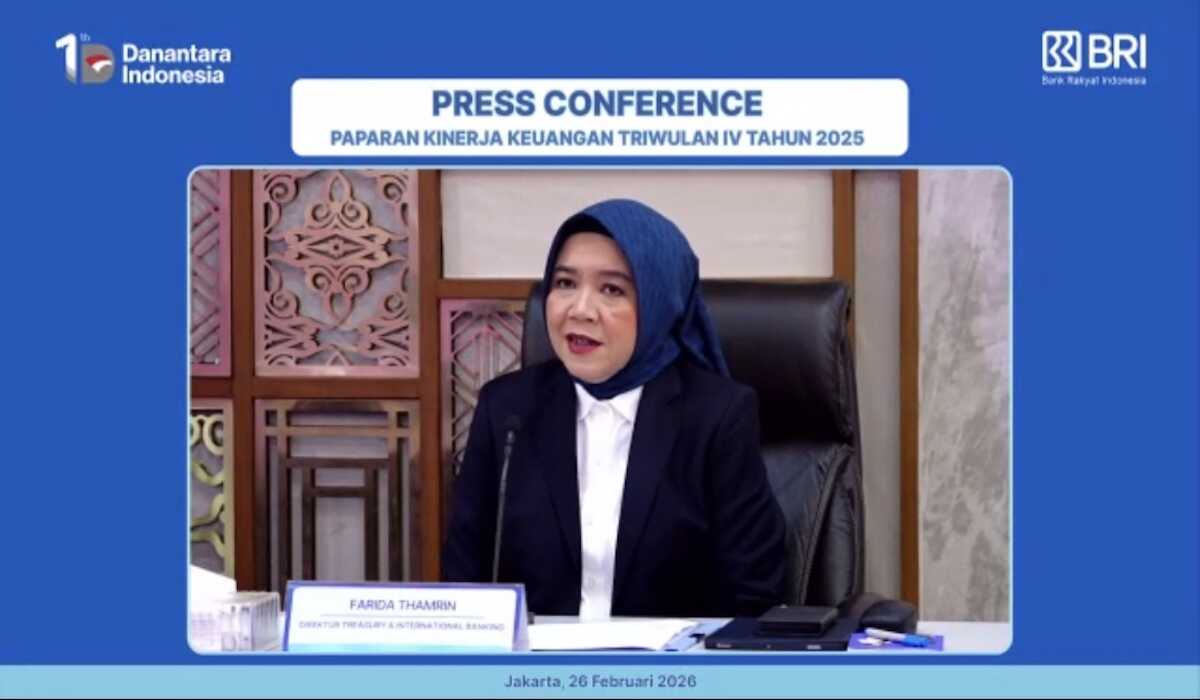
BRI’s Director of Treasury and International Banking, Farida Thamrin, said that the government’s SAL fund placement that will expire at BRI will occur on March 13, 2026. This was conveyed in a virtual press conference for BRI’s Q4 2025 Financial Performance Report, Thursday (February 26).
“We are very happy because there is information from the Ministry of Finance that the placement of government SAL funds will be extended,” she said.
According to Farida, the extension is good news because it strengthens market confidence in maintaining banking liquidity stability. With stable liquidity, the transmission of fiscal policy to the real sector is expected to run more optimally.
“If liquidity stability is maintained, the transmission of fiscal policy to the real sector is also increasingly maintained. So this is a good condition,” she said.
From BRI’s perspective, the total SAL funds received reached IDR 80 trillion. Of this amount, IDR 55 trillion is part of the total IDR 200 trillion placed in Himbara banks. Meanwhile, BRI also received a second-phase placement of IDR 25 trillion, which was short-term and not extended.
Farida explained that the SAL funds have been channeled by BRI in the form of loans to various segments, ranging from micro, small and medium enterprises (MSMEs), consumers, to a small portion of corporations. The largest portion is directed to the micro segment.
“The distribution to the micro sector is almost 50% of the total SAL distribution made by BRI,” she said.
From the economic sector side, loans sourced from SAL reach almost all sectors, especially those directly related to the activities of the real sector. These include agriculture, forestry, fisheries, and other sectors that support national economic growth.
With the extension of SAL, BRI is optimistic that banking credit growth will be even more positive in the future. As of the end of December 2025, BRI’s credit grew 12.3% year-on-year (yoy) to IDR 1,521 trillion, with the largest portion of financing dominated by the MSME segment. This achievement is higher than the national banking credit growth throughout 2025, which was recorded at 9.6% yoy.
However, Farida reminded that the increase in credit distribution is not only determined by liquidity as a supply factor, but also by the quality of demand and the readiness of the real sector.
“Credit growth is largely determined by the quality of demand and the readiness of the real sector. So there are two sides,” she said. (Z-10)
Finance Minister Purbaya Yudhi Sadewa said that the new rules regarding the placement of foreign exchange from natural resource exports (DHE SDA) in Himbara have been completed.
Danantara affirmed his openness to coordinate and consult to strengthen the governance of the Association of State-Owned Banks (Himbara).
The CHANGE in status of Bank Syariah Indonesia (BSI) to a public company is considered to strengthen the bank’s position, especially in terms of credibility and security perception.
FINANCE Minister Purbaya Yudhi Sadewa said that the additional placement of government funds in Himbara banks is sufficient to maintain liquidity and optimal credit transmission.
We live in an era when power no longer appears in palaces or factories, but resides in data servers, logistics networks, and digital code.
The credit growth in November 2025 reached 7.74% year-on-year. Credit quality is also maintained with a gross NPL of 2.21%.
INDONESIA is not short of money. What is lacking is direction. This is not a cyclical symptom or a market sentiment issue, but a structural failure.
Copyright @ 2026 Media Group - mediaindonesia. All Rights Reserved