
Breathing Life into Letters Through the Touch of the Braille Qur’an
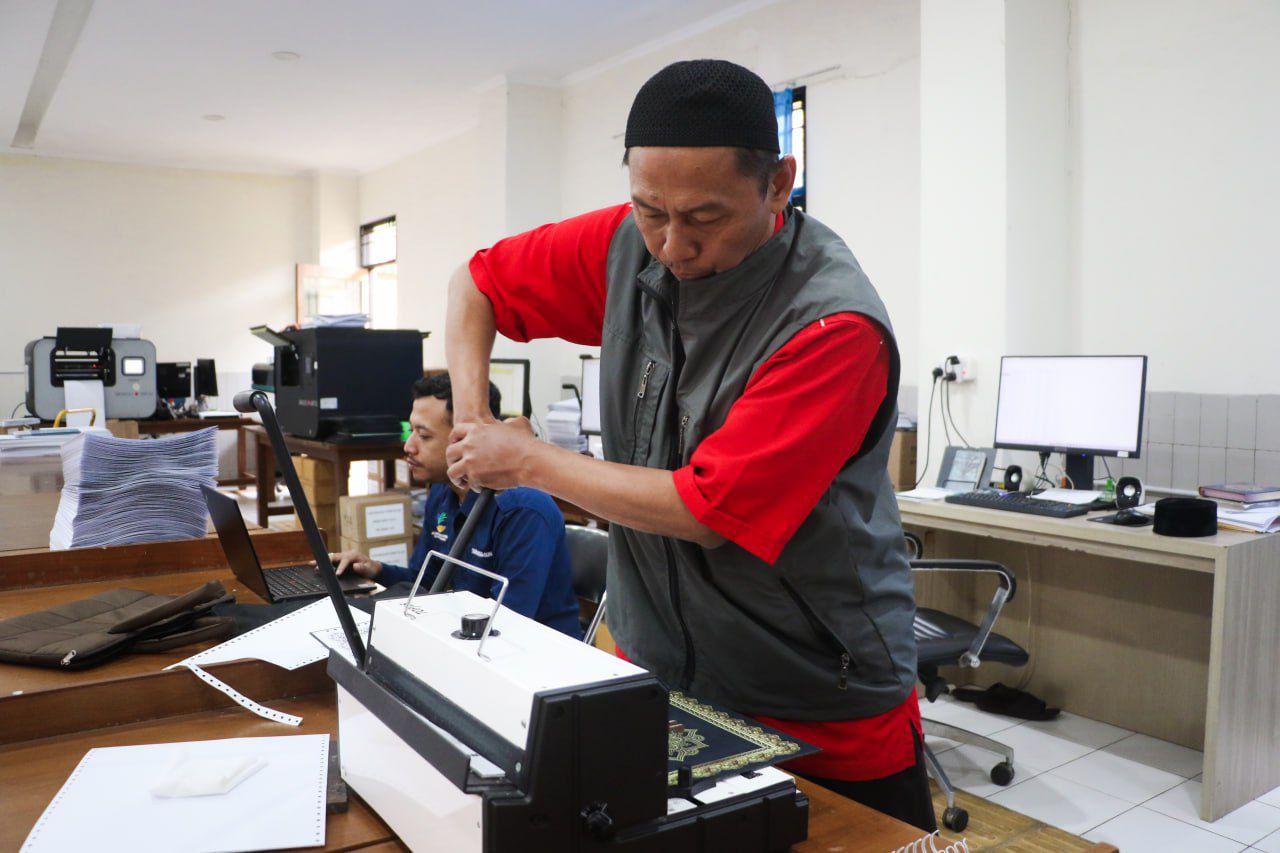
A long process stands behind the Qur’ān Braille read by visually impaired readers, from Braille translation, editing to printing, all carried out with patience by workers at a Braille-focused printing house. Sutiadi, a translator and Braille printer who has worked for three years, explains that the team moved from Sentra Abiyoso Cimahi to the current site. ‘Earlier I was at Abiyoso, but production moved here with the team,’ he said. In the production process, Sutiadi notes that printing the Qur’ān Braille already has an official master from the Ministry of Religious Affairs. Production therefore involves printing, duplicating and binding. For general Braille books, a worker can usually print around 30 copies in a day; for Braille Qur’ān the work is far larger and more complex. ‘In a year, the print house produces around 50 sets of Braille Qur’āns. Each set comprises 30 volumes, bringing total annual output to about 1,500 books. A Braille Qur’ān cannot be a single book: one juz is one book, so a set contains 30 books and often fills two large crates,’ he explained. Setiadi notes that although the process appears straightforward, challenges persist, especially with the printing machines. Sometimes printed Braille dots are imperfect, with missing or excess dots; ‘even if the screen is correct, printing may miss or add a dot. It must be rechecked and corrected,’ he added. He added that the Qur’ān Braille produced at the printing house is distributed across Indonesia, from west to east, and demand often comes from various organisations of the visually impaired. In addition to Qur’ān, the printer also produces other holy books in Braille, such as the Bible, with yearly production adjusted to demand. Last year the Qur’ān comprised 70 sets, the Bible three sets. This year the Qur’ān is 50 sets, and the Bible 20 sets. ‘The printing process is supported by more than ten Braille printing machines, most of which come from Norway. In the printing section there are about ten workers directly involved in producing the Braille books. Before printing, an equally crucial stage is the master editing process,’ he asserted. Hendra Kusumah, an editor since 2017, says his job is to ensure the manuscript is correct before printing. Editing goes beyond reading: it involves checking every detail, including letters, punctuation and sentence structure. ‘When reading normally you merely read. But when editing you must slow down, paying attention to commas, periods and capital letters, all of which must be correct,’ he noted. Editing the Qur’ān Braille can be very time-consuming; checking the master for 30 juz can take years. However, the master is now available, so the emphasis is on updates. ‘Usually every two years there is a review to align with the latest mushaf standard. If reading-harm symbols need to be added or adjusted, they are updated to align with the Qur’an itself,’ he added.