
Breaking! Rupiah Under Pressure, US Dollar Breaches Rp17,210
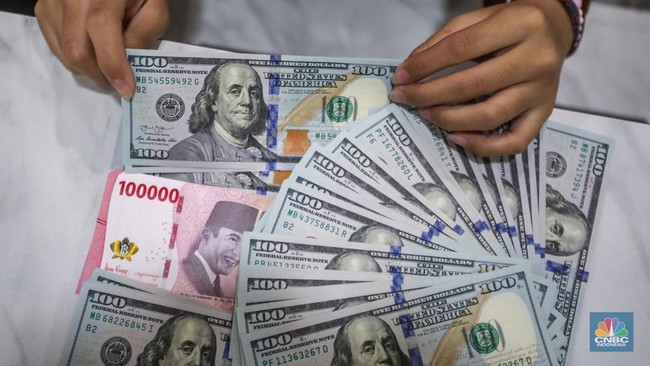
The rupiah exchange rate opened weaker against the US dollar on Thursday morning’s trading session (23/4/2026). According to Refinitiv data, the Garuda currency began trading in the red zone with a 0.23% correction to the level of Rp17,210/US.Thislevelmarkstherupiahbreachinganewpsychologicalthresholdandsimultaneouslyrecordinganewall − timeintradaylow.ThisweakeningfollowstheprevioussessiononWednesday(22/4/2026), whentherupiahcloseddown0.18. Meanwhile, the US dollar index (DXY) was observed moving steadily at 98.591 at 09:00 WIB, after strengthening 0.20% to 98.590 at the previous close. The rupiah’s movement today is still expected to be influenced by a combination of external and domestic sentiments. Externally, the strengthening of the US dollar over the past two days indicates that market participants are still inclined to chase safe-haven assets, thus limiting room for other currencies, including the rupiah, to strengthen. The US dollar is strengthening amid market concerns over the ongoing US-Israel war with Iran. Sentiment is also influenced by US President Donald Trump’s decision to extend the ceasefire to give Tehran more time to prepare a proposal to end the conflict. However, Iran has seized two ships in the Strait of Hormuz, reigniting uncertainty in the global energy market. Domestically, market participants are also monitoring Bank Indonesia’s (BI) latest steps to maintain rupiah stability. One of them is the reduction of the cash foreign currency purchase threshold, particularly for the US dollar, from US$100,000 to US$50,000 per person per month. BI Deputy Governor Thomas Djiwandono stated that the policy is starting to show results. “Since 17 April 2026, there has been a decrease in the average daily spot transaction volume from US$78 million to US$60 million,” he said during the Bank Indonesia Board of Governors’ Meeting announcement, quoted on Thursday (23/4/2026). In addition, BI has raised the threshold for selling Domestic Non-Deliverable Forward (DNDF) and swaps from US$5 million to US$10 million per transaction. BI Governor Perry Warjiyo is confident that this policy can suppress foreign exchange spot transactions, thereby supporting rupiah exchange rate stability. “We are confident that going forward it will be even more effective so that spot purchase transactions must have an underlying. I can add that the underlying, which was previously 89.2%, is now 93.5% of spot transactions with underlying,” he said in the BI RDG announcement.