
Breaking News! IHSG Plummets This Morning, Opens Down 1.33%
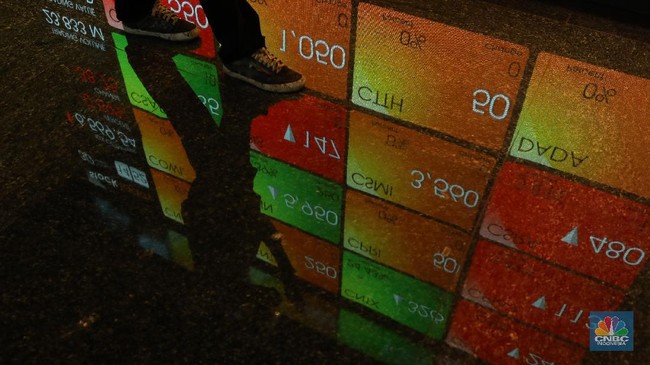
Jakarta, CNBC Indonesia — The Composite Stock Price Index (IHSG) plummeted this morning, on Monday (13/4/2026). The index opened down 99.01 points or 1.33% to the level of 7,359.49.
A total of 360 stocks declined, 147 rose, and 452 remained unchanged. The value of transactions this morning reached Rp 667.4 billion, involving 1.41 billion shares in 116,900 transactions.
Market capitalisation was also eroded to Rp 13,000 trillion.
The IHSG correction this morning aligns with the still unstable geopolitical situation. President Donald Trump stated on Sunday that the US would blockade the Strait of Hormuz after talks held in Pakistan to end the Iran war reached a deadlock.
“Effective immediately, the United States Navy, the best in the world, will begin the process of BLOCKADING every ship attempting to enter or exit the Strait of Hormuz,” Trump said in a post on his social media platform, Truth Social. “The blockade will begin soon. Other countries will join in this blockade. Iran will not be allowed to profit from this illegal extortion.”
The U.S. Central Command stated in a post on X on Sunday evening that the US military would begin implementing the blockade on Monday at 10 a.m. Eastern Time. CENTCOM said additional information would be provided to commercial ships before the blockade begins.
They added that the US would not impede ships transiting to and from non-Iranian ports. The blockade would only apply to ships entering or exiting Iranian ports or coastal areas, including all Iranian ports in the Arabian Gulf and Gulf of Oman.
The US blockade announcement has shattered hopes that the war would end in the coming days after peace talks in Islamabad. This move also threatens to worsen the economic crisis gripping the global economy since the war broke out and Iran began restricting access to the strait, a narrow passage through which about one-fifth of the world’s oil flows.
Trump said the US blockade aims to stop Iran from controlling the strait and gaining economic benefits while the world suffers from its closure.
Trump also announced that the US Navy would search and intercept any ship in international waters that has paid tolls to Iran.
Iran is reportedly preparing to impose tariffs on ships wishing to pass through the strait, a move that provoked Trump’s anger as Iran seeks to strengthen its control over the route amid a two-week ceasefire in the conflict.
The Pakistan-mediated peace talks collapsed because, according to the US, Iran was unwilling to stop its efforts to acquire nuclear weapons. Iran’s demands include control over the Strait of Hormuz, war reparations payments, and a ceasefire across the region, including in Lebanon, according to Iranian state television and officials. Iran also demands the release of its frozen assets abroad.
The US delegation, led by Vice President JD Vance, met with Iranian and Pakistani negotiators for more than 21 hours in the rare face-to-face meeting.
The war and the near-total closure of the strait have placed significant pressure on oil prices and the global economy. Markets have been volatile throughout the conflict, with oil prices surging above US$100 per barrel at one point.
Domestically, the first agenda comes from the release of Bank Indonesia’s Retail Sales Survey on Monday (13/4/2026). This data is often one of the fastest indicators to read household consumption behaviour.
Bank Indonesia previously projected the Real Sales Index (IPR) for February 2026 to grow 6.9% year-on-year, higher than January’s 5.7% growth. On a monthly basis, retail sales are also forecast to rise 4.4%, reversing January’s 2.7% contraction.
The increase is mainly supported by public demand during Ramadan and preparations for the National Religious Holiday of Eid al-Fitr. The groups of spare parts and accessories, household equipment, and clothing are said to be the main supports.
The market will monitor whether the consumption surge is merely seasonal or reflects genuinely strengthening purchasing power. This is important because household consumption remains the backbone of Indonesia’s economic growth.