
Breaking News! IHSG Opens Up 1% This Morning
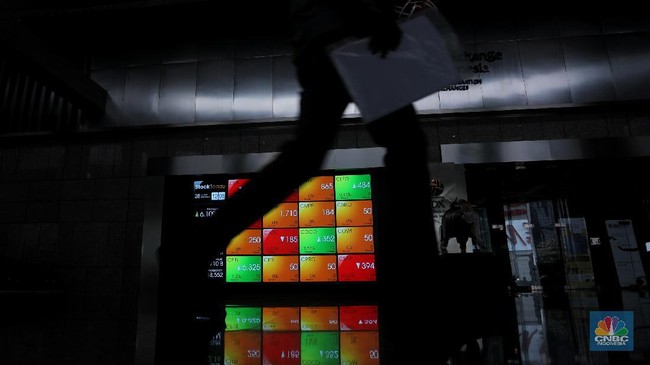
Jakarta, CNBC Indonesia — The Composite Stock Price Index (IHSG) began this week in positive territory on Monday (27/4/2026). The IHSG opened up 71.53 points or 1% at the level of 7,201.02. A total of 374 stocks rose, 189 fell, and 396 remained unchanged. Trading value was recorded at Rp1,956.7 billion, involving 1.56 billion shares in 119,500 transactions. Market capitalisation also rose to Rp12,883 trillion. Indonesia’s financial markets will operate for only four days this week, from Monday to Thursday, due to the Labour Day holiday on 1 May, or this coming Friday. The main focus of the market this week is on the latest developments in US-Iran negotiations, the Federal Reserve’s interest rate decision, the release of US PCE inflation data, US and China manufacturing data, and the Bank of Japan’s interest rate decision. The market expects the Fed to hold its benchmark interest rate in the range of 3.50%-3.75%. This expectation arises because US inflation remains above target, while the surge in energy prices due to Middle East conflicts makes it difficult for the US central bank to move too quickly to ease policy. The Fed’s decision this time will be very important for global markets. If the Fed signals that it will hold interest rates longer, the US dollar could remain strong. This condition could once again pressure Asian currencies, including the rupiah. Conversely, if the Fed’s statement begins to sound softer by considering the risks of economic slowdown, the market could interpret it as an opportunity for rate cuts in the following semester. This scenario could provide room for strengthening bonds and risk assets, including stocks in emerging markets. Meanwhile, market hopes for a diplomatic breakthrough are fading after US President Donald Trump cancelled the visit of two of his envoys to Pakistan at the weekend. Citing Reuters, Trump cancelled the planned visit of Steve Witkoff and Jared Kushner to Islamabad on Saturday (25/4/2026). This decision is a new blow to peace prospects after Iran’s Foreign Minister Abbas Araqchi left Pakistan without signs of any breakthrough in talks. Trump said the visit plan was cancelled because the talks in Islamabad were deemed to take too much travel and cost. He also stated that Iran’s latest offer was not good enough for the US. Iranian President Masoud Pezeshkian even told Pakistani Prime Minister Shehbaz Sharif that Tehran would not enter into forced negotiations under threat or blockade. Pezeshkian also emphasised that the US must first remove operational barriers, including the blockade on Iranian ports, to create a basis for resolving the issue. This situation shows that Washington and Tehran are still at an impasse. Iran is still closing most access in the Strait of Hormuz, a route that under normal conditions carries about one-fifth of global oil and liquefied natural gas shipments. On the other side, the US is still blocking Iranian oil exports. The stalemate in diplomacy keeps geopolitical risks high. The conflict that began with US-Israel airstrikes on Iran on 28 February 2026 has driven energy prices to their highest levels in several years, triggering inflation concerns and worsening global growth prospects.