
Breaking News! IHSG Falls 3%, Touches 7,100 Level
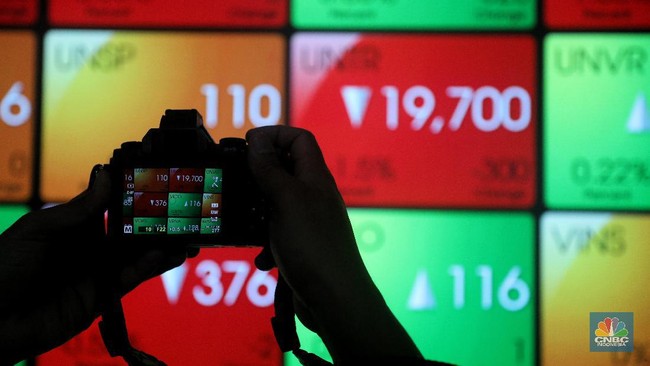
Jakarta — Indonesia’s Composite Stock Index (IHSG) fell sharply deeper towards the end of afternoon trading on Friday, 13 March 2026. At 15:20, the IHSG closed down 3% at the 7,141.46 level.
A total of 671 shares declined, 103 advanced, and 184 remained unchanged. Transaction value reached Rp 10.98 trillion, involving 21.51 billion shares across 1.33 million transactions.
The IHSG had previously dropped 1.81% or -133.18 points to 7,228.94 at the close of morning trading on Friday, 13 March 2026. Since the opening, the IHSG had consistently remained in negative territory with notably high volatility.
Bumi Resources (BUMI) registered the highest transaction value in the regular market. However, on an overall basis, XLSmart Telecom Sejahtera (EXCL) recorded the highest transaction value at Rp 800 billion conducted in the negotiated market.
According to Refinitiv data, all sectors were in the red. Raw materials declined the most at -2.94%, followed by utilities at -2.78% and non-essential consumer goods at -2.76%.
The heaviest drags on the index were Amman Mineral (AMMN) with a weighting of -12.89 index points, Bank Mandiri (BMRI) dragging the IHSG down by -10.87 index points, and Barito Renewables Energy (BREN) by -7.4 index points.
Market participants remained anxious over oil supply stability amid ongoing tensions between Iran and the United States and Israel, with concerns that the conflict could be prolonged. Oil prices have surged more than 38% in less than two weeks due to serious threats to global supply routes.
Brent crude oil reached USD 100.72 per barrel, whilst West Texas Intermediate (WTI) stood at USD 95.37 per barrel.
This surge was driven by attacks on two oil tankers and an oil port facility in Iraqi waters, triggering concerns over navigation security in the Strait of Hormuz. Iran’s military has even issued warnings that oil prices could spike to USD 200 per barrel.
In separate developments, amid large-scale military operations conducted by the United States and Israel, US intelligence indicates that Iran’s current government leadership structure remains intact and is far from the risk of collapse. The report confirms that the regime in Tehran maintains full control over its population.
The position of Supreme Leader has also been succeeded by Khamenei’s son Mojtaba to maintain stability. Meanwhile, Iranian Kurdish militia groups had offered rebel assistance, but this option was rejected by President Donald Trump due to intelligence doubts about their weaponry capacity.
According to the latest reports, Mojtaba explained in his first public address since becoming Iran’s Supreme Leader that the Strait of Hormuz must remain closed, implementing this as a tool to pressure adversaries.