
Breaking: IHSG Surges 2.75% in Response to Middle East War News
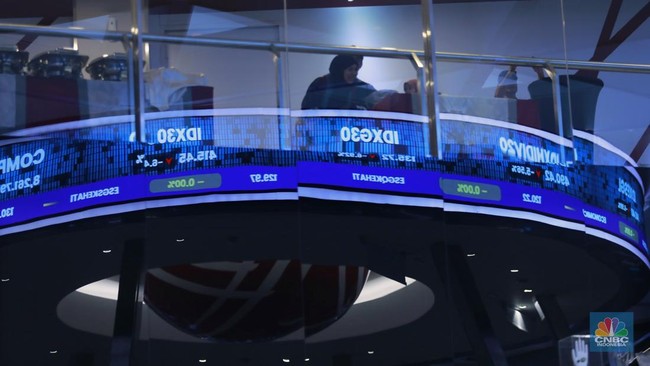
Jakarta, CNBC Indonesia - The Composite Stock Price Index (IHSG) opened strongly, surging 2.75% this morning, Wednesday (8/4/2026). The index rose to the level of 7,162.41, strengthening by 191 points.
Sixty-nine stocks declined, 351 rose, and 210 remained unchanged. The transaction value reached Rp 5,554.24 billion, involving 846 million shares in 42,676 transactions.
Market capitalisation was also pulled higher to Rp 12,573 trillion.
Financial market participants today will face several sentiments, from domestic to international. Developments in the war, particularly the Trump deadline, will be one of the main focuses of the market today.
Asia-Pacific stock markets strengthened on Wednesday (8/4/2026) after US President Donald Trump stated that he had agreed to suspend plans for strikes on Iranian infrastructure for two weeks. This decision was made on the condition that Iran agrees to the full, immediate, and safe opening of the Strait of Hormuz.
According to CNBC, in his statement on Truth Social, Trump emphasised that the agreement depends on Iran’s commitment to opening that vital route. He described the move as an effort to ease geopolitical tensions that previously triggered global market concerns.
Iranian Foreign Minister Abbas Araghchi, via a post on platform X, stated that Iran’s armed forces would halt their defensive operations. He also added that safe passage in the Strait of Hormuz could be coordinated with Iran’s military over the next two weeks.
In response to the news, the price of US West Texas Intermediate crude oil plummeted more than 16% to $94.23 per barrel. This sharp decline reflects the easing of concerns over global energy supply disruptions.
Significant gains occurred in Asian markets, with South Korea’s Kospi index jumping 5.3% and Kosdaq rising 3.4%. Blue-chip stocks such as Samsung Electronics and SK Hynix surged 7.25% and 9.2%, respectively.
In Japan, the Nikkei 225 index strengthened by 4.5%, while the Topix rose 3.2%. Meanwhile, Australia’s S&P/ASX 200 index also climbed 2.7%, reflecting widespread positive sentiment in the region.
Hong Kong’s market is also expected to strengthen after the holiday, with Hang Seng futures at 25,233 compared to the previous close of 25,116.53. This indicates investor optimism regarding short-term geopolitical stability.
Josh Rubin, portfolio manager at Thornburg Investments, stated that the decline in energy prices could help press down global inflation. This condition is seen as opening opportunities for central banks to consider easing interest rate policies.
In the United States, major index futures also strengthened, with the Dow Jones up 1.5%, the S&P 500 adding 1.6%, and the Nasdaq 100 gaining 1.7%. This positive sentiment aligns with the easing of geopolitical tensions and falling energy prices.
In the previous trading session, the S&P 500 rose slightly by 0.08% to 6,616.85, and the Nasdaq Composite added 0.10% to 22,017.85. Meanwhile, the Dow Jones Industrial Average fell 0.18%, or 85.42 points, to 46,584.46.
In addition, global attention will also focus on the release of the Federal Reserve’s FOMC Minutes. This document will provide deeper insights into the views of US central bank officials on the economic situation, inflation, and future policy direction.
Markets will dissect every detail in those minutes, particularly regarding how the Fed assesses the impact of the surge in energy prices due to geopolitical conflict.
Furthermore, on the same day, markets will also monitor Personal Consumption Expenditures (PCE)-based inflation data released by the Bureau of Economic Analysis. This indicator is the Fed’s primary gauge for measuring inflationary pressures.
In the latest release, for January 2026, the PCE price index rose 0.3% monthly and 2.8% annually.
Meanwhile, core PCE rose 0.4% monthly and 3.1% annually. This data is important because core PCE is considered to provide a cleaner picture of underlying inflation trends in the US, making it highly watched in determining interest rate directions.
What will be announced is the February 2026 data. Market participants expect core PCE to grow around 3.0% annually, slightly lower than 3.1% in January. Nevertheless, markets will still look to see if price pressures are persisting longer amid the global energy cost surge.