
Breaking! IHSG Slumps 1.48% as Gold-Mining Stocks Drag on the Index
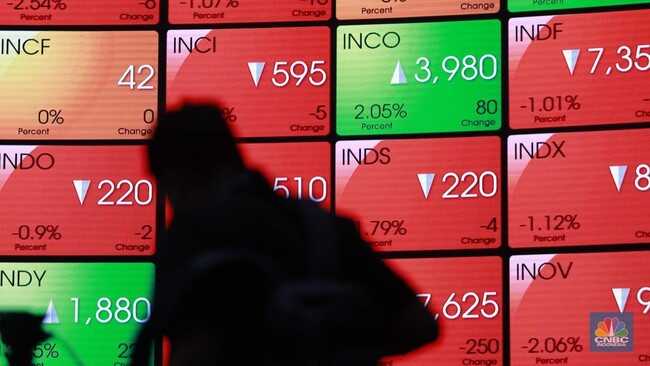
Jakarta, CNBC Indonesia — The Jakarta Composite Index (IHSG) opened weaker by 43.39 points, or 0.55%, at 7,896.38 at the start of this morning’s trading on Wednesday, 4 March 2026. The morning losses extend the sharp correction seen yesterday when the IHSG fell 0.96%, after a 2.65% slide two days earlier.
A total of 191 shares declined, 181 advanced, and 261 were unchanged. The morning turnover reached Rp 393.93 billion, involving 881.49 million shares in 44,962 transactions.
A minute after the market opened, the IHSG declined further, down 1.48%.
BUMI, GOTO and BMRI were the most actively traded stocks this morning; all three were down. The gold mining stocks collectively weakened and weighed on IHSG’s morning performance.
Indonesia’s financial markets are expected to remain under pressure, particularly from overseas. The Iran conflict and the closure of the Strait of Hormuz increase global uncertainty.
Domestically, Eid al-Fitr stimulus is expected to act as a positive catalyst today.
Ahead of Idul Fitri 1447 H, the government rolled out a series of policies to safeguard purchasing power and spur growth in Q1-2026.
The main instrument is the disbursement of Tunjangan Hari Raya (THR) for civil servants and private sector workers, accompanied by Bonus Hari Raya (BHR) for online ride-hailing driver partners, plus additional stimuli such as transport discounts and food aid.
For civil servants, THR has begun to be disbursed in phases since 26 February 2026. Coordinating Minister for Economic Affairs Airlangga Hartarto emphasised that the THR components are paid in full 100%, covering basic salary, family allowances, food allowances, and position or performance allowances in line with regulations.
The government has prepared a Rp55 trillion budget, up about 10% from last year, allocated to 2.4 million central government staff and the Armed Forces/Police (TNI/Polri) (Rp22.2 trillion), 4.3 million regional civil servants (Rp20.2 trillion), and 3.8 million pensioners (Rp12.7 trillion). He also stressed that THR differs from the ‘gaji ke-13’ (thirteenth salary) which will be paid separately in June 2026.
Also domestically, the Financial Services Authority (OJK) revealed the latest important developments in its efforts to meet the demands of global index providers MSCI.
OJK said regulators and self-regulatory organisations have updated disclosures on shareholder data for holders of more than 1% ownership that must be reported as public information. For the first time, KSEI disclosed investor shareholdings above 1% as of 27 February 2026, reported yesterday on Tuesday 3 March 2026.
Next, OJK stated that the reclassification of shareholders from 9 investor types to 27 types is being pursued by KSEI and Exchange Members (AB), and current progress has reached 94%.
Regarding the increase in the minimum free float from 7.5% to 15%, OJK said the process is still being carried out internally at BEI and will subsequently be approved by OJK so it can be implemented soon.
Finally, OJK said it will introduce a shareholder concentration list, which will help investors assess concentration risk and the difficulty in obtaining the specified shares in the market.
Meanwhile, the South Korea Kospi index fell 7.24% on Wednesday, continuing the sharp sell-off from the previous day when it posted its worst drop in 19 months, amid widening Middle East conflict.
Investors in the Asia-Pacific region will also be watching the annual policy meetings of Chinese policymakers, known as the ‘Two Sessions’, starting that day. The meetings comprise the Chinese Communist Party’s policy discussions, with Premier Li Qiang expected to announce a series of economic targets at the National People’s Congress, most of which were decided at the December meeting.
The S&P/ASX 200 Australia started the day down 1.81%. The Nikkei 225 in Japan shed 1.59%, with Topix down 1.61%.
Hong Kong Hang Seng index futures stood at 25,448, below the last close of 25,768.08.
Oil prices continued to rise, with US West Texas Intermediate (WTI) crude up 0.87% to $75.21 a barrel, and Brent up 5.43% to $81.96 a barrel amid widening conflict, with Iran seeking to close the Strait of Hormuz.
A senior commander of Iran’s Revolutionary Guards said the strait had been closed and warned that any ship attempting to pass through would be targeted, according to Iranian media.
U.S. President Donald Trump said on Tuesday afternoon that the U.S. Navy would escort tankers through the Strait of Hormuz if necessary.
“Whatever happens, the United States will ensure the flow of energy is UNRESTRICTED to the World,” he wrote in a Truth Social post. “The ECONOMIC and MILITARY POWER of the United States is the GREATEST ON EARTH - Further actions will follow.”
Last night in the U.S., the stock market again experienced a volatile session amid concerns over the prolonged U.S.–Iran conflict that rattled markets.
The Dow Jones Industrial Average fell 403.51 points, or 0.83%, to close at 48,501.27. The S&P 500 declined 0.94% to 6,816.63, while the Nasdaq Composite dropped 1.02% to 22,516.69. At its intraday low, the S&P 500 was down by as much as 2.5%, and the Nasdaq fell around 2.7%. The Dow finished with losses of more than 1,200 points, about 2.6%, from its intraday low.