
Breaking: IHSG Opens Up 0.32% This Morning
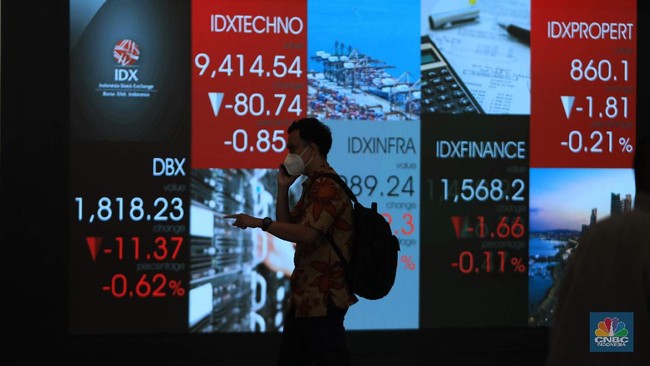
Jakarta, CNBC Indonesia — The Composite Stock Price Index (IHSG) strengthened modestly this morning, Friday (17/4/2026). The index opened up 24.43 points or 0.32% to the level of 7,645.81.
A total of 284 stocks rose, 55 fell, and 620 remained unchanged. The value of transactions this morning reached Rp 176.1 billion, involving 360.9 million shares in 42,490 transactions. Market capitalisation also rose to Rp 13,625 trillion.
Today marks the final trading day of the week, with market participants facing a series of crucial fundamental and geopolitical sentiments.
External dynamics coloured by tensions in the Middle East region, anomalies in the US derivatives market, and the release of Chinese macroeconomic data will be the main driving factors.
Leaders from Israel and Lebanon have agreed to a 10-day ceasefire following a meeting between officials from both countries in Washington.
The temporary ceasefire will begin at 5:00 p.m. Eastern Time (ET), Trump stated in a post on Truth Social.
In a follow-up post, Trump added that he would invite Israeli Prime Minister Benjamin Netanyahu and Lebanese President Joseph Aoun to the White House for “the first meaningful talks between Israel and Lebanon since 1983, a very long time.”
“Both sides want to see PEACE, and I am confident it will happen, quickly!” Trump wrote, quoted from Reuters.
The US State Department, in a statement released Thursday evening, said both countries will work to create conditions supporting long-term peace between the two nations, full recognition of each other’s sovereignty and territorial integrity, and building real security along their shared border, while maintaining Israel’s inherent right to self-defence.
In a separate development, oil tanker shipping traffic in the Strait of Hormuz has begun to show movement, although conditions remain far below normal capacity amid ongoing geopolitical tensions.
Based on maritime movement data, several very large crude carriers (VLCCs) have been observed transiting the area.
One of them is the RHN vessel, with a carrying capacity of around two million barrels of crude oil and an estimated cargo value of US$160 million, as well as the Alicia vessel heading towards the Persian Gulf.
Despite the movement activity, overall shipping volume has plummeted by up to 90% compared to normal conditions before the conflict erupted.
Amid these restrictions, US President Donald Trump claimed that his side has permanently opened the Strait of Hormuz. This policy is said to be the result of an agreement with China, where Beijing has agreed to no longer send arms supplies to Iran.
Domestically, amid global uncertainty, positive sentiment is flowing for the domestic economy after rating agency Standard & Poor’s decided to maintain Indonesia’s credit rating at BBB with a stable outlook.
Finance Minister Purbaya Yudhi Sadewa explained that S&P appreciates the Indonesian government’s commitment to maintaining fiscal discipline, particularly efforts to keep the budget deficit below 3% of GDP.
Based on the latest audit results, the fiscal deficit was realised lower at 2.8%. Another factor boosting the rating agency’s confidence is the improved performance in state revenue collection.
Tax revenue performance, which grew by up to 30% in the first two months of this year, is seen as a positive result from the restructuring of tax and customs organisations.
Nevertheless, the ministry acknowledges particular attention from S&P regarding the debt interest payment ratio to revenue, which is above 15%, and this indicator will continue to be monitored.
“They (S&P) asked in detail about our fiscal condition, including this year’s and last year’s deficit; mainly they want to see if we are consistent in keeping it below 3% of GDP,” he explained.
“I said we are consistent with that policy; President Prabowo has directed that our deficit be kept below 3%,” Purbaya clarified.
According to Purbaya, there is slight concern from S&P regarding debt payments to revenue or taxes. Purbaya immediately explained that this can be controlled going forward and is not yet at a dangerous level, given improvements in tax and excise collection.
Organisational restructuring steps for the Directorate General of Taxes and Directorate General of Customs have also been carried out to improve their performance.
“And when we told them that tax growth this year for the first two months is 30% and from January to March compared to last year it grew 20%, they seemed quite satisfied,” Purbaya said.