
Breaking Fast at the Indonesian Embassy: A Cherished Moment During Ramadhan in Beijing
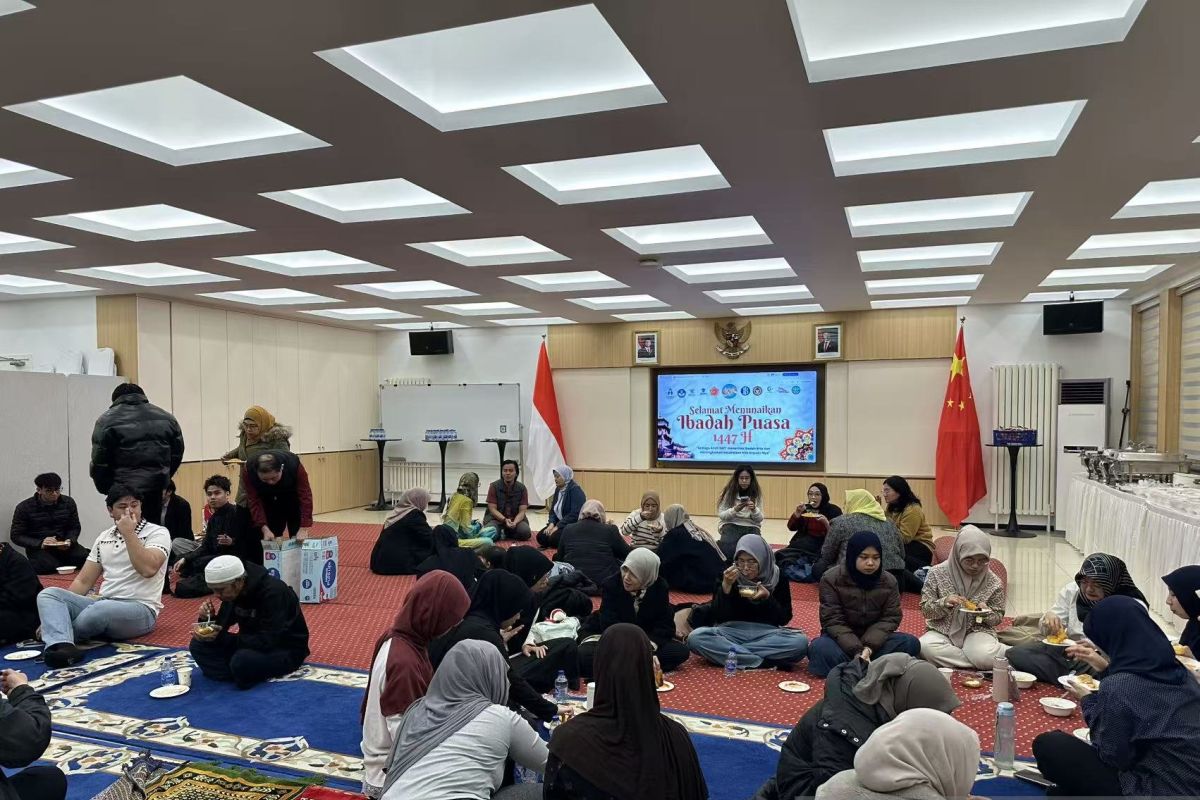
Beijing – Breaking fast together, listening to brief religious talks and performing evening prayers in congregation each day during Ramadhan 1447 Hijriah at the Indonesian Embassy in Beijing has become an eagerly awaited moment for the Indonesian diaspora.
“Praise be to God, this iftar programme at the Embassy has been tremendously helpful for me personally. Beyond strengthening bonds, I get to meet Indonesian friends, speak Indonesian and enjoy Indonesian food again,” said Irham Tanjung Fadilah, a man from Medan currently working at China National Petroleum Company, speaking at the Embassy hall on Friday (13 March).
Irham, experiencing Ramadhan in China for the first time, is also the first foreign staff member and Muslim at his company. He has had to explain the concept of fasting to his colleagues so they can support him during his religious observance.
“I explained that I don’t eat or drink from morning until evening and mentioned that many religions have fasting practices – they were surprised. I also explained how fasting is beneficial for health because it removes toxins from the body,” Irham added.
Beyond his tolerant and supportive work environment, Irham is grateful he can perform his daily prayers at the office – whether in unused conference rooms or the sports facility. “Every time I pray, they don’t make noise. Sometimes, if they’re alone when I’m praying in a room, they’ll leave to give me space,” he said.
He plans to celebrate his first Eid al-Fitr in Beijing and perform the Eid prayer at the Embassy whilst reconnecting with other Indonesians in China.
Another participant in the iftar gathering and evening prayers is Malikah Kautsar Ilmi, a postgraduate student at Beijing Normal University. “I pray tarawih at the Embassy because the tarawih at local mosques are usually rushed with repeated Qur’anic recitations. At the Embassy, tarawih consists of eight units with more diverse Qur’anic readings,” Malikah explained.
This is Malikah’s third Ramadhan in Beijing, and she notes that both her professors and classmates support her fasting. “Once I had to present during fasting. I informed my professor beforehand that I was fasting and requested understanding if I seemed a bit weak during the presentation. He said there was no problem,” she said.
Her classmates also support her by providing snacks and drinks when she breaks her fast during classes. Her thesis advisor even deliberately chose a halal restaurant when meeting so she could eat comfortably.
“Although China is a communist country, Malikah feels the Chinese people are welcoming towards Muslims because the second-largest ethnic minority in China – the Hui people – are native to China, practise Islam and are scattered across various regions,” she added.
Malikah, who serves as secretary of the Beijing Study Circle, has increased her Qur’anic recitation during Ramadhan and volunteered in preparing for the Eid prayer celebrations at the Embassy. “I’m also planning to buy new clothes to celebrate Eid during my final year as a student in Beijing,” Malikah said.
The iftar gatherings have been held daily from 24 February 2026 to 19 March 2026, attended by approximately 40–70 Indonesian citizens. The meals feature various Indonesian dishes including ketoprak, fried snacks, bakwan malang, nasi uduk, yellow rice, Bandung vegetable soup, braised chicken, vegetable curry, eggs, white rice, prawn crackers and other Indonesian specialities.
To conclude the Ramadhan observances, the Indonesian Embassy plans to hold Eid al-Fitr prayers at the Embassy grounds on Saturday, 21 March 2026 at 08.45 local time. Following this, the Indonesian Ambassador to China and Mongolia, Djauhari Oratmangun, will hold an open house at the Embassy compound.