
Brace Yourself: Prabowo to Present a 'Candidate' for the 2027 APBN, BI Rate Up Today?
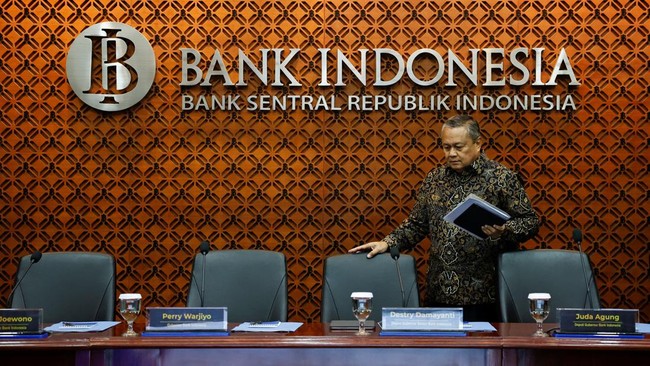
The Jakarta Composite Index (IHSG) collapsed, and the rupiah again posted the weakest closing level in history, while the yield on 10-year government bonds began to ease.
Market volatility in Indonesia is expected to colour trading today, Wednesday (20 May 2026). Details of today’s market outlook can be read on page 3 of this article.
The IHSG closed at 6,370.68 on trading Tuesday. The index fell by 228.56 points or 3.46%. This level marked the IHSG’s lowest close in the past year.
Over the course of trading, 647 stocks finished in the red zone. Only 117 rose, while 195 were flat.
Activity in trading was fairly brisk. The value of trades reached Rp25.71 trillion, with 43.29 billion shares changing hands in 2.77 million transactions.
Meanwhile, foreign investors were net buyers amounting to Rp260.1 billion.
However, the heaviest drag on the IHSG came from PT Bank Central Asia Tbk (BBCA). BBCA shares fell 2.86% and contributed around 16.39 points to the IHSG.
Additionally, stocks that were deleted from MSCI, such as Dian Swastatika Sentosa Tbk (DSSA), Chandra Asri Pacific Tbk (TPIA) and PT Amman Mineral International Tbk (AMMN), also weighed on the index. DSSA contributed around 11.46 points of pressure, TPIA about 11.16 points, and AMMN about 8.51 points.
TPIA and DSSA even hit the lower auto-reject bound (ARB) or fell by 15%. AMMN approached the ARB zone before closing lower.
From the currency market, the rupiah ended the session weaker against the United States dollar (US$) on Tuesday (19 May 2026).
Refinitiv data show the rupiah closed down 0.31% at Rp17,695/US.WhilemovingawayslightlyfromtheRp17, 700/US area, this level remains an all-time closing low for the rupiah.
Rupiah weakness had been visible since the session’s start. At the opening, the rupiah opened down 0.06% at Rp17,650/US.Pressurethendeepened, withtherupiahbreakingthepsychologicalRp17, 730/US level in intraday trading.
The rupiah’s weakness also prompted a government response. Finance Minister Purbaya Yudhi Sadewa confirmed that the pressure on the rupiah’s exchange rate against the US dollar is not yet too severe.
For the time being, the government is still relying on funds from the APBN to manage sentiment in the government securities market, with around Rp2 trillion per day.
Purbaya explained that the government will only use the Bond Stabilization Fund (BSF) scheme if market pressure is much heavier. The scheme also involves a public service body (BLU) under the Ministry of Finance.
“This is just cash management. If the framework, I will call SMV and others to participate. But for now it is not that serious; the situation remains relatively reasonable,” Purbaya said at his office in Jakarta, on Tuesday (19 May 2026).
Of the Rp2 trillion set aside per day to stabilise sentiment in the bond market, Purbaya noted that only about Rp600 billion had been absorbed for SBN intervention so far.
According to Purbaya, that amount indicates selling pressure in the SBN market is not yet large.
From the bond market, the 10-year SBN yield closed down 1.05% to 6.779% on Tuesday’s trading.
The yield decline indicates prices in SBNs are rising due to demand in the bond market. This eased some of the pressure in the government securities market, though overall the domestic financial market remains under the shadow of rupiah weakness, the IHSG correction, and expectations around BI’s rate decision.
The US stock market, Wall Street, closed lower on Tuesday or early Wednesday in Indonesia.
The S&P 500 index posted a decline for the third straight session, as surging bond yields threatened a bull market.
Market participants are watching oil markets after President Donald Trump cancelled planned attacks on Iran.
The S&P 500 closed down 0.67% at 7,353.61, while the Nasdaq Composite ended 0.84% lower at 25,870.71. The Dow Jones Industrial Average fell 322.24 points, or 0.65%, to close at 49,363.88.
Bond market volatility added a new challenge to the bullish market. The 30-year Treasury yield briefly breached 5.19% on Tuesday, the highest in nearly 19 years.
Meanwhile, the 10-year Treasury yield, a key benchmark for mortgage rates, auto loans, and credit card debt, rose to 4.687% at one point, marking the highest level since January 2025.
This rise in rates comes after a string of weekly reports last week showing that inflation is rising again amid tensions in Iran that have pushed oil prices higher.
The high interest rates on things like credit cards and mortgages could restrain consumer spending. At the same time, higher rates could slow long-term economic growth and highlight the very high valuations of some chip stocks in recent times.
“Bond vigilantes are playing right now,” said Will McGough, Head of Investment at Prime Capital Financial, to CNBC International.
“Everyone is aware energy prices remain high, which could trigger inflation that runs a bit behind the curve.”
Bond vigilantes refer to institutional investors who sell government bonds to express disagreement with monetary policy that fuels inflation.
McGough added that investors may be sending a message that the Federal Reserve is behind the curve in tackling inflation ahead of Kevin Warsh’s inauguration as central bank chair on Friday.
“There is a narrative that the new Fed chair will be tested by the market. You can see the bond vigilantes clearly testing it here, if you buy that theme,” he told CNBC.
Oil prices edged lower on Tuesday after President Donald Trump announced on Monday night that he had cancelled plans to attack