
BPOM Withdraws 56,027 Food Products from Circulation for Failing to Meet Regulations, Protecting Consumers
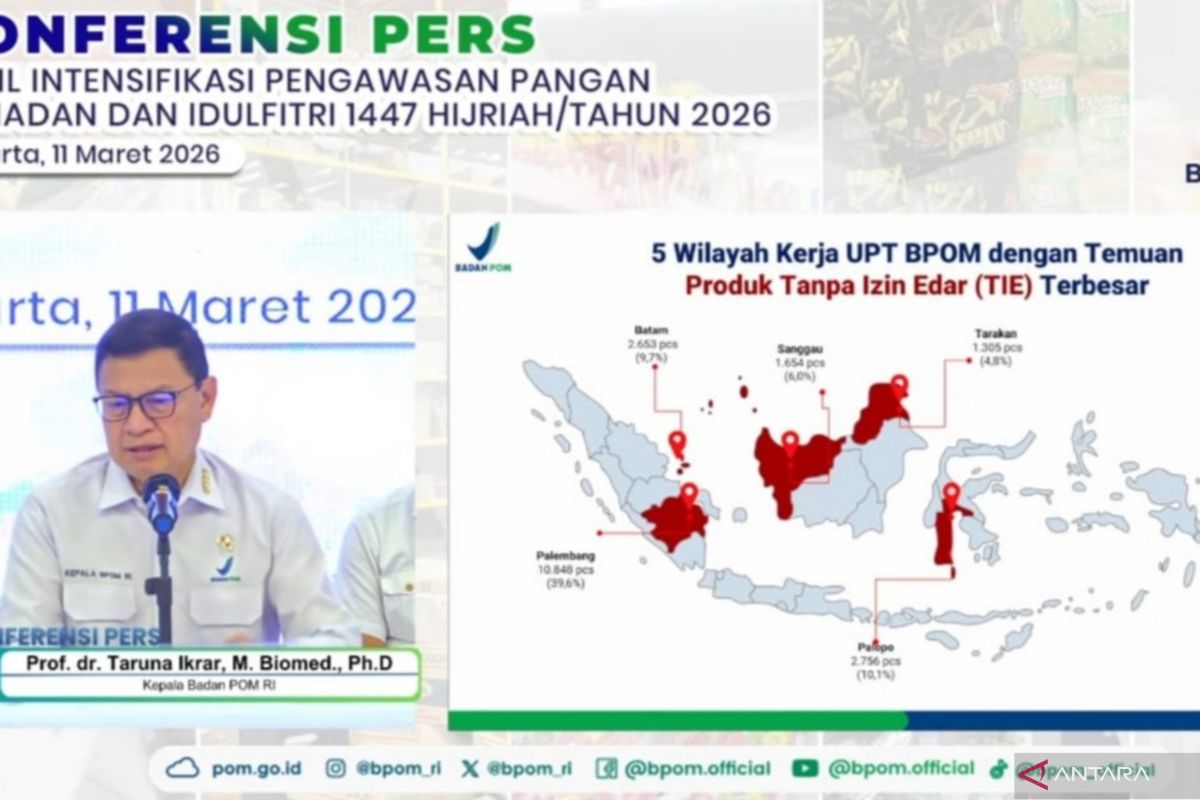
Jakarta — Indonesia’s Food and Drug Authority (BPOM) has successfully withdrawn 56,027 processed food products from circulation across multiple regions to prevent public health risks as part of an intensified surveillance operation ahead of Ramadhan and Eid al-Fitr 1447 Hijriah/2026.
BPOM Head Taruna Ikrar announced the figures during a press conference on food surveillance on Wednesday in Jakarta, stating that the non-compliant products comprised 27,407 items lacking distribution licences, 23,776 expired products, and 4,844 damaged goods.
The largest seizures of unlicenced products occurred in Palembang, South Sumatra, where 10,848 products were found—approximately 39 per cent of total findings. Additional significant discoveries were recorded in Batam (2,653 unlicenced products), Palopo in South Sulawesi (2,756 products), Sanggau in West Kalimantan (1,654 products), and Tarakan (1,305 products).
Taruna explained that BPOM’s food surveillance operates through two mechanisms: pre-market oversight before products enter distribution and post-market monitoring after they reach retailers.
The intensified operation involved 76 technical implementation units conducting simultaneous surveillance across Indonesia. By the third phase on 5 March 2026, BPOM had inspected 1,134 food distribution facilities across 38 provinces. The majority of inspected facilities were modern retail outlets at 50.2 per cent, followed by traditional markets at 32.5 per cent, distributor warehouses at 16.6 per cent, importer warehouses at 0.6 per cent, and e-commerce warehouses at 0.1 per cent.
According to Taruna, non-compliant products result partly from surging consumer demand, which drives supply through illegal channels or smuggling routes. “We must recognise that in an archipelagic nation like ours, smuggling routes from overseas are numerous at poorly monitored borders,” he stated.
He emphasised that enforcement against non-compliant food products is crucial for preventing public health risks and potential foodborne illness outbreaks among consumers.