
BPOM Recognition as WHO Listed Authority Will Strengthen Indonesia's Health Diplomacy
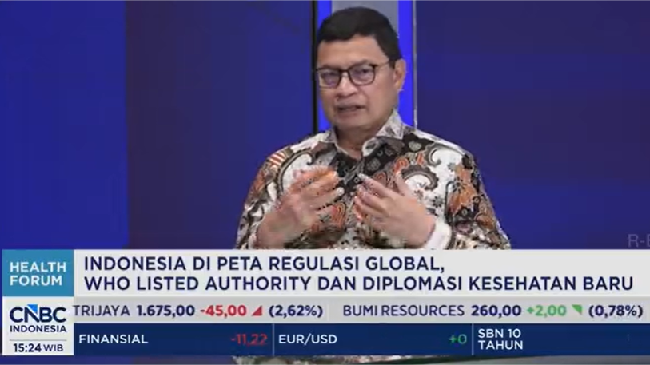
Jakarta — The head of Indonesia’s drug and food regulatory authority (BPOM), Taruna Ikrar, has stated that recognition as a WHO Listed Authority (WLA) represents a significant achievement that will unlock substantial opportunities. Indonesia now possesses advantages over nations without WLA status, enabling broader expansion capabilities.
“It opens significant opportunities, ranging from pharmaceutical product exports to strengthening Indonesia’s health diplomacy at both national and international levels,” he said during the CNBC Indonesia Health Forum on Friday, 27 February 2026.
In detail, Taruna explained that WLA status would commercially open broader markets with far-reaching impacts. Additionally, there remain reference and reliance benefits, as well as improved negotiating positions for global health diplomacy.
“We thus become global players, rather than merely domestic champions. Going forward, we can also ensure the distribution of medicines and vaccines even during emergency situations,” Taruna explained.
The WLA represents the highest achievement for regulators involved in drug and food oversight. With this designation, Indonesia becomes the first regulatory authority from a developing nation worldwide whose regulatory system is recognised as meeting the highest global standards.
At least nine evaluation criteria were assessed in establishing this status. The first involves regulatory governance and management systems. The second, which is thoroughly evaluated, concerns marketing authorisation. The third is vigilance—the extent to which medicines and vaccines circulating in Indonesia provide protection to the public. The fourth is surveillance, the fifth is clinical trial oversight, and the sixth concerns the quality of laboratories overseeing medicines and vaccines.
“Seventh, evaluated with particular rigour, concerns what we call licensing. Licensing means every document, every permit, everything we issue to the public carries supervisory impact and quality of oversight, ensuring public health safety,” Taruna explained.
There is also a criterion related to inspections—how BPOM executes its duties according to standards for inspections in medicine and vaccine manufacturing.
“We inspect factories including in marketing matters and what is called good manufacturing practice—the extent to which equipment standards meet requirements for drug production. This is evaluated strictly, and finally concerns vaccine batch management,” Taruna stated.