
BPOM Discovers 108 Iftar Food Samples Containing Harmful Substances
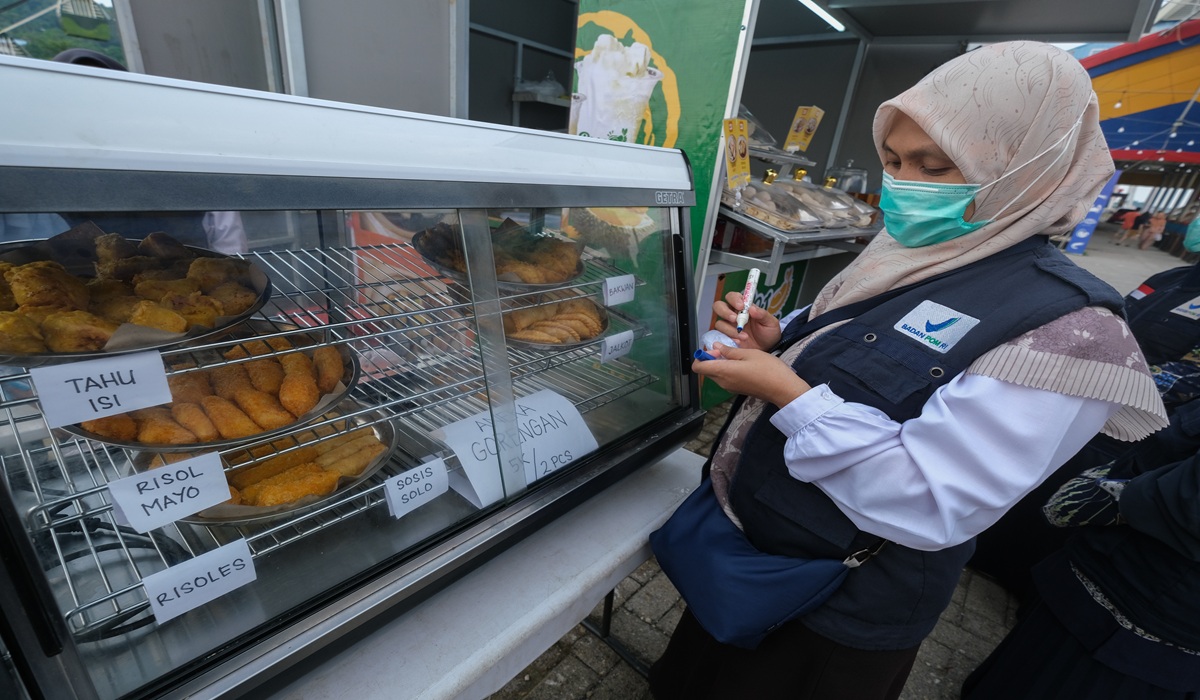
The Indonesian Drug and Food Monitoring Agency (BPOM) conducted surveillance of iftar food products through rapid testing using rapid test kits. Sampling was performed on 2,407 vendors at 513 iftar sales centres. Of the total 5,447 samples tested, 5,339 samples (98%) met requirements and 108 samples (2%) did not meet requirements. The iftar samples were found to contain harmful substances including formaldehyde (50 samples), borax (22 samples), metanil yellow (1 sample), and rhodamine B (45 samples).
“We have instructed vendors not to sell food products containing harmful substances. Do not let temporary profit come at the expense of public health,” said Taruna Ikrar firmly.
During this Ramadan, the Food and Drug Authority also conducted direct inspections and food safety education for iftar vendors in the Mappanyukki area of Makassar. Additionally, inspections were carried out at a modern retail facility in Pasar Rebo Jakarta and a dry cake production facility in Jakarta.
Beyond this, BPOM discovered tens of thousands of processed food products that did not meet requirements (TMK) in food safety intensification efforts during Ramadan and ahead of Eid al-Fitr 1447 Hijriah/2026. By 5 March 2026, the Food and Drug Authority had inspected 1,134 processed food distribution facilities across Indonesia. The inspection results showed 65.2% or 739 facilities met requirements (MK) whilst 34.8% or 395 facilities did not meet requirements (TMK).
“395 facilities were declared non-compliant because they sold processed food products that did not comply with regulations, namely without distribution permits (TIE)/illegal, expired, or in damaged condition,” said BPOM Head Taruna Ikrar in Jakarta on Wednesday (11 March).
The distribution facilities inspected included 569 modern retail facilities (50.2%), 369 traditional retail facilities (32.5%), 188 distributor warehouses (16.6%), 7 importer warehouses (0.6%), and 1 e-commerce warehouse (0.1%).
Based on surveillance conducted by 76 technical implementation units (UPT) of BPOM, either independently or in collaboration with relevant cross-sector partners, 227 modern retail facilities, 143 traditional retail facilities, 24 distributor warehouses, and 1 importer warehouse were found to be non-compliant. From the surveillance results, BPOM discovered 56,027 pieces of non-compliant processed food products with an estimated economic value exceeding 600 million rupiah.
Ramadan food surveillance this year was conducted on a risk-based approach, targeting distribution facilities with poor surveillance records, including marketplace warehouses given the increasing trend of online shopping among the public.
The largest category of findings remained dominated by illegal processed food products at 48.9% or 27,407 pieces. Other findings included expired products at 42.4% or 23,776 pieces and damaged food at 8.7% or 4,844 pieces. Products without distribution permits were most frequently found in South Sumatra, South Sulawesi, Riau Islands, West Kalimantan, and North Kalimantan.
Based on country of origin, the most commonly found illegally imported food products were sweets from Malaysia sold at traditional retail facilities in the Sambas area of West Kalimantan. Other findings included chocolate beverages from Singapore in the Tarakan area and frozen potatoes from China in the Palembang area.
Additionally, various other illegal processed food products were frequently found in border regions such as Batam, Sanggau, and Tarakan. Products suspected to originate from Malaysia included powdered beverages, flavoured drinks, and sweets or candy.
“These findings demonstrate the continued existence of illegal distribution networks in border regions. Therefore, cross-sector surveillance needs to be continuously strengthened to protect the public from food products that do not meet requirements,” said Ikrar.
Findings of expired products were most frequently discovered in East Nusa Tenggara, East Kalimantan, West Sulawesi, and Maluku. The types of products most commonly found included flavoured powdered beverages, salt, pasta and noodles, food additives, spices and condiments.