
BPKH Reveals Plans for Hajj Fund Placement to Maximise Returns
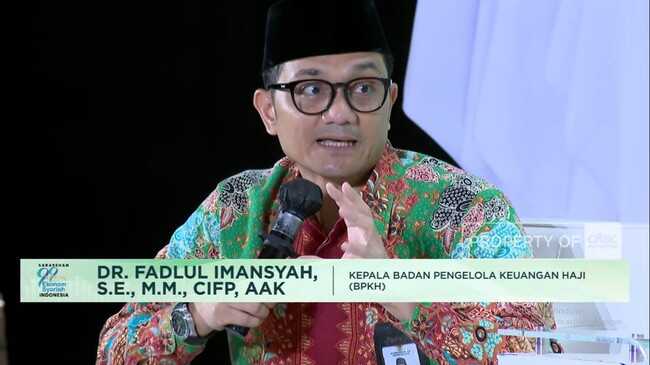
Jakarta — The Head of the Indonesian Hajj Financial Management Body (Badan Pengelola Keuangan Haji, BPKH), Fadlul Imansyah, has announced that hajj funds will be placed in multiple investment instruments moving forward. This initiative aims to bridge the gap between fees paid by hajj pilgrims and fluctuations in the rupiah exchange rate.
Fadlul stated that currently Rp180 trillion of managed hajj funds, representing 75%, are allocated to Islamic State Securities (SBSN). The remaining 20% is placed in deposits provided by Islamic banks across Indonesia.
However, both investment instruments offer yields lower than targeted. SBSN yields stand at 6.4% for approximately 10 years, whilst the target exceeds 7%.
“Regarding deposits, our placement is 20% with Islamic banks across all Islamic banks in Indonesia. The yield on that is also relatively certain to be lower. Around a maximum of 5%, even below 5%,” Fadlul stated during the 99th Assembly of Indonesian Islamic Economists 2026 held at the Bank Mega Tower Auditorium in South Jakarta on Tuesday (24 February 2026).
It should be noted that 80% of hajj funds are disbursed in Saudi Riyal (SAR), whilst Indonesian people contribute in rupiah. This presents a significant challenge in managing hajj funds.
Consequently, BPKH is currently awaiting revision of the hajj fund management law. If approved, opportunities for future investment allocation will expand significantly.
“The asset allocation stipulated in the new law will be required to allocate a larger proportion directly to investment. The parliament understands that it is not feasible for us to provide yields of around 7% through the current instruments,” Fadlul explained.
Beyond investment instruments, hajj funds could be placed within the hajj and umrah services ecosystem. This includes food exports for hajj and umrah pilgrims, as well as the export of 2,280 tonnes of rice to Saudi Arabia.
“Indeed, in hajj fund management under the new law, we are focused on the hajj ecosystem. So if colleagues ask whether we can invest in coal or palm oil, the mandate is now very specific for entering the hajj ecosystem which will support the Ministry of Hajj and Umrah,” Fadlul concluded.