
BPJS Ketenagakerjaan Partners with Mosques and Community Units to Expand Protection for Informal Workers
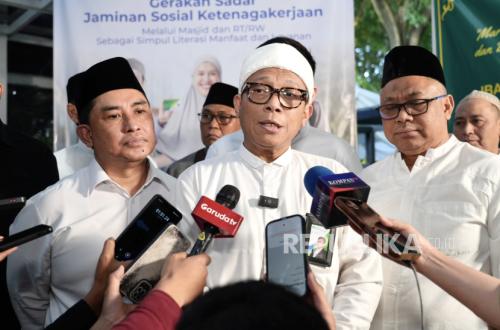
JAKARTA — BPJS Ketenagakerjaan continues to strengthen community-based approaches to expand employment social security protection for informal workers. Through collaboration with community organisations such as mosques and neighbourhood unit management (RT/RW), BPJS Ketenagakerjaan seeks to reach workers in their immediate living and working environments.
This commitment was demonstrated through the symbolic handover of BPJS Ketenagakerjaan membership cards to informal workers in the Eramas 2000 housing complex in East Jakarta, conducted directly by BPJS Ketenagakerjaan Chief Executive Officer Saiful Hidayat, along with the distribution of death benefit (JKM) compensation to three beneficiaries of deceased members.
“Through this activity, we want to ensure that employment social security services are not only available at service offices, but are also present directly in communities through a mobile outreach approach so that more workers can be protected,” said Saiful.
According to him, the community approach represents an important strategy because many informal workers live close to social environments including neighbours, traders, neighbourhood leaders and other community organisations.
“Often without our realisation, people around us remain vulnerable and lack protection through the employment social security programme. Therefore, worker protection can begin from the nearest environment through mutual reminders and invitations to involve more workers in protection,” he explained.
He added that communities such as RT/RW neighbourhood units and activities at mosques constitute important nodes for reaching workers on a broader scale.
“Through communities such as mosques and RT/RW, we can build shared awareness that worker protection is a collective need. With this approach, it is expected that more workers will understand the importance of employment social security,” Saiful said.
The death benefits provided amounted to 42 million rupiah each for the beneficiaries of Drs Suswoyo from the Indonesian Mosque Council (DMI) in Duren Sawit District, Hadi Alamsyah, a neighbourhood unit administrator in Pondok Kelapa Village, and Ratna, a trader.
The activity, representing the state’s commitment to workers, was attended by East Jakarta Mayor M. Anwar, BPJS Ketenagakerjaan Supervisory Board Members Swartoko and Alif Noeriyanto Rahman, Membership Director Agung Nugroho, Services Director Trisna Sonjaya, Head of BPJS Ketenagakerjaan’s Jakarta Regional Office Deny Yuslian, and Head of BPJS Ketenagakerjaan’s Jakarta Buaran Branch Office Muhammad Romdhoni, alongside community leaders, mosque administrators and neighbourhood unit officials.
Saiful also encouraged workers to take advantage of government policies offering premium relief for non-wage earners.
“The government has provided a 50 per cent premium reduction for the Work Accident Insurance and Death Benefit programmes for non-wage earner participants through Government Regulation Number 50 of 2025. This momentum is expected to be utilised by workers to obtain protection with affordable premiums whilst receiving substantial benefits,” he said.
Meanwhile, the Assistant for Economy and Development of the East Jakarta Municipal Government, Fauzi, appreciated BPJS Ketenagakerjaan’s initiative of partnering with community organisations as a gateway to expand worker protection.
“East Jakarta Government has a moral responsibility to ensure its people are better protected in the future. We appreciate BPJS Ketenagakerjaan’s approach through communities such as mosques and RT/RW neighbourhoods. We hope this collaboration continues to expand so that more workers are protected and community welfare improves, and can become a model for other regions,” he said.
Similarly, Chairman of the Al Akbar Mosque Administrators, Deden Edi Soetrisna, stated that mosque administrators also encourage employment social security protection for community service workers in mosque environments by including imams, mosque attendants, Quran teachers and RT/RW officials in the BPJS Ketenagakerjaan programme for non-wage earners. This step is expected to inspire mosques to serve not only as centres of worship but also as centres of social service for the community.