
BPJS Ketenagakerjaan Expands Informal Worker Protection Through Mosque Community Networks
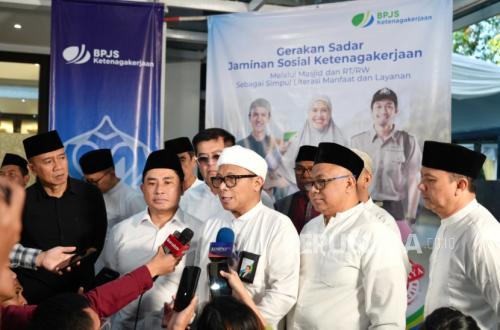
JAKARTA — BPJS Ketenagakerjaan continues to strengthen community-based approaches in expanding employment social security protection for informal workers. Through collaboration with community organisations such as mosques and neighbourhood administrative units (RT/RW), BPJS Ketenagakerjaan aims to reach informal workers in their immediate residential and daily activity environments.
This commitment was demonstrated through a symbolic membership card handover event for BPJS Ketenagakerjaan informal workers in the Eramas 2000 residential area, East Jakarta, on Sunday (8 March 2026), conducted directly by BPJS Ketenagakerjaan Chief Executive Saiful Hidayat, alongside the distribution of Death Benefit (JKM) payments to three beneficiaries of deceased members.
“Through this activity, we wish to ensure that employment social security services are not only available at service offices, but also present directly within communities through direct outreach, so that more workers can be protected,” Saiful stated in a press release.
According to him, the community-based approach is an important strategy because many informal workers live in close proximity to social environments such as neighbours, traders, neighbourhood administrators, and other community organisations.
“Often without our realisation, the people around us are vulnerable and not yet protected by employment social security programmes. Therefore, worker protection can begin from the immediate neighbourhood through mutual reminders and encouragement to ensure more workers become protected,” he explained.
He added that communities such as neighbourhood administrative units and mosque activities are critical nodes in reaching workers more widely.
The death benefits distributed were each valued at Rp42 million to beneficiaries of the late Drs. Suswoyo from the Indonesian Council of Mosques (DMI) in Duren Sawit District, the late Hadi Alamsyah, a neighbourhood administrator in Pondok Kelapa Sub-district, and the late Ratna, a trader.
Saiful also encouraged workers to take advantage of government policy providing premium relief for non-wage earning participants.
Meanwhile, the Assistant for Economy and Development of East Jakarta City Government, Fauzi, appreciated BPJS Ketenagakerjaan’s steps in engaging community organisations as a gateway to expanding worker protection.
Similarly, the Chairman of Al Akbar Mosque’s Steering Committee, Deden Edi Soetrisna, stated that mosque administrators also encourage employment social security protection for community service workers in mosque environments by including imams, caretakers, Qur’an teachers, and neighbourhood administrative officials in the BPJS Ketenagakerjaan non-wage earner segment programme. This step is hoped to serve as inspiration so that mosques become not only centres of worship, but also centres of social service for communities.
At this occasion, the Head of BPJS Ketenagakerjaan Jakarta Buaran Branch Office, Muhammad Ramdhoni, emphasised that community involvement is key to accelerating the expansion of employment social security protection, especially for informal sector workers who continue to dominate employment structures in society.
“Community-based approaches through mosques, neighbourhood administrators, and community leaders have proven effective in reaching workers directly. Many informal workers actually require protection, but remain unserved due to limited access to information and distance from formal services. By being present directly in their environments, we can ensure that BPJS Ketenagakerjaan programmes genuinely benefit communities,” Ramdhoni stated.
He explained that non-wage earning workers retain equal rights to obtain protection from socio-economic risks through BPJS Ketenagakerjaan programmes, such as Work Accident Insurance and Death Benefit, which provide compensation to participants or beneficiaries should work-related risks or death occur.
According to Ramdhoni, his office will continue to expand collaboration with various community elements so that the worker protection movement begins from the smallest neighbourhood level.
“We hope this neighbourhood-level movement can serve as an example for other areas. If every neighbourhood administrative unit and mosque can become a driver of worker protection, then membership coverage will increase significantly, and ultimately more families will be protected from unexpected risks,” he affirmed.