
BPJS Ketenagakerjaan Engages Places of Worship and Community Groups to Expand Protection for Informal Workers
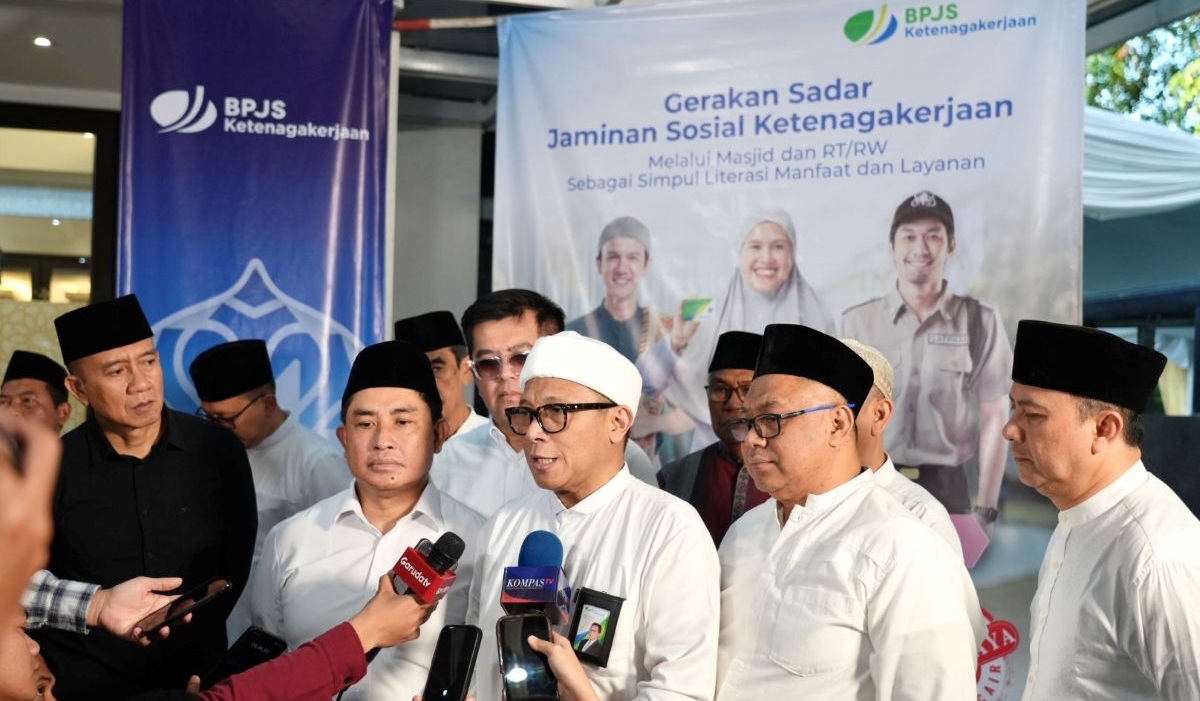
BPJS Ketenagakerjaan continues to promote expansion of employment social security protection for informal workers through community-based approaches. Beyond formal outreach activities, this approach involves engaging various community networks such as neighbourhood administrators and communities in places of worship, including mosques and other religious institutions, ensuring worker protection messages reach communities in their residential and daily activity environments.
This commitment was demonstrated through a symbolic presentation of BPJS Ketenagakerjaan membership cards to informal workers in the Eramas 2000 residential area, East Jakarta. The event was conducted directly by BPJS Ketenagakerjaan Chief Executive Saiful Hidayat, alongside the distribution of Death Benefit (JKM) payments to three heirs of deceased members.
“Through this activity, we want to ensure that employment social security services are not only available at service offices, but are also present directly in communities through a door-to-door approach so that more workers can be protected,” said Saiful.
According to him, the community approach is an important strategy because many informal workers are closely situated within social environments such as neighbours, traders, neighbourhood administrators and other community organisations.
“Often without our realisation, people around us are still vulnerable and not protected by employment social security programmes. Therefore, worker protection can begin from the closest environment through mutual reminders and invitations to ensure more workers are covered,” he explained.
He added that communities such as neighbourhood associations and activities in places of worship like mosques are important nodes in reaching workers more widely.
“Through communities such as mosques and neighbourhood associations, we can build collective awareness that worker protection is a shared need. With this approach, it is hoped that more workers will understand the importance of employment social security,” added Saiful.
The benefits distributed comprised Death Benefit payments of 42 million rupiah each to heirs of the late Drs Suswoyo from the Indonesian Mosque Council (DMI) of Duren Sawit District, the late Hadi Alamsyah, an administrator of neighbourhood associations in Pondok Kelapa Village, and the late Ratna, a trader.
This activity, as a manifestation of state commitment to workers, was also attended by East Jakarta Mayor M. Anwar, BPJS Ketenagakerjaan Supervisory Board Members Swartoko and Alif Noeriyanto Rahman, Membership Director Agung Nugroho, Services Director Trisna Sonjaya, BPJS Ketenagakerjaan Regional Office Head for DKI Jakarta Deny Yuslian, and BPJS Ketenagakerjaan Branch Office Head for Jakarta Buaran Muhammad Romdhoni, together with community leaders, mosque administrators, and local neighbourhood administrators.
Saiful also urged workers to take advantage of government policy providing premium relief for non-wage earner participants.
“The government has provided a 50 per cent premium reduction for the Work Accident Insurance and Death Benefit programmes for non-wage earner participants through Government Regulation Number 50 of 2025. This opportunity is expected to be utilised by workers to obtain protection at affordable premiums with substantial benefits,” he said.
Meanwhile, the Economic and Development Assistant of the East Jakarta City Government, Fauzi, appreciated BPJS Ketenagakerjaan’s step in engaging community organisations as an entry point for expanding worker protection.
“East Jakarta Government has a moral responsibility to ensure its people are better protected in the future. We appreciate BPJS Ketenagakerjaan’s approach through communities such as mosques and neighbourhood associations. Hopefully this collaboration will continue to expand so that more workers are protected and community welfare can improve and become a role model for other regions,” he said.
Similarly, the Head of the Management Board of Al Akbar Mosque, Deden Edi Soetrisna, stated that mosque administrators also encourage employment social security protection for community workers in the mosque environment by including imams, caretakers, Quran teachers, and neighbourhood officials in the BPJS Ketenagakerjaan programme for non-wage earners. This step is hoped to inspire mosques not only to be centres of worship, but also centres of social service for communities.