
BPDP and Aspekpir Promote Palm Oil Innovation for Palm Farmers and Women SMEs in Kampar
“Peace is not merely the absence of war. It is a virtue,” wrote the philosopher Baruch Spinoza.
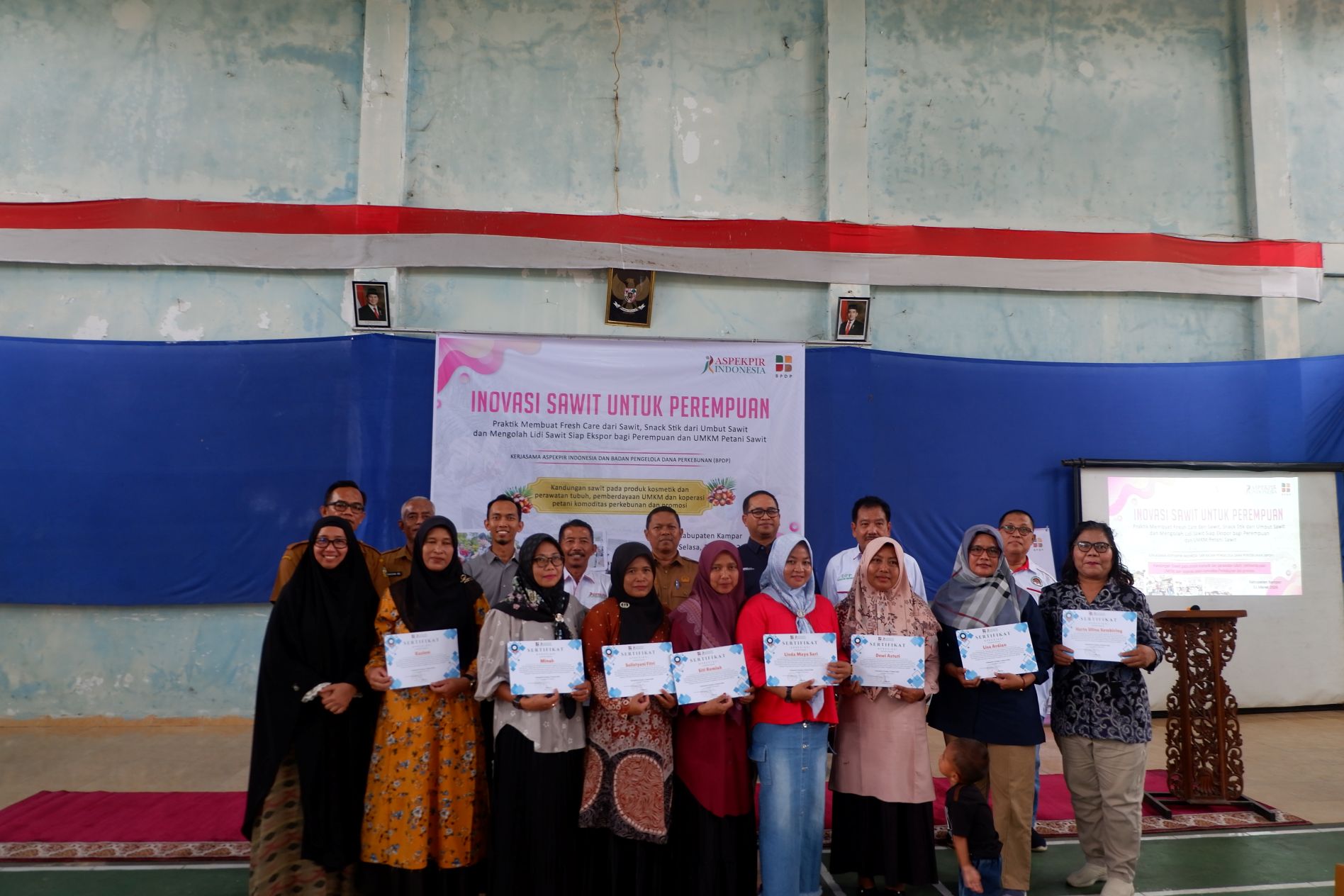
A collaboration between the Plantation Fund Management Agency (BPDP) and the Indonesian PIR Palm Oil Farmers Association (Aspekpir Indonesia) organised a Workshop on Palm Oil Innovation for Women in Kampar Regency, Riau Province, on Tuesday, 31 March 2026. This activity forms part of BPDP’s strategic efforts alongside Aspekpir Indonesia to enhance the capacity of women from palm oil farming and SME backgrounds in Indonesia through the development of value-added derivative products.
The workshop, attended by 80 participants representing palm oil farmers and SMEs, featured strategic narratives from BPDP on the use of palm oil in cosmetic and body care products, empowerment of SMEs and farmers’ cooperatives in plantation commodities, and promotion. In his remarks, the Head of the Kampar Regency Agriculture, Livestock, and Animal Health Office, Marahalim, emphasised the importance of women’s roles in supporting family economies through innovations based on the palm oil commodity, which has long been the backbone of the region.
He explained that palm oil has great potential because almost all parts can be utilised. From the fruit processed into various economically valuable products, to waste such as fronds and kernel cake that can be used as livestock feed or alternative fuel. “This opens up new business opportunities for rural communities, including the development of livestock sectors based on palm oil waste,” he said.
The Kampar Regency Government expressed appreciation for the support from various parties in this activity, including institutions that promote innovation and community empowerment. It is hoped that this event will serve as an initial step towards the emergence of further innovations that can increase community incomes.
Meanwhile, the Chairman of Aspekpir for Riau Province, Sutoyo, explained the significant contribution of palm oil to the nation and state. Palm oil is a national strategic commodity that has long been the main pillar of Indonesia’s economy. However, the utilisation of palm oil is still dominated by the primary raw material sector, while the development of value-added derivative products has not yet been optimally pursued by the community, even though the potential for processing palm oil into economically valuable derivatives is very high.
In addition to uses for food and energy needs, palm oil and its derivatives can also be processed into personal care and health products with high selling value, such as fresh care (aromatherapy roll-on), and can be turned into various food products like sticks from palm midribs, even palm spines can be processed into export-ready materials with high economic value.
FULL SUPPORT
Representative of the Community Cooperation and SME Division of BPDP, Linda Sitanandra, stated that BPDP fully supports the Palm Oil Innovation for Women activity, which targets the enhancement of skills and economic independence of communities, especially women, in palm oil plantation areas. This programme is a concrete step in encouraging the broader and value-added utilisation of the palm oil commodity.
The event featured various practical training sessions, including making fresh care products based on palm oil, processing snack sticks from palm midribs, and utilising palm spines for export-ready crafts. Through this training, participants not only gained knowledge but also direct skills that can be applied as productive businesses.
With this activity, mothers in palm oil plantation areas have gained new insights into the diverse processing potentials of palm oil. This opens opportunities for them to develop home-based businesses based on local resources that have not been optimally utilised so far.
Regional Head of PTPN IV Regional IV, Bambang Budi Santoso, stated that PTPN IV Regional III reaffirms its commitment to promoting the palm oil sector through collaborations with various parties, including the government, BPDP, the Agriculture Office, associations, and farmers. This joint support is seen as key to increasing productivity and the welfare of palm oil farmers, especially in the Riau region.
According to him, the main goal of these efforts is to reduce the productivity gap between farmers and companies. Through various mentoring programmes and capacity building, it is hoped that farmers can achieve optimal harvests, even surpassing the national average, thereby directly impacting their income increases.
The workshop was attended by the Head of the Kampar Regency Agriculture, Livestock, and Animal Health Office, Marahalim, Chairman of Aspekpir Riau, Sutoyo, DPP Aspekpir Executive Tri Yantana, Representative of the Community Cooperation and SME Division Linda Sitanandra, and Regional Head of PTPN IV Regional IV, Bambang Budi Santoso.
The speakers for the event were Irdawati Novita (Medical Aesthetician), Duta Setiawan (Lecturer at the Faculty of Agriculture, Tanjungpura University), and Ilham Setiadi (Palm Spine Exporter).
ACTIVITY SESSIONS
The event was divided into two sessions: material and discussion, and practical sessions. In the material and discussion session, it was explained that palm oil and its derivatives are widely used in the cosmetics and body care industry because they have moisturising, softening properties, as well as the ability to cleanse and stabilise product textures.
Some common palm-derived ingredients used include palmitic acid and stearic acid as emollients and cream texture formers, glycerin as a humectant to maintain skin moisture, SLS and SLES as cleansing agents and foam formers in soaps and shampoos, and tocotrienol (vitamin E from palm) which functions as a natural antioxidant to protect the skin from free radicals.
This event also serves as a momentum to strengthen the role of women in the palm oil industry value chain.