
BPDLH Partners with Private Sector to Strengthen Green Financing for Forest Farmers
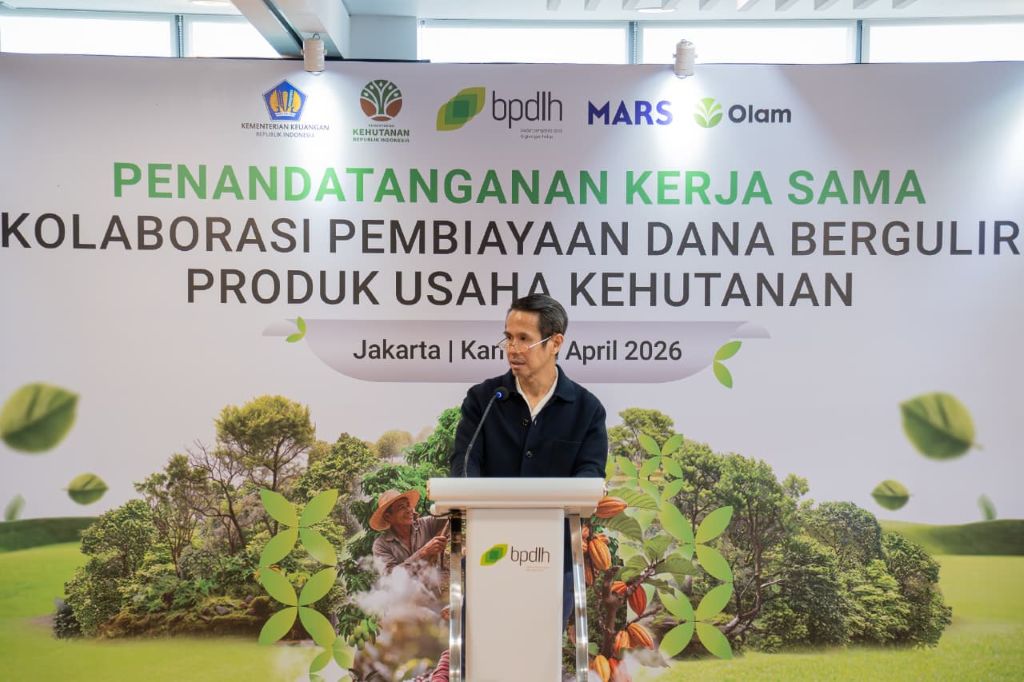
Jakarta: The Badan Pengelola Dana Lingkungan Hidup (BPDLH) is establishing a strategic collaboration with the private sector to strengthen green financing in the forestry sector, particularly through agroforestry. The partnership involves global suppliers and off-takers from PT Mars Symbioscience Indonesia, which collaborates with PT Olam Food Ingredients (OFI) Indonesia and PT Papandayan Cocoa Industries (Barry Callebaut), targeting cocoa and coffee farmers in Indonesia.
This synergy aims to integrate private sector technical support with BPDLH’s financing instruments to build a transparent, accountable supply chain with high traceability.
The distribution of Revolving Fund Facilities (FDB) has also targeted People’s Forest Farmer Groups and Social Forestry Groups with forestry business products. In line with BPDLH’s mandate to support low-carbon development, BPDLH provides a Revolving Fund Facility specifically designed to reach forest farmer groups and social forestry actors.
People’s Forest Farmer Groups (KTHR) that have implemented forest cover through delayed felling mechanisms and multi-purpose forestry businesses, such as the KTHR in Kediri for delayed felling of podang mango trees in working capital and investment financing for agriculture, livestock, and trade businesses.
This scheme is intended to enhance farmers’ capacities towards becoming visible and bankable business entities. Some advantages of this revolving fund scheme include:
Flexible financing through inclusive requirements with repayment cycles adjusted to the characteristics of forestry and agroforestry businesses.
Implementation of a Blended Finance Model (BFM) that combines capital access with intensive technical assistance to increase productivity and harvest quality.
Integration with off-takers through partnerships with global companies to provide market certainty, reduce business risks, and ensure economic sustainability at the grassroots level.
The collaboration between BPDLH and supporting parties in forming an agroforestry financing ecosystem opens up financing access opportunities for communities around forests in several regions of Indonesia.
This access is provided to 500 cocoa farmers in North Luwu Regency and East Luwu Regency, South Sulawesi Province. Then 200 cocoa farmers in East Lampung Regency and Pesawaran Regency, Lampung Province. As well as 150 coffee farmers in the Social Forestry Group KTH Rengganis in Jember Regency, East Java Province, and Tanggamus Regency, Lampung Province, through PT Mars Symbioscience Indonesia.
“Forest farmer groups need to develop into professional business entities with good governance, capable of managing and utilising revolving funds optimally and responsibly. Revolving funds must also be connected to market certainty through partnerships with off-takers,” stated the Director General of Social Forestry, Ministry of Forestry, Catur Endah Prasetiani, in a written statement on Friday, 3 April 2026.
Strengthening the integration of the farmer data ecosystem
This collaboration also emphasises strengthening the integration of the farmer data ecosystem. With a more accurate data-based monitoring system, BPDLH aims to improve the quality of targeted policy-making and build trust from other formal financial institutions to engage in green financing in the future.
“BPDLH is here to help increase farmers’ financial literacy. Through the revolving fund scheme, we not only disburse financing but also build farmers’ financial track records,” added BPDLH’s President Director Joko Tri Haryanto in his presentation.
This initiative aligns with the national low-carbon development agenda. Through the agroforestry model and delayed felling financing, this collaboration demonstrates that protecting forests’ ecological functions can run in parallel with improving community welfare.
In the future, this collaboration is expected to serve as a pilot project or best practice for developing other green financing schemes in Indonesia. Ensuring that every fund disbursed can continue to circulate sustainably to have a positive impact on future generations.