
Books Never Die: The Story of the Pondok Cina Book Seller Surviving the Pandemic Onslaught
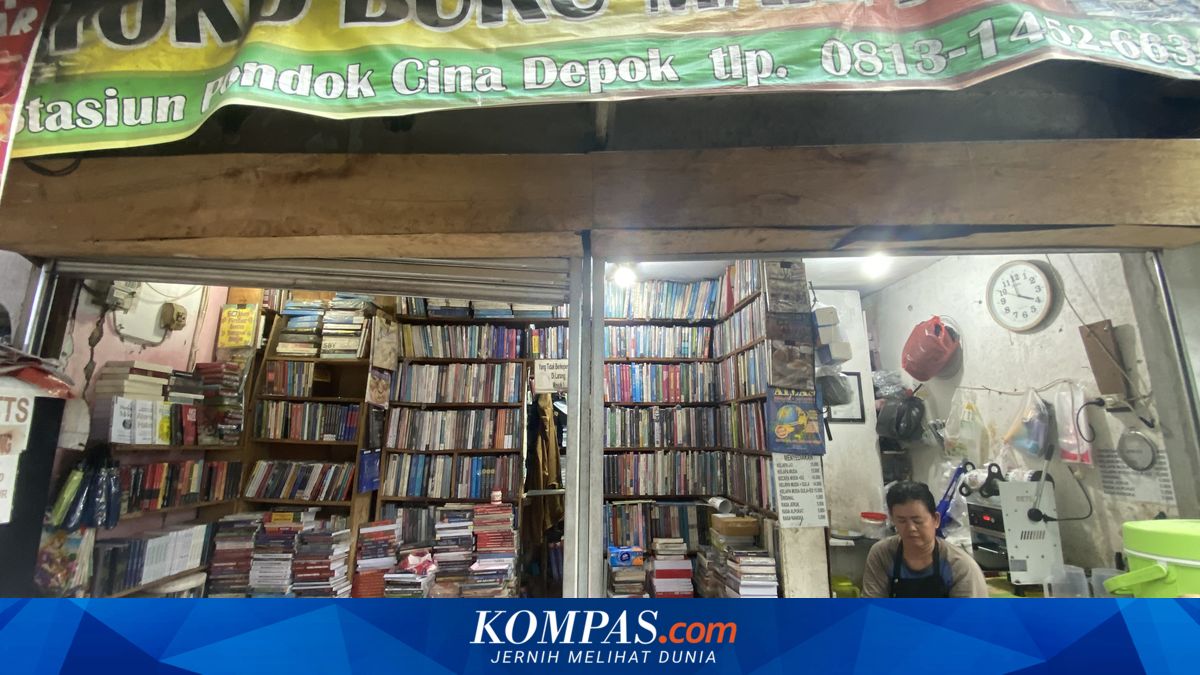
DEPOK, KOMPAS.com - Amid the proliferation of neat, brightly lit, and fully digital modern bookstores, an old book stall near Pondok Cina Station in Depok continues to hold on with a face that has scarcely changed in over a decade.
From the outside, a shabby banner reading “TOKO BUKU MAIL POCIN” hangs casually.
But as one steps closer, the stall becomes like a gateway to another time: towering stacks of books leaving narrow walkways, and old wooden shelves crammed with volumes right up to the ceiling.
She is not someone who grew up with a reading habit, but years of living among thousands of books have convinced her of one thing.
Books will never truly die.
“Even if it’s quiet, there are always buyers. Books are knowledge. They won’t die, unless there’s a fire,” said Marita with a small laugh during Kompas.com’s visit on Wednesday (15/4/2026).
That statement has become a kind of mantra she has held onto since the Covid-19 pandemic struck her physical book trade.
In a situation where people prefer reading on screens, she still opens her stall every day.
Not because she is confident of big profits, but because she has already invested her life among the pages of paper.
“If you sell cigarettes, they run out, and the money runs out. But books don’t. That’s what I always tell people who haggle,” she said.
At that time, the area along the railway tracks was still a bustling space for second-hand book sellers, before it was eventually cleared.
“I’ve been here since 2011. Before that, I sold at UI Station from 2006,” said Marita.
She moved to Pondok Cina in 2011, after the clearance of traders along the tracks. Although still near the railway line, her current location is considered safer.
The stall is not large. The kiosk stretches sideways, with a boundary of about 5 metres.
Yet, that cramped space holds thousands of books stacked in layers almost reaching the ceiling.
Some other traders did not follow. Some chose to return to UI, while others gradually disappeared.
“Thousands. Stacked all the way up. The oldest ones are from when I first opened in 2006,” she said.
The books she sells include both new and used ones. School books for junior and senior high school used to dominate, but she has now stopped them due to curriculum changes that are too rapid.
Instead, university books are seen as more stable, especially for majors where the theory does not change quickly.
“Law, engineering, psychology books rarely change. It’s always the same ones,” said Marita.
However, there are majors that change editions quickly, like economics and accounting.
“Economics and accounting. They often change editions. Students usually say, ‘Auntie, it’s already a new edition,’ so I have to check again,” she said.
She gets some new books directly from publishers. The problem is that unsold books cannot be returned.
For book sellers, piled-up stock means a risk of loss.
But in the world of second-hand books, something considered unsellable today can become a sought-after rarity years later. Marita has experienced this herself.
“There was a law book I thought wouldn’t sell. The cover got damaged by mosquito repellent. But someone was looking for it, even saying they’d pay Rp 75,000 if they found it,” she said.
She noted that rare books have different prices because they are no longer produced.
“If it’s rare, it’s more expensive. Because it’s no longer in production,” she said.
At the Pondok Cina book stall, prices are not fixed. Books on the shelves do not always have price tags. Buyers must ask, then haggle.
For some students, the bargaining process is not just a way to save money, but part of the experience.
Marita admits to dealing with various buyer personalities. Some haggle reasonably, others what she considers too aggressively.
“Sometimes it’s the people that annoy you. Some haggle to death,” said Marita.
But she still serves them, because bargaining is the main pulse of the second-hand book market.
In that cramped space, students crouch, open pages, check the condition of the books, then count the money left in their wallets.
If new books at modern stores can cost hundreds of thousands of rupiah, the Pondok Cina stall offers a more realistic alternative for students.
“Students looking for cheap ones definitely come here. If you ask for cheap at Gramedia, they might laugh at you,” said Marita.
The stall even offers “tilted” books, a term for pirated or reproduced copies.
“There are originals, and also tilted ones. Sometimes students say, ‘Auntie, nothing over 100,000, just the cheap ones,’” she said.
She still remembers that time as the most difficult point in her life.
“From the start of corona, that’s what made us cry. Reading interest dropped, people switched to digital and PDFs,” said Marita.