
Board of Peace and Palestinian Independence: Lessons from the History of the "Committee of Good Offices"
Jakarta (ANTARA) - Indonesian independence was not born solely from armed resistance. The Proclamation of 17 August 1945 was indeed a starting point, but full recognition of sovereignty was only achieved after a long and structured campaign of international diplomacy.
During the most critical phase of the revolution, when Dutch military aggression sought to extinguish the republic’s existence, the international community intervened through the establishment of the Committee of Good Offices on Indonesia by the United Nations Security Council in 1947.
The Committee, known in Indonesian as the “Komite Jasa Baik”, was not formed in a configuration entirely favourable to Indonesia. Belgium, one of its members, was relatively close to the Netherlands. The United States was also initially still calculating within the context of European interests and the early dynamics of the Cold War. Only Australia was relatively more sympathetic to the Republic’s struggle. Indonesia came to the negotiating table with limited military and material standing.
It was precisely there that the strategic significance of Indonesian diplomacy lay. The Committee of Good Offices provided a legal and political space for the Republic of Indonesia to be recognised as a legitimate party in the conflict, rather than merely a colonial rebellion. The Committee oversaw ceasefires, mediated negotiations, and ensured that the political channel remained open.
Indonesia may not have won every detail of the negotiations. The Renville Agreement even felt bitter, but the Republic managed to preserve its existence until the geopolitical momentum shifted. When the United States began to view Indonesian stability as a strategic interest, international pressure on the Netherlands increased and the path towards recognition of sovereignty in 1949 opened up.
From Mediation to Statehood
A key lesson from Indonesia’s experience is that multilateral forums do not automatically side with the weak. They are arenas of interest. However, when they possess a clear mandate and collective oversight, multilateral forums can serve as a bridge from conflict to statehood.
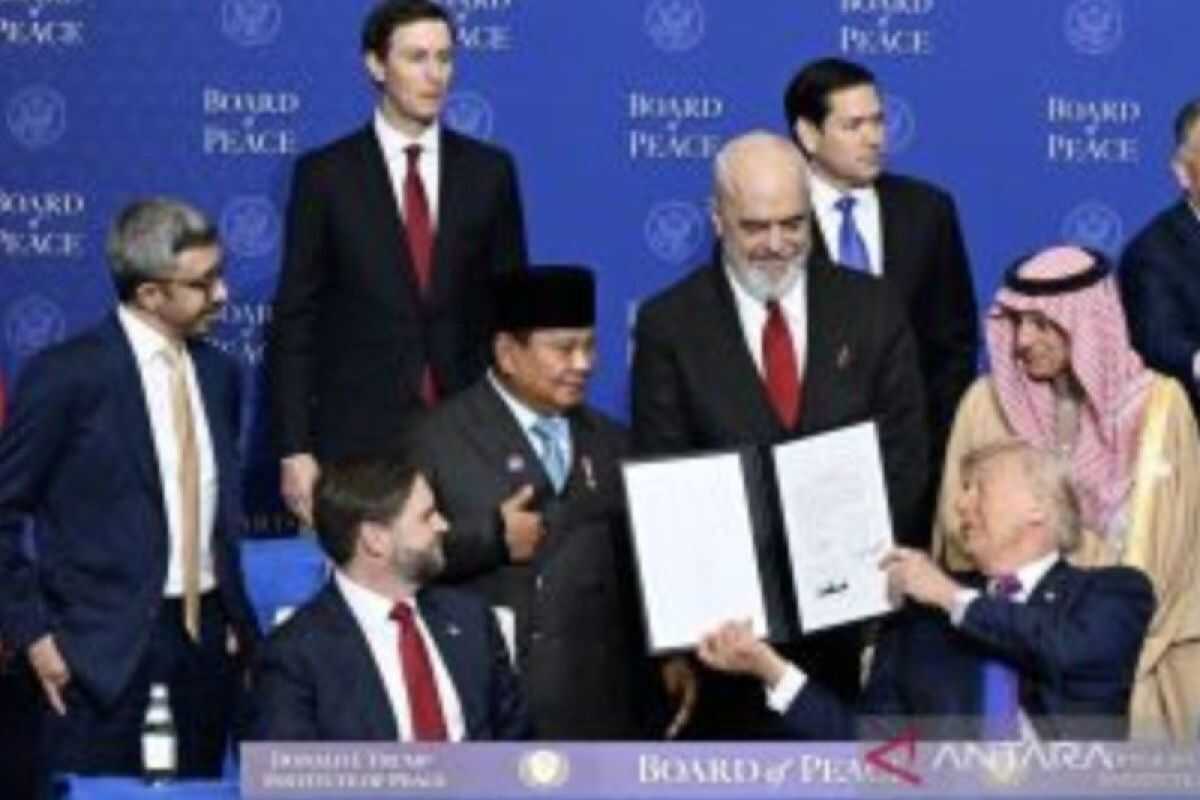
It is this framework that has now re-emerged through the “Board of Peace” initiative proposed by US President Donald Trump, which has gained legitimacy through a UN Security Council resolution. With a formal mandate from the Security Council, this mechanism has a strong foundation in international law. However, as with the Committee of Good Offices before it, the success of this Peace Board will not be determined by rhetoric, but by the ability to oversee implementation.
The Israel-Palestine conflict is not merely a matter of ending violence. It concerns questions of statehood, legitimacy, regional security, and internal political fragmentation. In many respects, the challenges facing Palestine are even more complex than those facing Indonesia in 1947. Today’s world is more polarised. Great power rivalries are sharper. Global security concerns and perceptions of terrorism also shape how the conflict is viewed.
For this reason, the “Board of Peace” will be tested not merely as a mediator, but as a guardian of political transition. It must be capable of ensuring that agreements do not stop at declarations, but move towards the establishment of legitimate governing institutions, joint security arrangements, and a roadmap towards recognition of sovereignty. Without consistent collective supervision, agreements risk collapsing under mutual distrust and the domestic dynamics of the parties involved.
Indonesia did not sit at the table in a position of advantage. But the nation’s leaders capitalised on shifts in the calculus of global interests. Palestine’s opportunities likewise depend heavily on similar dynamics — whether regional stability and conflict resolution are regarded as a shared strategic interest by the major powers.
The Multilateralism of the “Peace Board”
Amid scepticism about the effectiveness of multilateralism, Indonesia’s history serves as a reminder that international mechanisms can work when mandates are respected and strategic interests converge with moral legitimacy. The Committee of Good Offices was not a perfect institution. Yet it was effective because it became part of a changing global political architecture in the post-World War II era that was increasingly anti-colonial.
The “Board of Peace” now stands at a similar historical crossroads, albeit in a different context. It could become merely another forum in the long list of resolutions that are never fulfilled. But it also has the potential to become a catalyst for change if it can transform a protracted conflict into a structured, internationally supervised political process.
For Indonesia, this reflection is not mere historical nostalgia. We once stood as a nation fighting for the right to self-determination within an international system that was not always welcoming. We understand that global legitimacy, when managed carefully, can strengthen the struggle for independence.
Like Indonesia in 1947, Palestine may not sit at the negotiating table in an ideal position, yet history shows that even from a position of vulnerability, the right diplomatic architecture can open the path to sovereignty — so long as geopolitical momentum shifts and internal consolidation is maintained.
Ultimately, independence is not only about the courage to endure, but also the intelligence to read the direction of history. If the “Board of Peace” is able to carry out its mandate consistently and credibly, it may be recorded as an instrument that helped pave the way for the birth of an independent State of Palestine — just as the Committee of Good Offices once helped guide the Republic of Indonesia towards full recognition of sovereignty.
Khairul Fahmi is a defence and security analyst and co-founder of the Institute for Security and Strategic Studies (ISESS).