
BNPB Urges Residents in These Indonesian Regions to Prepare for Self-Evacuation: Why?
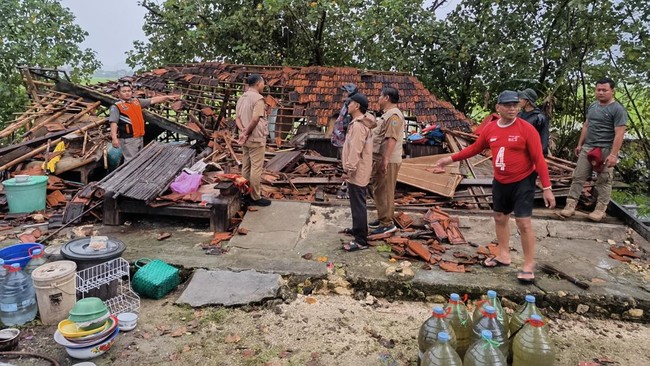
Jakarta, CNBC Indonesia - The National Disaster Management Agency (BNPB) has urged the public and local governments to actively enhance preparedness and vigilance against various potential disaster threats, particularly the dangers of wet hydrometeorological events during the transitional season.
This was stated by the Head of the BNPB Data, Information, and Disaster Communication Centre, Abdul Muhari, in response to a series of disasters that have struck several regions in Indonesia, as well as in reaction to weather forecasts from the Meteorology, Climatology, and Geophysics Agency (BMKG).
“According to the weather forecast issued by BMKG on Tuesday (31/3/2026), heavy to very heavy rain is still likely to occur in several regions of Indonesia until 2 April 2026. Such weather conditions could trigger wet hydrometeorological disasters such as floods, landslides, including impacts from extreme weather phenomena,” said Abdul Muhari in his statement on Tuesday (31/3/2026).
The regions forecasted to experience heavy to very heavy rain, he added, include West Sumatra, Bengkulu, Banten, West Java, Central Java, DI Yogyakarta, West Kalimantan, Central Kalimantan, West Sulawesi, South Sulawesi, and Papua.
“In Central Java itself, the districts/cities forecasted to experience heavy to very heavy rain on 1 April 2026 are Tegal Regency, Pemalang, Kudus, Cilacap, Banyumas, Purbalingga, Banjarnegara, Wonosobo, Temanggung, Boyolali, Karanganyar, Kebumen, Purworejo, Magelang Regency, and Magelang City,” said Abdul Muhari.
On the other hand, he continued, several regions in Indonesia are now entering the transitional season or pancaroba, the shift from the rainy to the dry season.
“BMKG predicts that the onset of the dry season this year will begin from April to June in various regions,” he said.
“Pancaroba is marked by significant and rapid weather changes such as sudden rain, strong winds, and air temperatures that feel hotter,” he explained.
Therefore, he added, BNPB reminds all parties to increase vigilance.
“If there is rain with high intensity and long duration, the public is advised to carry out independent evacuation and know safe evacuation routes,” said Abdul Muhari.
“The public is urged to stay away from trees or structures that are prone to collapse or fall, such as billboards and fragile buildings,” he emphasised.
For the record, BNPB reported several disaster events that have struck regions in Indonesia, with significant impacts dominated by wet hydrometeorological disasters. Namely, extreme rainy weather accompanied by lightning and strong winds that hit the Tasikmalaya City-West Java area, Wonosobo Regency-Central Java, Klaten Regency-Central Java, and Kudus Regency-Central Java.
“Up to now, emergency handling continues to be carried out by joint teams. Previously, the Regent of Kudus has issued Decree No. 300.2/296/2025 on the Determination of Emergency Alert Status for Hydrometeorological Disasters in the Form of Floods, Landslides, and Strong Winds effective from 28 October 2025 to 31 May 2026,” said Abdul Muhari.
BMKG Early Warning
Meanwhile, in its Weekly Rain Potential Release for the Next Period from 31 March to 6 April 2026, BMKG has warned to be alert to the potential for extreme weather amid the transition to dominance by the Australian Monsoon.
Specifically for the period from 31 March to 2 April 2026, BMKG stated that the weather in Indonesia is generally dominated by light to moderate rain conditions.
However, an increase in rain with moderate to heavy intensity needs to be watched in Aceh, North Sumatra, West Sumatra, Riau, Jambi, South Sumatra, Bangka Belitung Islands, Lampung, Banten, Jakarta, East Java, Bali, West Nusa Tenggara, East Nusa Tenggara, West Kalimantan, Central Kalimantan, East Kalimantan, North Kalimantan, South Kalimantan, North Sulawesi, Gorontalo, Central Sulawesi, South Sulawesi, Southeast Sulawesi, North Maluku, Maluku, Southwest Papua, West Papua, Central Papua, Papua, Papua Mountains, and South Papua.
In addition, heavy rain that may be accompanied by lightning/thunder and strong winds could occur in:
- Alert (heavy to very heavy rain):
Bengkulu, West Java, Central Java, DI Yogyakarta, and West Sulawesi.
- Strong winds:
East Nusa Tenggara.
“Considering the still significant atmospheric dynamics in the coming days, BMKG urges the public and stakeholders to increase vigilance against the potential for extreme weather that could trigger hydrometeorological disasters,” BMKG wrote, quoted on Tuesday (31/3/2026).
“Motor vehicle drivers also need to be alert to the potential for heavy rain that may be accompanied by lightning/thunder and strong winds, which could disrupt travel,” BMKG added.
BMKG also urged the public to be wary of the potential for falling trees or branches, collapsing billboards, puddles, and lightning strikes by avoiding sheltering under trees, billboards, or fragile buildings, and limiting activities in open spaces during rain accompanied by strong winds and thunder.