
BNPB: Decline in Disaster Risk Index Serves as Performance Report Card for Local Governments
Jakarta (ANTARA) - The National Disaster Management Agency (BNPB) has emphasised that the reduction in the Indonesian Disaster Risk Index (IRBI) serves as the main indicator for measuring local governments’ performance in implementing disaster mitigation efforts in their regions.
BNPB Deputy for Systems and Strategies, Raditya Jati, stated that local governments are required to meet minimum service standards (SPM) for disaster affairs as basic services to the community.
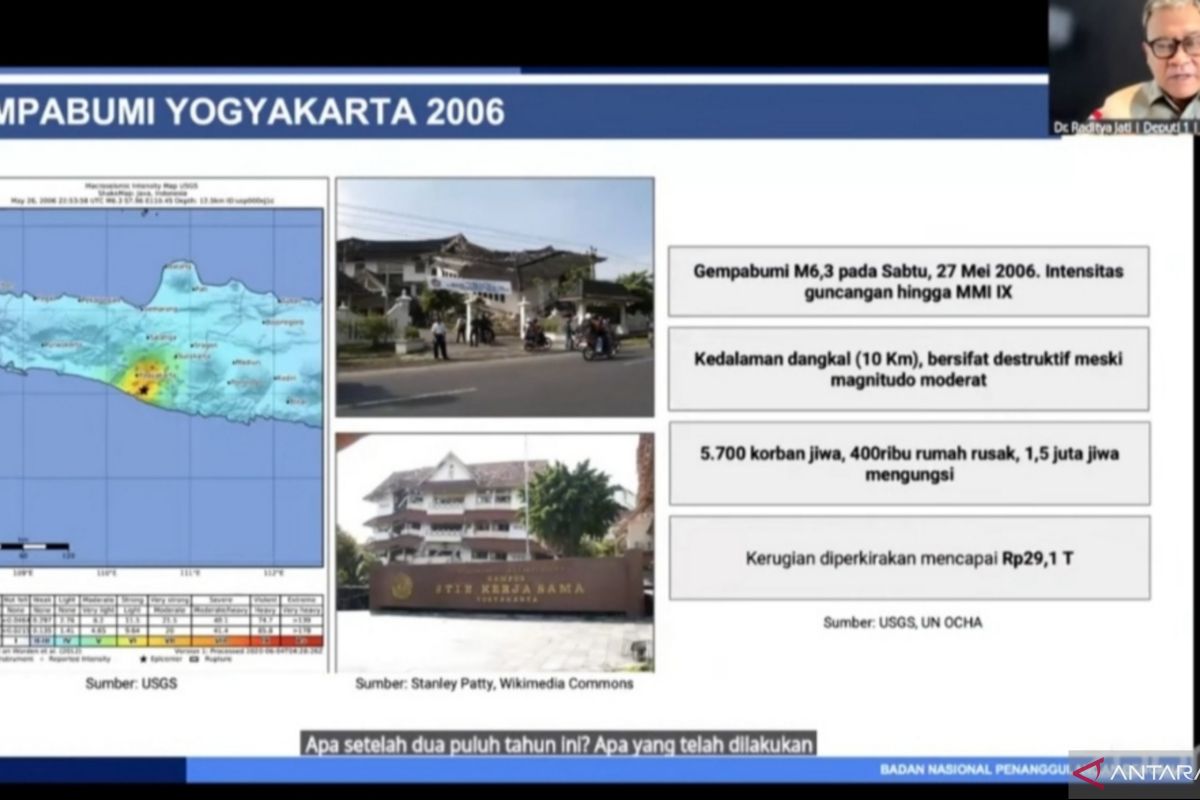
“Disaster risks can be reduced through increased capacity. The Disaster Risk Index that we issue annually serves as a performance report card for local governments. If the index decreases, it means the region’s performance in risk management is improving,” he said during the seminar commemorating National Disaster Preparedness Day and the 20th anniversary of the Yogyakarta Earthquake, attended from Jakarta on Thursday.
BNPB has provided hazard maps at a scale of 1:50,000 for all regions in Indonesia to support the strengthening of local capacities.
He mentioned that in 2026, BNPB plans to release a national vulnerability map at the same scale.
“The public and local governments can access the InaRISK platform to view risk maps up to a detailed scale. Specifically for the Yogyakarta and Central Java regions, we have mapped cultural heritage areas in 3D as an effort to protect historical heritage from disaster threats,” he said.
Raditya stressed the importance of a people-centred approach in building national resilience.
According to him, the community should not merely be objects but must be the main subjects in every disaster mitigation policy, investment, and technological innovation.
BNPB considers it important because future disaster challenges cannot be separated from climate change issues. For example, the Senyar Cyclone phenomenon at the end of 2025, which triggered floods and landslides in Aceh, West Sumatra, and North Sumatra, serves as a reminder that climate impacts are very real on social, economic aspects, and people’s livelihoods.
“This is the momentum to build community-based national resilience; currently, all development pillars, from infrastructure to budget governance, must focus on the interests and safety of the community,” said Raditya.
He hopes that data integration between ministries and agencies, such as synchronising weather monitoring systems with BNPB’s affected area maps, can continue to be strengthened to create more effective and efficient emergency responses.