
BNPB: 20 Years of Yogyakarta Earthquake as Momentum to Strengthen Disaster Mitigation
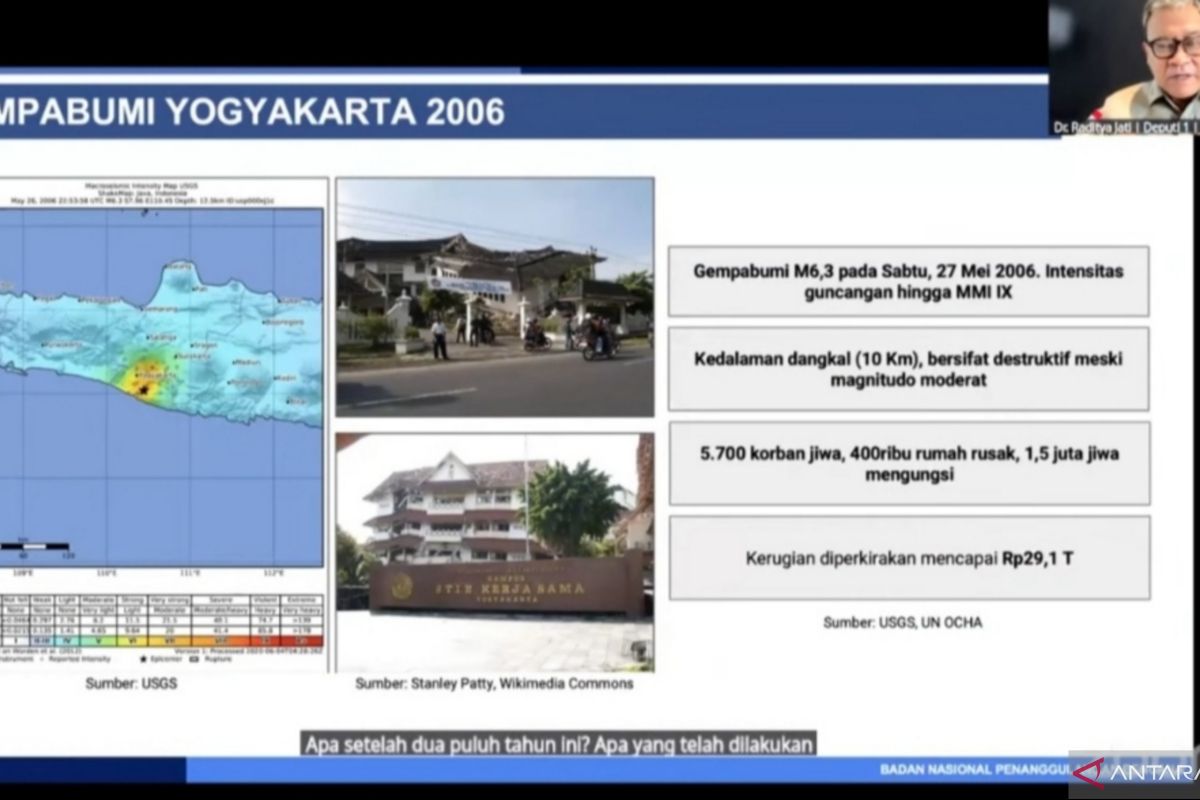
Jakarta (ANTARA) - The National Disaster Management Agency (BNPB) states that commemorating two decades of the 2006 Yogyakarta earthquake represents a crucial moment for Indonesia to reflect once again on the importance of sustainable disaster mitigation and risk management.
BNPB Deputy for Systems and Strategy, Raditya Jati, emphasised that natural disasters can no longer be viewed merely as events to await; instead, their risks must be managed proactively from the outset.
“The 20-year period since the Yogyakarta earthquake serves as a wake-up call for us all. That event was one of the primary milestones in the birth of Law No. 24/2007 on Disaster Management, which transformed our paradigm from mere emergency response to risk reduction,” he said during the seminar marking National Disaster Preparedness Day and the 20th Anniversary of the Yogyakarta Earthquake, attended from Jakarta on Thursday.
In this regard, Yogyakarta is regarded as a centre of excellence or national hub for disaster management learning, owing to its extraordinary social capital and strong multi-stakeholder collaboration, from government and academics to community volunteers.
“Yogyakarta was the first place where the Disaster Risk Reduction Forum (DRRF) and a disaster studies centre at a university were established. Other regions must learn from Yogyakarta’s resilience in rebuilding its areas after the disaster,” he stated.
On this occasion, BNPB also encouraged local governments to integrate Disaster Management Plans (DMPs) into regional development planning documents. This is essential to ensure the availability of fiscal financing for disasters, thereby preventing economic losses that could impact inflation.
In anticipation of Disaster Preparedness Day on 26 April, Raditya urged all segments of society, particularly in Yogyakarta, to conduct simultaneous evacuation simulations at 10:00 WIB.
BNPB asserts that strengthening literacy, education, and early warning systems directly connected to communities is the key to realising sustainable national resilience towards 2045.
“From schools to universities, conduct simulations. In Sleman, scenarios of Merapi eruption can be used; on the Bantul coast, tsunami scenarios. Do not wait for an incident to then rush into planning; preparedness must be our investment,” Raditya remarked.