
BNN-Customs Raid Drug Laboratory in Bali, Two Russian Nationals Detained
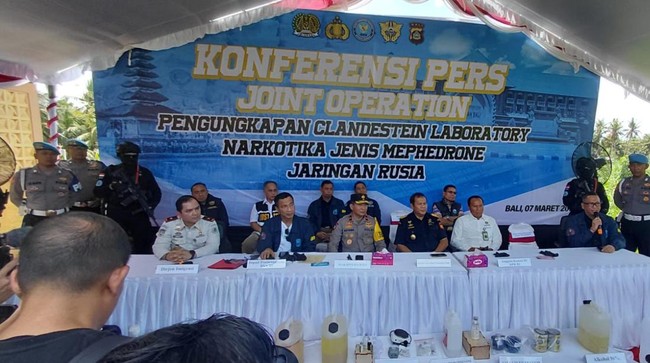
Customs and the National Narcotics Agency (BNN) have uncovered a clandestine drug laboratory in Gianyar Regency, Bali. In a joint operation, authorities detained two Russian nationals suspected of producing mephedrone at a villa.
Director of Narcotics Interdiction at Customs, R. Syarif Hidayat, said the discovery underscores the importance of monitoring cross-border flows of goods, including shipments that could serve as precursors for drug production.
‘The uncovering of this clandestine lab is a tangible demonstration of Customs’ commitment to protecting the public from the dangers of narcotics. Surveillance is not limited to narcotics themselves, but also to chemicals and equipment that can be used to produce them,’ he said in an official statement on Saturday, 7 March 2026.
The case began on 21 January 2026, when Soekarno-Hatta Customs intercepted a shipment from China destined for Uluwatu, Bali. The package contained two bottles of liquid believed to contain Valerophenone and 4’-Methylpropiophenone, chemicals that can be used in the manufacture of narcotics.
The findings were subsequently followed by the formation of a joint team involving the Directorate of Narcotics Interdiction at Customs, the Bali, NTB, and NTT regional offices (Bali Nusra), and Soekarno-Hatta Customs, in cooperation with BNN. The team conducted in-depth information gathering and surveillance of the movement of shipments from 28 January to 5 March 2026.
‘From the analysis and development, we identified a number of shipments of laboratory equipment and chemicals, both domestic and foreign, entering via Soekarno-Hatta and Ngurah Rai airports. The items are believed to be used to support the production activities of narcotics at a villa in Bali,’ Syarif said.
On 6 March 2026, the joint team carried out the uncovering operation, arresting a woman identified by the initials NT, a Russian national, at Vila The Tetamian Bali. Afterwards, officers conducted a search at Vila The Lavana De’Bale Marcapada, suspected to be the site of narcotics production.
From the location, authorities found various chemicals in solid and liquid forms, as well as a Class I narcotics, mephedrone. Simultaneously, the team detained a man identified by the initials ST, a Russian national, at Vila Rena’s Kubu. A further search of that site found a liquid chemical believed to be related to the production process.
From the operation, officers seized a number of evidentiary items related to narcotics production, including 644 grams of crystalline mephedrone, 7,250 millilitres of semi-processed mephedrone in liquid form, 2,600 grams of solid chemicals as precursors for mephedrone production, and 219,780 millilitres of liquid chemicals. In addition, 36 laboratory equipment items used to manufacture narcotics were seized.
‘The existence of a clandestine lab shows that the narcotics networks are not only seeking to smuggle finished goods, but also to manufacture them domestically. With this discovery, the potential circulation of narcotics that could harm society can be prevented at the production stage,’ said Syarif.
He added that inter-agency synergy is the key to tackling increasingly complex, cross-border narcotics networks. Through integrated surveillance of the movement of goods, chemicals, and laboratory equipment, authorities hope to tighten the networks’ operating space so that the public is protected from the adverse effects of narcotics abuse.